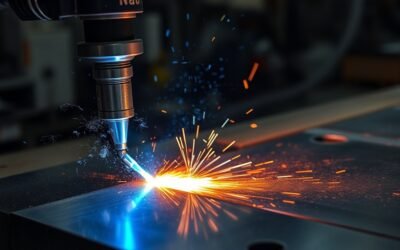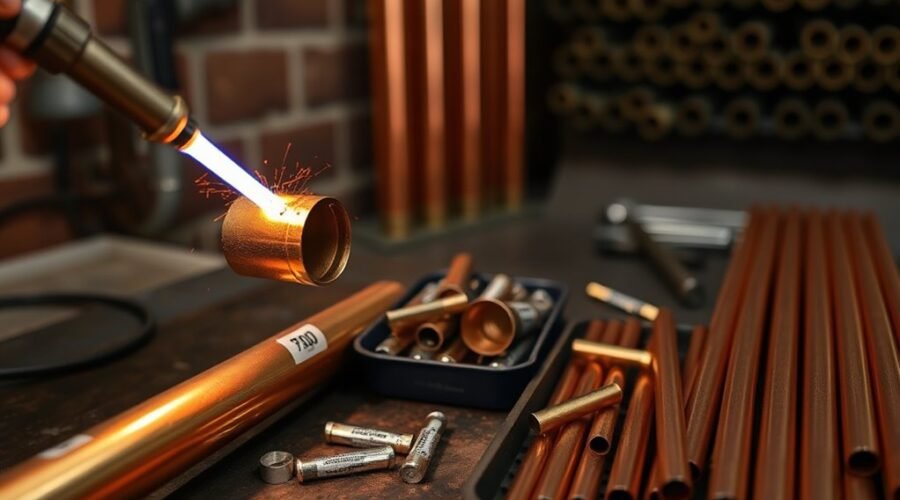
Brazing is a metal-joining process that uses a filler metal melting above 450°C while the base materials remain solid. Cleaned surfaces, flux, and tight joint clearances let the molten filler flow by capillary action and solidify into a strong bond. Common filler metals include silver, copper, aluminum, and nickel alloys. Torch, furnace, and induction methods serve different assemblies. It joins dissimilar metals with low distortion, though strength and temperature limits matter. Further detail clarifies the tradeoffs.
Key Takeaways
- Brazing joins metals using a filler metal above 450°C, while the base metals stay solid and undamaged.
- Capillary action pulls molten filler into a tight joint gap, typically between 0.03 and 0.08 mm.
- Clean surfaces and flux are essential to remove oxides, prevent reoxidation, and ensure strong wetting.
- Common filler metals include silver, copper, aluminum, and nickel alloys, chosen for compatibility and joint strength.
- Brazing is used in aerospace, HVAC, automotive, appliances, and jewelry for strong, low-distortion joints.
What Is Brazing?
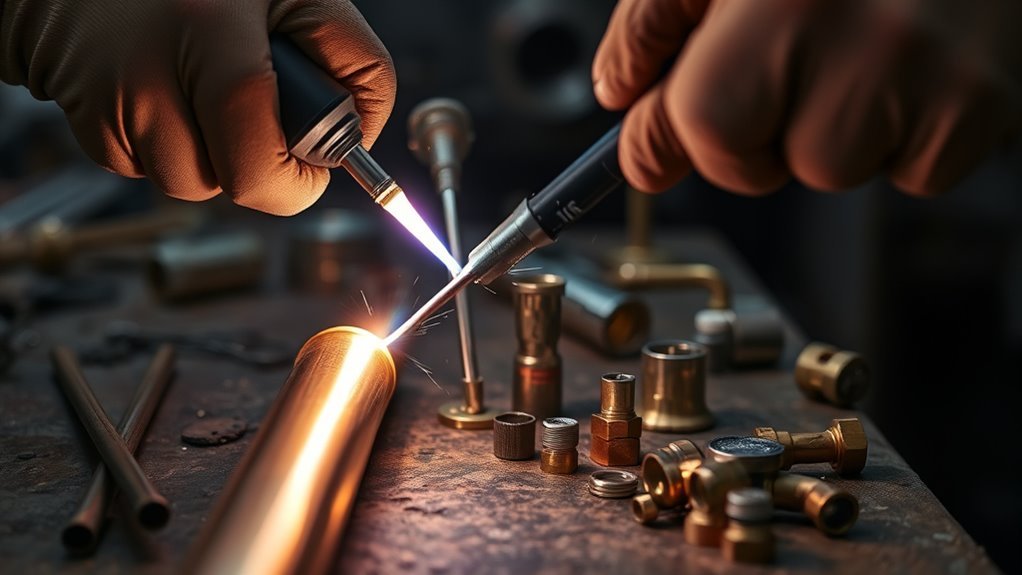
Brazing is a metal-joining process in which a filler metal with a melting point above 450°C flows into a joint without melting the base materials. In brazing, the base metals remain structurally intact while the filler metal forms the bond, producing joints that are typically stronger than soldered joints yet weaker than welded joints.
This balance makes the process valuable for joining dissimilar metals and certain non-metals where freedom from distortion and excessive heat is necessary. Capillary action draws the molten filler metal into narrow gaps, so joint clearance must be controlled to support strength and reliability.
Surface cleanliness is critical; oxides, oils, and other contaminants interfere with wetting and weaken the result. Chemical cleaning or abrasive preparation is thus common.
Because it joins diverse materials efficiently, brazing supports aerospace components, automotive parts, and appliances with high precision.
How Brazing Works Step by Step
Brazing begins with rigorous metal cleaning and flux application to remove oxides and promote wetting, since clean base surfaces are essential for reliable bonding.
Once the filler metal is heated above its melting point, it flows into the narrow joint gap by capillary action, with clearance typically held between 0.03 and 0.08 mm.
After filling the joint, the filler solidifies on cooling, creating a strong bond without melting the base metals.
Metal Cleaning
Effective brazing depends on exceptionally clean base-metal surfaces, since contaminants such as oil, grease, rust, and oxides can block capillary flow and weaken the bond. Metal cleaning is consequently a controlled prerequisite, not a cosmetic step.
Typical practice includes:
1) chemical removal of oxides through acid pickling,
2) abrasive preparation for residual scale, and
3) immediate flux application to suppress new oxidation.
Clean base metal surfaces should then be assembled quickly, preserving joint clearances of 0.03 to 0.08 mm. Such precision supports strong capillary action and joint integrity.
A good milling finish adds useful surface roughness, improving wetting behavior without compromising fit. In analytical terms, liberated performance begins with disciplined surface preparation, because even minor recontamination can degrade adhesion and compromise structural reliability.
Filler Metal Flow
Once the cleaned components are assembled with a controlled clearance, molten filler metal is introduced and drawn into the joint by capillary action.
The narrow gap, typically 0.03 to 0.08 mm, promotes flow by surface tension rather than force. Surface cleanliness remains decisive: oil, oxide, and other residues restrict wetting and disrupt penetration.
The filler metal is heated above its melting point, commonly 450°C to 900°C, while the base metals remain unmelted and retain their mechanical properties.
Selection of silver, aluminum, or nickel-based filler metal alters flow behavior and application range.
As the molten alloy spreads through the joint, it accommodates dissimilar metals and supports joint integrity by filling the available space with controlled precision, enabling a liberated, reliable connection without excessive thermal distortion.
Joint Solidification
As the molten filler metal completes capillary flow through the controlled joint clearance, solidification begins when heat input is withdrawn and the alloy cools below its melting point. During joint solidification, the liquid changes into a cohesive joint, locking the base metals together without fusion.
- Correct clearance, about 0.03 to 0.08 mm, supports uniform freezing.
- Flux suppresses oxide formation, preserving wetting and adhesion.
- Cooling rate governs mechanical properties; rapid cooling raises hardness, but may increase brittleness.
The resulting microstructure reflects thermal history, alloy composition, and restraint in the assembly. If temperature drops unevenly, residual stress can form and weaken performance.
Controlled cooling as a result enables durable, liberated joints that resist separation while maintaining functional integrity.
Brazing Filler Metals and Flux
Brazing filler metals are selected to melt within a range typically between 450°C and 1200°C, allowing them to flow into the joint without compromising the base metals. Each brazing filler metal is chosen by melting point, compatibility, and required strength. Common filler metals include silver alloys, copper, aluminum, and nickel, each offering distinct flow behavior and service performance.
Their selection determines whether the joint can meet demanding mechanical and thermal conditions while preserving material integrity.
Flux is equally critical: it must prevent oxidation, support wetting, and promote the smooth migration of molten filler through the interface. Borax-based and proprietary fluxes are applied according to the base metals and the brazing filler metals used.
Precise flux coverage is essential for joint quality, because incomplete coverage invites contamination and weak bonding. In this process, technical control replaces guesswork, enabling reliable, clean, and durable metal joining.
Brazing Joint Design and Clearances
Joint geometry governs the reliability of a brazed assembly, with clearance controlling whether molten filler metal can be drawn through the interface by capillary action.
Effective brazing joint design depends on joint clearances held near 0.03 mm to 0.08 mm, with stainless steel often performing best around 0.0015 inches, or 0.038 mm. This narrow range supports flow, reduces voids, and improves bonding strength without starving the joint.
- Lap joints are preferred because they provide greater bonding area than butt joints.
- A lap length of three times the thinner member thickness improves load capacity and pressure resistance.
- Dissimilar metals require clearance planning that accounts for thermal expansion to limit stress during temperature swings.
Proper geometry enables durable, efficient joints and preserves structural integrity under service loading.
Cleaning and Preparing Metal Surfaces
Effective brazing begins with removal of oil, grease, rust, and oxides from the joint surfaces, since contaminants reduce wetting and interrupt capillary flow.
Cleaning may be accomplished by chemical degreasing, abrasive methods, or other controlled surface-preparation techniques, with parts kept clean until immediately before brazing to prevent recontamination.
Joint clearances should be maintained in the range of 0.03 to 0.08 mm to support reliable filler-metal flow and strong bond formation.
Surface Cleaning Methods
Clean metal surfaces are essential for reliable brazing, since oil, grease, rust, and scale inhibit wetting and weaken the bond. Effective surface cleaning removes contaminants before assembly, preserving joint clearances of 0.03 to 0.08 mm and allowing filler metal to flow freely.
- Chemical cleaning uses degreasing solvents for oils and acid pickle solutions for rust and scale.
- Mechanical cleaning employs wire brushing or abrasives to refine the surface and improve wetting.
- Fluxing then limits oxide formation and supports complete coverage during heating.
Together, these methods create controlled, liberated interfaces where capillary action can operate with precision.
Proper preparation does not merely improve quality; it removes resistance from the process and enables stronger, more consistent brazed joints.
Remove Oxides And Grease
Oxides, grease, and other surface contaminants must be removed before brazing because they interfere with wetting and can severely reduce joint strength.
Effective cleaning targets oil, scale, rust, and residual films through chemical treatment and degreasing solvents, leaving metal chemically active and ready for bonding.
Abrasive cleaning can also create controlled surface roughness, which improves wetting and supports capillary action by giving the filler metal a more receptive path.
Once prepared, the parts should receive prompt fluxing to suppress oxide regeneration, since fresh oxides form rapidly in air and can block intimate contact.
Precise cleaning is consequently not a cosmetic step but a technical requirement that protects joint integrity, preserves flow behavior, and supports a liberated process free from hidden contamination.
Ideal Joint Clearances
With the surfaces cleaned of oxides and grease, joint geometry becomes the next controlling factor in brazing performance. Ideal joint clearances are typically 0.03 to 0.08 mm, a range that preserves capillary action and directs filler metal through the joint without resistance.
- Narrow clearances increase joint strength by forcing intimate contact between base metals.
- Excessive gaps reduce filler metal penetration and invite weak bonds.
- For stainless steel butt joints, about 0.0015 inches, or 0.038 mm, provides maximum bond strength.
Surface cleanliness remains essential; oil, grease, and residue suppress wetting and weaken adhesion. A controlled surface roughness can further improve wetting, allowing the filler metal to anchor firmly to the base metals.
Precise clearance discipline enables stronger, freer brazed assemblies.
Brazing Heating Methods and Atmosphere Control
Brazing employs several heating methods, each selected according to part geometry, production rate, and thermal sensitivity: localized techniques such as torch, induction, and resistance brazing concentrate heat at the joint, while furnace and dip brazing provide more uniform, diffuse heating for larger or more complex assemblies.
These brazing heating methods must raise the filler metal above its melting temperature, typically 620°C to 870°C, yet remain below the base metal limit. A controlled atmosphere, whether air, nitrogen, hydrogen, or vacuum, reduces oxidation and supports joint integrity.
Brazing heat must melt the filler metal without exceeding the base metal’s limit.
Capillary flow depends on a narrow joint gap, usually 0.03 to 0.08 mm, so molten filler metal can spread freely. When heat input and atmosphere are controlled precisely, contamination is minimized and the base metals retain their mechanical properties.
The result is a clean, disciplined process that enables reliable joining without surrendering structural strength or metallurgical freedom.
Torch Brazing, Furnace Brazing, and Induction Brazing
Three primary brazing methods—torch, furnace, and induction—differ mainly in how heat is delivered to the joint.
- torch brazing uses a handheld flame for localized heating, giving operators direct control over small or intricate assemblies.
- furnace brazing places parts in a controlled atmosphere, where uniform heating supports repeatability in complex, high-volume production.
- induction brazing generates heat electromagnetically in the workpieces, enabling rapid, precise thermal input and limiting distortion.
In each process, the filler metal must melt within roughly 450°C to 1150°C while the base metals remain solid.
Performance also depends on joint design; clearances near 0.03 to 0.08 mm support capillary flow and bond formation.
These parameters define the method’s technical freedom: heat can be directed, distributed, or induced according to geometry, scale, and process control requirements.
Advantages of Brazing
Brazing produces strong, clean joints with tight tolerances, reducing the need for secondary finishing in assembled components.
It also introduces less thermal distortion than welding, which helps preserve the geometry and integrity of complex parts.
In addition, it enables reliable joining of dissimilar metals, expanding design flexibility across demanding industrial applications.
Strong, Clean Joints
By forming joints that can rival or exceed the strength of the base metals themselves, brazing is well suited to high-stress applications where structural integrity is critical. Its brazed joints rely on a filler material with a lower melting point, selected for compatible heating methods and precise capillary flow.
- Strong, clean joints emerge with minimal contamination.
- Dissimilar metals can be joined without compromising function.
- The process supports efficient, controlled assembly.
Operating near 1150ºF to 1600ºF, it preserves base-metal properties while producing smooth, clean joints that often need little post-processing. In aerospace and automotive systems, this combination expands design freedom and maintains performance under demanding service conditions, offering engineers a disciplined route beyond conventional constraints.
Low Distortion
Low distortion is another major advantage of brazing, closely tied to its controlled heat input and lower operating temperature. In the brazing process, heat application remains localized, typically between 1150°F and 1600°F, so the base metals experience less thermal stress than in welding.
This low distortion supports tighter tolerances and reduces the need for secondary finishing, preserving dimensional accuracy in assembled parts. A properly formed brazed joint retains the mechanical properties of the base metals while limiting warping, shrinkage, and structural alteration in sensitive components.
The result is a precise, efficient method suited to complex assemblies that demand stability and clean fit-up. Such control also helps in joining dissimilar metals, where restrained distortion enables material combinations to remain functional without compromising alignment or form.
Dissimilar Metal Joining
A key advantage of brazing is its ability to join dissimilar metals, such as aluminum to copper, without melting the base materials. In this process, low-melting filler metals flow by capillary action, producing controlled joints while preserving mechanical properties and component integrity.
- It enables reliable brazing of dissimilar assemblies where welding can degrade performance.
- It supports diverse joint geometries, increasing design freedom for engineers.
- It often yields stronger joints than soldering, improving durability in service.
This joining method is highly valued in HVAC and automotive systems, where metals with different thermal and mechanical behavior must cooperate without loss of function.
Brazing Disadvantages and Limits
Brazing has several important limitations that constrain its use in demanding applications. Brazed joints often show lower strength than welded ones because softer filler metals govern performance, reducing margin in high-stress service. They also remain sensitive to high temperatures, where softened filler can lose integrity and weaken the bond. Effective fabrication depends on tight joint clearances, typically 0.03–0.08 mm; wider gaps disrupt capillary flow and degrade joint quality. Contamination on base metal surfaces further impairs wetting, so rigorous cleaning is essential for sound bonding and leak resistance. The aesthetic appearance may also differ from adjacent base metals, creating visible inconsistency in finished work.
| Limitation | Effect | Control |
|---|---|---|
| Lower strength | Stress limits | Design conservatively |
| High temperatures | Joint degradation | Select suitable service range |
| Contamination | Poor wetting | Clean thoroughly |
| Joint clearances | Weak capillary action | Maintain precision |
Common Brazing Uses in Industry
Across industry, brazing is selected where reliable joints must be formed between dissimilar metals, thin sections, or heat-sensitive assemblies. Its controlled brazing temperatures permit joining dissimilar metals with a filler metal while preserving base-metal properties and delivering high integrity.
Brazing joins dissimilar metals with controlled heat, preserving base-metal properties while delivering strong, high-integrity joints.
- In the aerospace industry, it secures jet engines and turbine blades, where thermal cycling and stress demand durable, heat-resistant bonds.
- In HVAC systems, it joins copper and aluminum circuits, producing leak-proof connections that support efficient cooling and reduce service failures.
- In automotive and appliance manufacturing, it joins small parts, repairs assemblies, and builds refrigerators and ice machines with repeatable joint quality.
Fine jewelry also benefits, because precise heat input protects appearance while locking precious metals together.
Across these sectors, brazing provides a disciplined method for forming compact, robust joints without the distortion associated with fusion welding, enabling lighter designs and longer component life.
Frequently Asked Questions
What Are the Common Filler Metals Used in Brazing?
Common filler metals in brazing are silver, copper, aluminum, and nickel. Each is selected by filler metal properties, brazing joint strength, temperature considerations, and application techniques.
Silver alloys suit demanding joints; copper fillers fit copper and brass; aluminum fillers improve fluid flow; nickel fillers endure heat.
Flux types and post brazing treatments further influence performance. Proper selection enables liberated, efficient fabrication while maintaining precision, durability, and resistance to corrosion.
Can You Explain the Brazing Process?
The brazing process joins metals by heating a filler above its melting point so it flows into a close joint by capillary action, while the base metals remain solid.
Effective brazing techniques depend on joint design, controlled heat sources, and flux applications that prevent oxidation.
Safety measures reduce thermal and chemical risk.
Troubleshooting tips address poor wetting, overheating, or gaps, preserving precision and enabling liberated material integration.
What Metals Are Used for Brazing?
The metals used for brazing are commonly aluminum, copper, gold, nickel, silver, stainless steel, and zinc-coated steel.
A theory that any metal can be joined is partly true, yet brazing alloys perform best within specific temperature ranges. Joint design and surface preparation strongly affect capillary flow.
In applications industries such as aerospace and HVAC, advantages and disadvantages depend on compatibility, precision, and the liberation offered by joining dissimilar metals efficiently.
What Metals Cannot Be Brazed?
Many metals cannot be brazed successfully, especially aluminum, magnesium, lead, zinc, titanium without proper process control, and some high-alloy steels in unsuitable filler systems.
These brazing limitations arise from oxide films, incompatible alloys, poor surface preparation, and severe thermal expansion mismatch.
Corrosion resistance and joint strength can also collapse when contamination or melting behavior is uncontrolled.
Certain plastics, composites, and ceramics remain poor candidates because stable, durable bonds are not reliably formed.
Conclusion
Brazing bridges base metals with brilliance, bonding components through controlled heat, capillary flow, and carefully selected filler alloys. Its precision produces strong, clean joints with minimal distortion, making it invaluable in aerospace, refrigeration, electronics, and automotive assemblies. Yet its limits remain clear: joint fit, surface cleanliness, and service temperature govern success. When these variables are controlled, brazing delivers durable, dependable, dimensionally stable connections with remarkable repeatability and refined reliability.