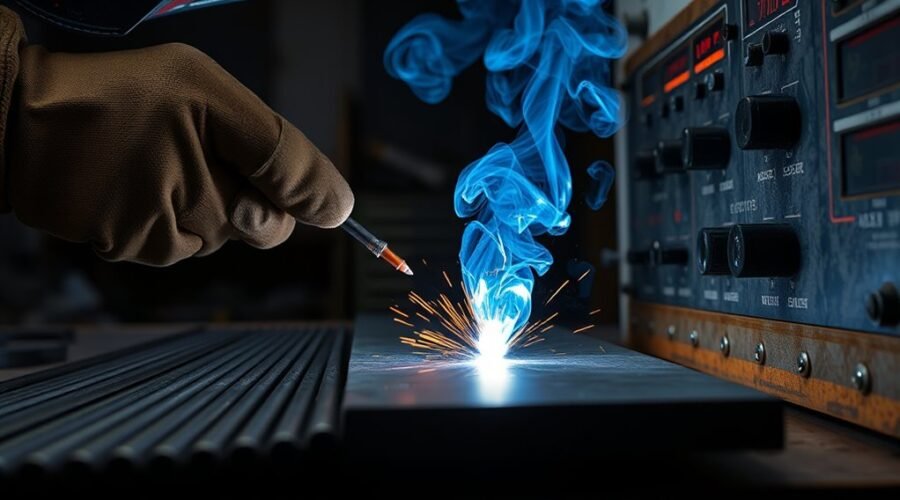
SMAW, or stick welding, is a manual arc process that uses a flux-coated consumable electrode to melt the base metal and form a joint. The flux creates shielding gas and slag, which protect the weld during cooling. Electrode selection depends on AWS code, material thickness, and welding position. DCEP usually increases penetration, while AC can reduce arc blow. Amperage should match electrode diameter. Proper setup, technique, and cleanup improve weld quality and consistency, with more detail ahead.
Key Takeaways
- SMAW uses a flux-coated stick electrode to create an arc that melts the electrode and base metal into a weld.
- The flux produces shielding gas and slag, protecting the weld from oxidation until it cools.
- Electrode selection follows AWS codes; common choices include E6013 for versatility and E7018 for stronger welds.
- Set amperage mainly by electrode size, and use higher current for thicker material and deeper penetration.
- DCEP usually gives deeper penetration, while AC can help reduce arc blow and improve arc stability.
What Is SMAW Welding?
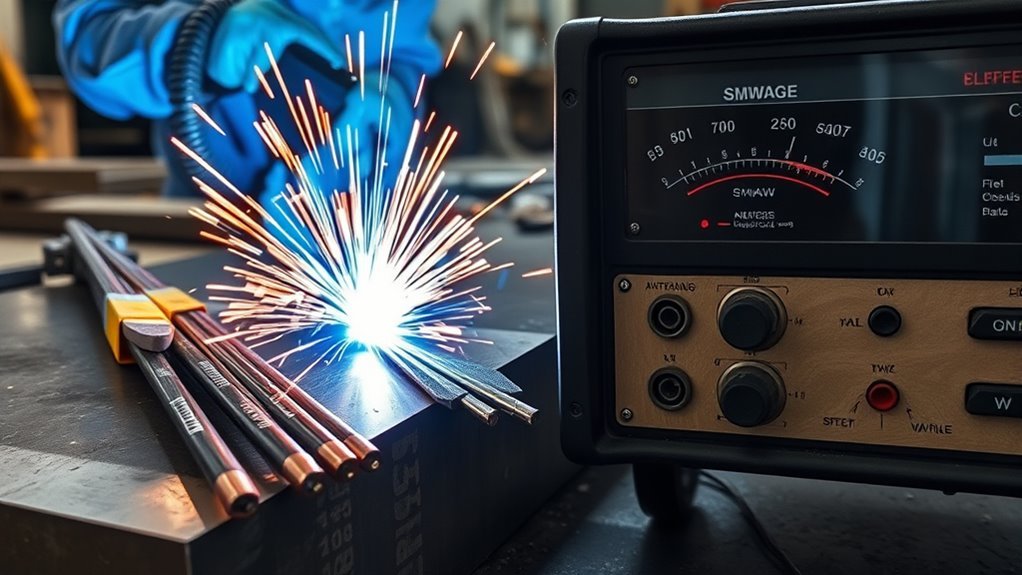
Shielded Metal Arc Welding (SMAW) is a manual welding process that uses a consumable, flux-coated electrode to form an electric arc between the electrode and the base metal, melting both to create the weld.
In SMAW, the arc is sustained by a consumable electrode, and the flux coating decomposes to produce a shielding gas that protects the molten metal from oxidation and contamination.
This Shielded Metal Arc Welding method is widely applied to ferrous metals in construction, pipeline work, and maintenance, where flexible field use supports practical autonomy.
The welding process demands disciplined manual control, including electrode handling and stable arc length, to secure sound joints.
Disciplined manual control and stable arc length are essential to producing sound weld joints.
Common electrodes include E6013 and E7018, selected according to the required weld properties.
Polarity is commonly set to Direct Current Electrode Positive for stronger penetration, making SMAW a dependable choice when controlled, accessible fabrication is needed.
How SMAW Welding Works
SMAW begins when the electrode is struck against the base metal, creating an electric arc that melts both materials and forms a weld pool.
As the flux coating vaporizes, it produces shielding gas that protects the molten metal from atmospheric contamination.
The weld pool is then controlled by maintaining a consistent arc length, correct electrode angle, and steady travel speed.
Arc Formation
Arc formation in SMAW begins when a flux-coated electrode is struck against the base metal, initiating an electric arc that generates intense heat to melt both the electrode tip and the workpiece surface.
In the SMAW process, welding current, polarity, and arc length govern stability and penetration.
- The electric arc ionizes the gap.
- The flux-coated electrode supplies filler metal.
- A weld pool forms at the joint.
- DCEP increases penetration on thicker material.
- A short, steady arc prevents sticking.
This controlled transfer lets operators work with precision and autonomy, while maintaining a consistent arc length near 1/8 to 1/4 inch.
As the molten metal coalesces, a sound bond develops on cooling, ready for the next pass.
Flux Shielding
During welding, the flux coating on the electrode vaporizes under arc heat, forming a protective gas envelope around the molten weld pool and reducing exposure to atmospheric contamination. A flux-coated electrode consequently serves as both filler and shield. The gas shield limits oxidation, while the slag layer floats on the surface, protecting the bead until cooling permits removal.
| Function | Effect |
|---|---|
| Gas shield | Blocks air ingress |
| Slag layer | Seals the solidifying weld |
| Flux chemistry | Shapes weld behavior |
| Electrode choice | Supports structural integrity |
Proper electrode selection, matched to base metal and flux type, is essential. Slightly acidic or basic fluxes alter defect resistance and weld characteristics, enabling controlled, dependable results for workers seeking durable, liberated fabrication.
Weld Pool Control
A consistent weld pool in shielded metal arc welding depends on controlled arc length, steady travel, and deliberate electrode manipulation. In SMAW welding, the flux-coated electrode and the base are melted by the arc, creating molten weld metal that must be guided, not rushed.
- Hold arc length near 1/16 to 1/8 inch.
- Match travel speed to joint thickness.
- Keep the weld pool centered.
- Use weaving techniques only when width demands it.
- Watch for slag and contour.
Too fast reduces fusion; too slow increases heat and burn-through. The operator’s freedom comes from discipline: stable hand motion, clear pool awareness, and precise control of heat.
This method yields sound reinforcement, proper penetration, and a bead profile suited to demanding service.
AC vs. DC Power in SMAW
In Shielded Metal Arc Welding (SMAW), both alternating current (AC) and direct current (DC) are used, but polarity selection directly affects arc stability, penetration, and weld quality.
In SMAW, Direct Current Electrode Positive (DCEP) is the common choice because its polarity delivers strong penetration and dependable arc performance.
Alternating Current (AC) is selected when arc blow threatens control, especially on magnetized work, because it helps steady the arc.
DCEN gives a softer arc and more control, yet with reduced penetration.
Correct polarity is thus essential; the wrong setting can cause shallow fusion, spatter, and erratic operation.
Each set of electrodes must also match the power source specified by the manufacturer, since some are engineered for AC and others for DC.
Proper current selection gives the operator greater control, cleaner welds, and more freedom to work effectively across varied conditions.
How to Choose a Stick Electrode
Stick electrode selection begins with the AWS classification, where the “E” designation identifies tensile strength, position capability, and flux coating type.
The electrode must also match the base metal thickness, since heavier sections often call for stronger electrodes such as E7018, while thinner material may be served by more versatile options like E6013.
Polarity requirements should be verified before welding, because many electrodes perform best with the machine set for DCEP.
Electrode Classification
Electrode classification provides a compact code for selecting the correct stick electrode: it begins with the letter E, followed by two digits indicating tensile strength, a third digit identifying usable welding positions, and a final digit specifying the flux coating type.
In practice, electrode classification guides selection without guesswork and supports informed, independent work.
- E6013: versatile, beginner-friendly, stable arc
- Tensile strength: the first two digits
- Welding positions: 1 all, 2 flat and horizontal, 3 flat only
- Flux coating type: the last digit
- Polarity recommendations: consult packaging for Direct Current Electrode Positive (DCEP) or Direct Current Electrode Negative (DCEN)
This code helps match rod behavior to task, enabling cleaner control and safer, more liberated welding decisions.
Match Metal Thickness
After selecting the proper electrode classification, the next step is matching rod diameter to the base metal thickness. In SMAW, electrode size should track the base metal closely to support controlled fusion and disciplined heat input.
For material around 1/8 inch to 1/4 inch thick, a 1/8-inch rod is commonly selected, with recommended amperage near 90 to 125 amps. When the base metal exceeds 1/4 inch, 3/16-inch or 1/4-inch electrodes may provide deeper penetration and higher weld strength, with 125 to 175 amps often appropriate for 3/16-inch rods.
Proper pairing helps preserve arc stability, prevents burn-through, and reduces underfill. For ideal weld quality, consult the electrode manufacturer’s specifications before setting current.
Check Polarity Requirements
Polarity must be verified before selecting a stick electrode, since the packaging typically specifies whether the rod is intended for AC or DC use, and many electrodes perform best on DCEP for stronger penetration and a steadier arc.
In SMAW, technicians should check polarity requirements with the electrode code and the guidance from electrode manufacturers to preserve control and weld quality.
- Match AC or DC to the rod rating.
- Choose DCEP when deeper penetration is needed.
- Avoid wrong polarity, which causes spatter and instability.
- Confirm welding positions from the code before use.
- Select versatile rods, such as E6013, when liberated flexibility is required.
How to Read Stick Electrode Codes
Stick electrode designations follow a standardized code that begins with the letter E and four digits, each part indicating a specific performance characteristic.
In SMAW, stick electrode codes allow the welder to read tensile strength, welding positions, and flux coating without guesswork. The first two digits state the weld’s tensile strength in megapascals after welding. The third digit defines welding positions: 1 for all positions, 2 for flat and horizontal, 3 for flat only.
The fourth digit identifies the flux coating, which influences usability and arc behavior. For example, E7018 indicates 700 MPa strength, all-position use, and a basic low-hydrogen flux coating.
Such knowledge supports disciplined electrode selection and improves weld quality by matching the rod to the task. Clear reading of these codes gives the operator control, reduces wasted motion, and promotes safer, more effective work on the shop floor.
How to Set SMAW Polarity
SMAW polarity should be selected first by matching the electrode classification to the required current and polarity, with DCEP commonly used for deeper penetration and DCEN used when less penetration is needed.
The machine settings are then adjusted to the specified polarity, or set to AC when arc blow or magnetic interference must be reduced.
The resulting arc direction and stability should be verified before welding to confirm proper performance and weld quality.
Choose Electrode Polarity
Correct polarity selection is essential in SMAW because it directly affects arc behavior, penetration, and weld quality.
Electrode polarity determines weld characteristics in SMAW: DCEP delivers deeper penetration for thicker joints, while DCEN produces a smoother arc and finer control.
Most electrode packs identify the recommended setting, allowing the operator to align process choice with electrode design.
AC may be selected when magnetized work causes arc blow, preserving arc stability in difficult conditions.
Incorrect polarity can reduce penetration, increase spatter, and destabilize the arc, weakening the weld.
- Check the electrode package first.
- Select DCEP for stronger penetration.
- Use DCEN for smoother control.
- Choose AC to counter arc blow.
- Verify polarity before striking the arc.
Match Machine Settings
Once polarity is selected, the welding machine must be configured to match the electrode and joint requirements.
In SMAW, polarity settings should follow the electrode packaging: some electrodes require Direct Current Electrode Positive (DCEP), others perform best on direct current electrode negative, and some accept AC or DC.
For thicker material, DCEP is often chosen for deeper penetration; for thin sections or tighter control, DCEN is preferred. AC may be used where arc blow or magnetized work disrupts stability.
Set amperage to suit the electrode size, with about 125 amps as a starting point for 1/8-inch rod.
Secure the ground clamp to clean, bare metal so the circuit remains stable and the welding machine delivers consistent arc energy.
Verify Arc Direction
Before striking an arc, the welder should verify the direction of current flow by checking the electrode classification and packaging, since the code beginning with E indicates the polarity required for proper performance.
In SMAW, the electrode classification code guides selection of Direct Current Electrode Positive or Direct Current Electrode Negative, protecting weld quality and arc performance. DCEP is commonly chosen for deeper penetration in thicker joints.
Incorrect polarity can cause poor fusion, excessive spatter, and an unstable arc. AC may serve as a compromise when arc blow or magnetized material disrupts control.
- Verify the package marking.
- Match machine leads to polarity.
- Confirm electrode manufacturer guidance.
- Select DCEP when penetration is needed.
- Recheck before striking.
How to Set Amperage for SMAW
Setting amperage for SMAW begins with the electrode diameter, using a general guide of about 1 amp per 0.001 inch of electrode diameter; for example, a 1/8-inch electrode typically calls for roughly 125 amps.
In SMAW, amperage should then be matched to material thickness: thicker plate usually needs higher heat for penetration, while thinner stock requires lower output to prevent burn-through.
E6010 electrodes commonly run from 60 to 130 amps, and E7018 electrodes from 70 to 180 amps, depending on the joint and position.
The operator should start near the lower end of the recommended range, then increase gradually until the arc is stable and fusion is adequate.
Manufacturer’s specifications remain the final authority, since brand and coating differences can shift the ideal setting.
How to Clean Up Slag and Spatter
After amperage and travel have produced the weld bead, cleanup begins with slag removal. Allow the slag to cool slightly, then strike it with a chipping hammer to lift it without bruising the bead. Wear personal protective equipment, including gloves and safety glasses, because sharp fragments and flying debris can escape with force.
After amperage and travel set the bead, let the slag cool slightly, then chip it away carefully.
- Chip along the weld length in controlled strokes.
- Remove loose slag before brushing.
- Use a wire brush to clear residue and light spatter.
- Inspect for stubborn spatter and treat it carefully.
- Maintain tools so they remain effective and durable.
For persistent deposits, a grinder with a flap disc may be used to clear stubborn spatter while preserving weld integrity.
A final wire brush pass should leave a clean finish and reveal any missed defects. Careful cleanup restores visibility, supports sound inspection, and preserves the liberation of the finished joint.
Best Uses for SMAW Welding
SMAW welding is best suited to outdoor, heavy-duty, and field repair work because its flux coating generates shielding that helps protect the weld from wind and contamination.
In construction, SMAW joins thick sections in structural steel, frames, and machinery where reliable fusion is required. The process is widely chosen for repair welding on equipment, because the portable power source and flux-covered electrode support on-site work without external gas cylinders.
For pipelines, remote maintenance, and agricultural fabrication, stick welding enables access in locations where setup space and services are limited.
SMAW also serves ferrous alloys effectively and can be applied in flat, horizontal, vertical, and overhead positions, allowing technicians to match the joint geometry instead of forcing the job to fit the process.
This versatility gives workers practical control over field repairs, preserving momentum and autonomy while meeting demanding site conditions with disciplined technique and consistent electrode handling.
SMAW Welding Pros and Cons
Viewed through a practical lens, SMAW offers a strong balance of affordability, portability, and application range, since it requires only modest equipment, travels easily to remote or field locations, and can join many materials and thicknesses in repair or production work.
The process is cost-effective because welding electrodes and an electric current are the primary consumables and power inputs. Its versatility supports field repair, fabrication, and maintenance where freedom of access matters.
- Minimal capital cost reduces entry barriers.
- Portable gear supports work beyond the shop.
- Versatility covers varied metals and thicknesses.
- High skill requirement can limit first-pass quality.
- Post-weld cleanup adds time due to slag and spatter.
In practice, SMAW rewards disciplined setup, electrode selection, and arc control.
When the operator is trained, it produces durable joints with dependable performance. When skill is limited, defects rise, and cleanup burdens increase.
Frequently Asked Questions
What Type of Electrodes Are Used in SMAW Welding?
SMAW uses flux-coated consumable electrodes, classified by AWS codes such as E6010, E6011, E6013, and E7018.
This electrode classification guides welding applications, penetration depth, coating types, polarity options, electrode diameter, and joint preparation.
The coating determines arc behavior and slag control, while the core wire supplies filler metal.
E6013 suits general work; E7018 supports stronger structural welds with proper polarity.
What Setting Should My Stick Welder Be On?
A stick welder is typically set between 70 and 125 amps for ⅛-inch rods.
90 to 110 amps suits E6010, while 120 to 160 amps suits E7018. That 40-amp spread matters.
Welding amperage settings should reflect electrode diameter selection, workpiece thickness considerations, material type compatibility, welding position effects, arc length adjustments, and travel speed techniques.
The operator should verify packaging guidance and polarity, then tune the machine for control, freedom, and clean fusion.
Is SMAW Harder Than MIG?
Yes, SMAW is generally harder than MIG because it demands tighter control of welding techniques, higher skill levels, and constant attention to arc length and electrode handling.
In MIG comparisons, SMAW advantages include portability and outdoor use, while SMAW limitations include a steeper learning curve and more defects if preparation is poor.
Equipment costs can be lower, but safety practices remain essential. For liberated workers, mastery comes through disciplined practice, not convenience.
Should I Use 6011 or 7018?
6011 suits dirty or rusty steel, difficult joint types, and all welding positions, offering greater penetration depth and strong 6011 advantages for repair work.
7018 benefits clean material, producing better arc stability, smoother beads, and reduced cracking risk on critical structures.
For metal thickness, 6011 favors thicker sections; 7018 fits thinner, cleaner work.
Selection should follow base metal condition, position, and required weld quality, not convention or habit.
Conclusion
SMAW welding remains a steady workhorse in the welding world, striking like a dependable spark in harsh conditions. By matching the correct electrode, polarity, and amperage, the process produces durable welds across construction, repair, and fieldwork. Proper technique, slag removal, and parameter control improve weld quality and consistency. Though slower than some alternatives, stick welding rewards careful setup with versatility, portability, and reliable performance where other processes may falter.