
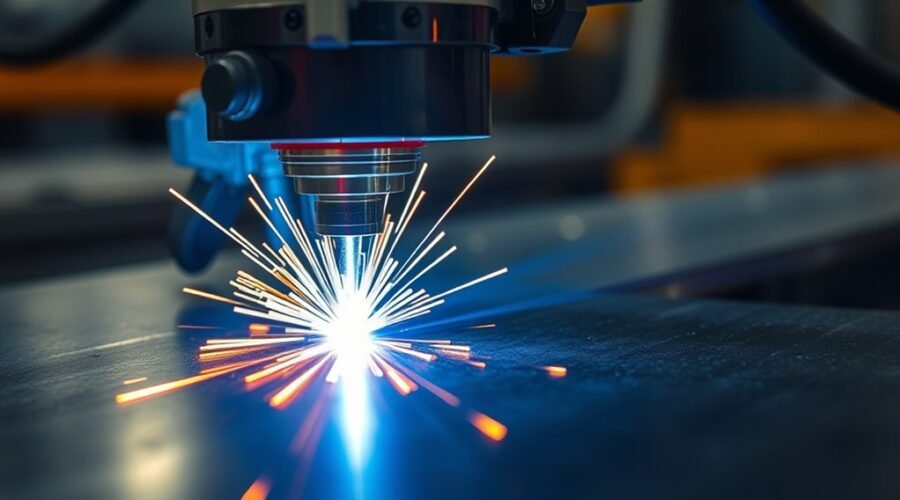
Laser welding uses a concentrated beam of light to melt and fuse materials at the joint, creating a localized pool that solidifies into a strong metallurgical bond. It can operate in conduction or keyhole mode, with fiber lasers often preferred for stable delivery and efficiency. The process produces low distortion, a small heat-affected zone, and clean welds. It is widely used in automotive, medical, aerospace, electronics, and jewelry work, with more details available below.
Key Takeaways
- Laser welding uses a concentrated beam to melt and fuse materials into a strong metallurgical bond.
- It creates a small heat-affected zone, reducing distortion and improving dimensional accuracy.
- Conduction welding is slower and cleaner, while keyhole welding provides deeper penetration.
- Fiber lasers are widely preferred for efficient, stable beam delivery and high-precision welding.
- It is used in automotive, medical, aerospace, electronics, and jewelry applications for clean, accurate joints.
What Is Laser Welding and How Does It Work?
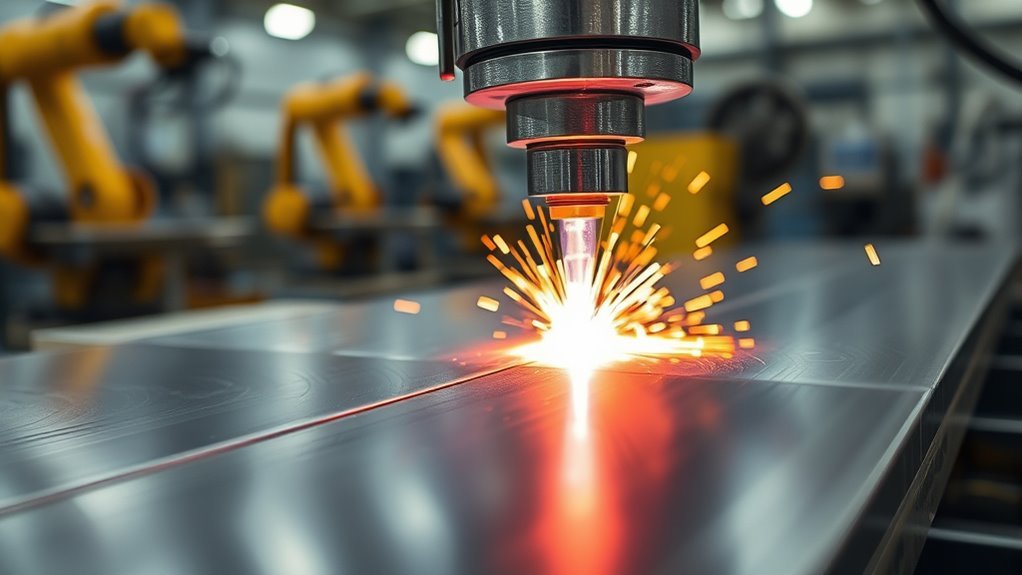
Laser welding uses a concentrated high-energy beam to fuse materials with high precision and minimal deformation. In laser welding, a concentrated beam of light is directed at the joint, where it generates a localized molten pool. As the pool cools, it forms a metallurgical bond with strong mechanical integrity.
Laser welding fuses materials with a focused beam, creating precise joints with minimal deformation and strong metallurgical integrity.
This process relies on low heat input, producing minimal distortion and a reduced heat-affected zone (HAZ) compared with conventional welding processes. The result is accurate welds with clean edges and limited post-processing.
It can join metals and thermoplastics, expanding its usefulness across industries including automotive, aerospace, and medical devices. Its controlled energy delivery supports high precision, repeatability, and consistent quality, enabling production that reduces wasted material and unnecessary rework.
For systems seeking efficiency and freedom from excessive thermal damage, laser welding offers a disciplined route to joining components with speed, stability, and structural reliability.
Laser Welding Methods and Laser Types
Two primary welding modes shape process selection: conduction welding, which melts the metal without vaporization for slower, low-spatter joints, and keyhole welding, which uses higher power density to vaporize material and achieve deeper, faster penetration at the cost of a larger HAZ and more spatter.
These laser welding methods give engineers distinct welding techniques for balancing speed, control, and thermal distortion.
Fiber lasers are now preferred for many metal jobs because they deliver high efficiency, about 30%, and stable beam delivery that supports precise thermal management.
CO2 lasers remain historically important, but their lower beam quality and weaker robotic integration limit current use.
Nd:YAG lasers offer broad material compatibility and useful flexibility, though they often demand greater upfront investment.
In practice, the choice of laser type and mode determines penetration, cycle time, and process stability.
Together, these options let production move beyond rigid limits toward cleaner, more adaptable manufacturing.
Why Laser Welds Stay Cleaner and Stronger
Because the beam is tightly focused, laser welding delivers energy exactly where it is needed, reducing spatter, limiting contamination, and producing cleaner joints than conventional processes.
This focused energy delivery creates cleaner welds because less metal is displaced and less debris is formed. The smaller heat-affected zone also reduces thermal distortion, so surrounding material keeps its properties and the finished joint retains higher joint strength.
High precision supports tighter fit-ups, which lowers the chance of gaps that would weaken weld quality. Shielding gases such as argon or helium further suppress oxidation, helping the weld surface remain bright and stable.
In many cases, post-processing becomes unnecessary because the bead is already clean and accurate. The result is a process that preserves material integrity, reduces rework, and supports stronger, more reliable assemblies without excess waste or correction.
Where Laser Welding Is Used Most
Major industries rely on laser welding where precision, speed, and low thermal distortion are essential. The laser welding process is most visible in the automotive industry, medical devices, aerospace sector, electronics manufacturing, and jewelry production.
Major industries rely on laser welding for precision, speed, and minimal thermal distortion.
These manufacturing sectors depend on high-quality welds and precision welds across diverse types of materials, from thin metals to precious alloys.
- Automotive industry: body panels, structural parts, and lightweight assemblies
- Medical devices: implants and surgical instruments requiring micro-welding
- Aerospace sector: stress-exposed components, fuel tanks, and riveted replacements
- Electronics manufacturing: compact connectors and dense circuit assemblies
- Jewelry production: delicate repairs and intricate precious-material designs
In each case, laser welding enables controlled energy delivery, narrow seams, and minimal distortion. The result is repeatable joining for fragile or complex parts, supporting efficient production and tighter design freedom.
Is Laser Welding the Right Choice?
Choosing laser welding depends on whether a process can meet the required balance of speed, fit-up precision, thermal control, and cost. For high-volume production, laser welding can deliver high speed, often 5 to 10 times faster than traditional welding methods, reducing cycle time and supporting demanding schedules.
Its minimal thermal input helps preserve part geometry and produce a strong bond with limited distortion. However, the process is less forgiving than conventional joining because it requires tight fit-up, so upstream fabrication and quality control must be disciplined.
High initial investment can limit adoption, yet savings may follow through lower post-weld work and better throughput. In industries and applications with strict tolerance, such as aerospace and medical devices, the method is often justified.
Expert review remains important to confirm feasibility, align parameters, and guarantee the selected system matches production freedom and quality needs.
Frequently Asked Questions
How Thick Will a Laser Welder Weld?
A laser welder typically handles 0.5–20 mm welding thickness, with penetration depth rising under higher laser power and slower weld speed. Material types, joint design, cooling rates, energy efficiency, equipment costs, and safety measures further determine capability.
What Are the Disadvantages of Laser Beam Welding?
Laser beam welding disadvantages include cost considerations, equipment maintenance, strict safety protocols, material limitations, slower speed comparison in some cases, demanding joint preparation, training requirements, possible distortion effects, and limited application versatility despite energy efficiency.
What Is the Average Lifespan of a Laser Welder?
A laser welder typically lasts 10–20 years; laser welder maintenance, laser technology advancements, welding safety practices, operator training, and environmental control extend service. Cost effectiveness, energy efficiency, material compatibility, laser beam types, industry applications, future trends matter.
Can You Weld Stainless Steel With a Laser Welder?
Yes, stainless steel can be welded with laser technology. The welding process supports precision welding, strong material compatibility, efficient joint design, and cost efficiency in industrial applications, while limiting heat treatment needs and simplifying post weld inspection.
Conclusion
Laser welding stands as a focused beam in modern joining technology, delivering speed, precision, and minimal distortion where conventional methods often leave a wider heat trail. Its cleaner seams and strong bonds make it valuable across automotive, medical, aerospace, and electronics applications. Yet, like any specialized tool, it suits certain materials, thicknesses, and production needs better than others. When matched correctly, it becomes less a compromise than a sharpened instrument of manufacturing.