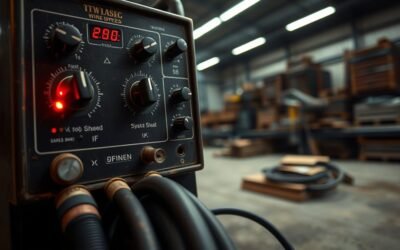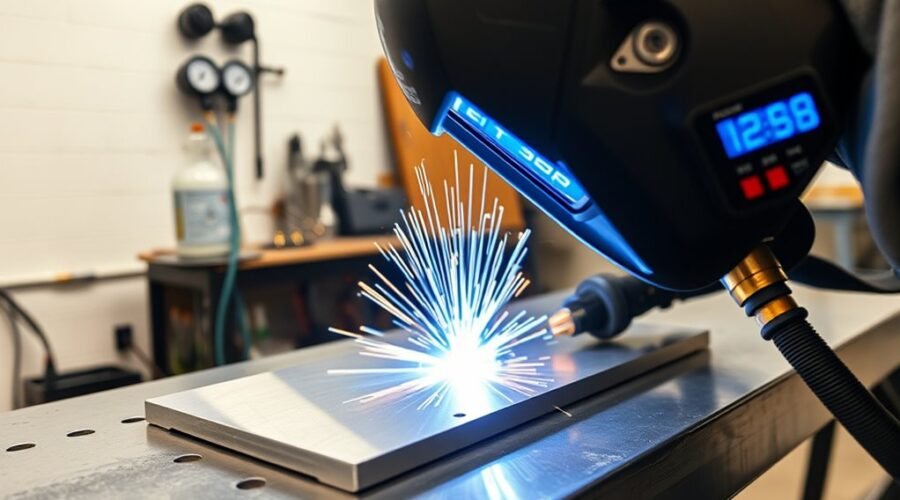
MIG welding aluminum works best with a spool gun to prevent birdnesting and improve wire feed reliability. Use 100% argon, or an argon-helium mix for thicker material, at about 20 CFH. Set DCEP polarity, 20–24 volts, and wire feed speed 30–100% higher than steel. ER4043 filler suits 6061 aluminum. Clean the base metal thoroughly, use a 10–15 degree push angle, and keep stickout near 3/4 inch. More detail follows.
Key Takeaways
- Use a spool gun with MIG welder compatibility to prevent aluminum wire birdnesting and feeding problems.
- Set polarity to DCEP and start around 20–24 volts for stable aluminum spray transfer.
- Use 100% argon at about 20 CFH; argon-helium blends help on thicker aluminum.
- Choose ER4043 filler wire for 6061 aluminum and keep stick-out near 3/4 inch.
- Clean aluminum thoroughly and weld with a 10–20 degree push angle and faster travel speed.
What You Need for MIG Welding Aluminum
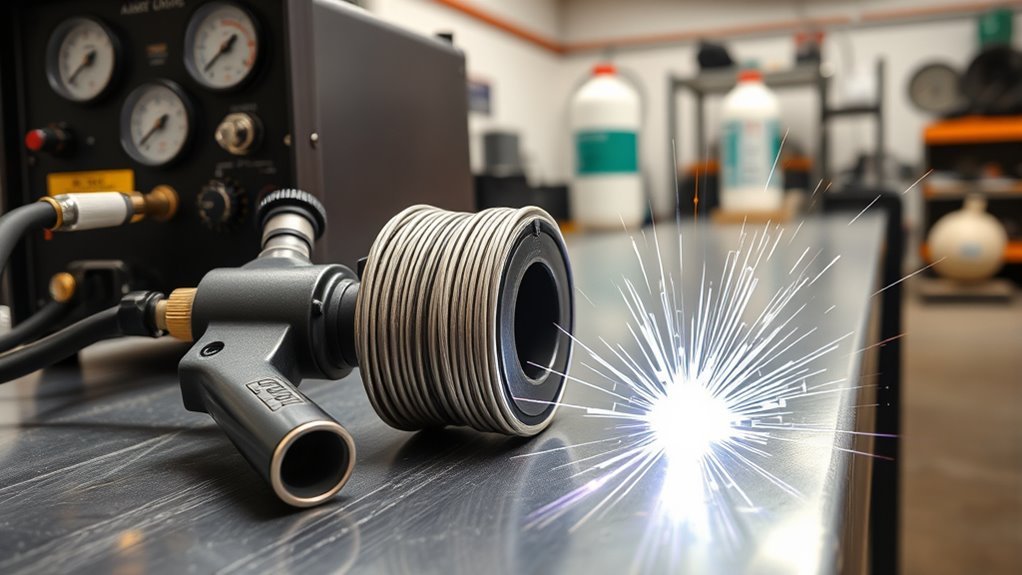
Successfully MIG welding aluminum requires a spool gun to feed the soft wire reliably without jamming, along with 100% argon or an argon-helium shielding gas mixture at roughly 20 CFH to protect the weld pool. This setup reduces resistance in the liner and supports stable transfer over the arc.
The shielding gas must remain consistent to exclude oxygen and limit oxidation, a prerequisite for clean fusion and structural integrity. Wire feed speed should be set substantially higher than steel settings, typically 30–100% above baseline, because aluminum demands faster delivery to maintain a uniform bead and adequate penetration.
DCEP polarity is required, and voltage generally begins near 20–24 V to sustain spray transfer. Together, these parameters give the operator disciplined control over heat input and deposition.
For those seeking practical liberation from poor weld quality, the process depends on precise machine setup rather than force, letting the metal be joined cleanly and efficiently without unnecessary struggle.
Choose a Spool Gun and Filler Wire
A spool gun designed for aluminum welding is essential because it feeds soft filler wire more smoothly and reduces the risk of birdnesting or jamming in the liner. Compatibility with the MIG welder model should be confirmed before setup, since mismatched equipment can impair delivery and create instability.
For general work, ER4043 filler wire is favored because it offers good fluidity, clean feeding, and reliable results on 6061 aluminum alloys. The operator should keep stick-out near 3/4 inch to preserve arc stability and penetration.
Wire feed speed must then be raised, typically 30-100% above steel settings, because aluminum requires faster delivery to maintain a consistent arc. A properly matched spool gun and filler wire combination gives the welder more control, less resistance, and a more direct path to precise, liberated fabrication.
Choose the Best Gas for MIG Welding Aluminum
Argon is the standard shielding gas for MIG welding aluminum, as 100% argon helps prevent oxidation and supports a clean, stable arc. For MIG welding aluminum, this choice offers the most reliable protection, especially using a spool gun on wire that must feed freely and stay uncontaminated.
- 100% argon: primary option for clean shielding and minimal porosity.
- 20 CFH Shielding Gas Flow: a practical baseline for consistent coverage.
- Argon-helium blends: useful on thicker sections where added heat improves penetration and bead shape.
- Avoid CO2: it increases porosity and degrades weld quality.
Shielding Gas Flow should be adjusted only when the arc becomes erratic or hissing becomes excessive, signaling poor coverage.
Adjust shielding gas flow only when erratic arc behavior or excessive hissing signals poor coverage.
A controlled gas envelope preserves weld integrity and keeps the process efficient. For operators seeking liberation through precision, the correct gas choice reduces rework, supports stable transfer, and yields cleaner aluminum welds.
Dial In Aluminum MIG Settings
Dialing in aluminum MIG settings begins with a voltage range of 20–24V, which supports stable spray transfer while allowing adjustments for material thickness and wire feed speed. The MIG gun should be held with the contact tip about 3/4-inch from the workpiece, recessed roughly 1/8 inch inside the nozzle to stabilize the arc and reduce burnback. Wire speed must be set 30–100% above steel values to sustain penetration without causing burn-through.
| Setting | Target |
|---|---|
| Voltage | 20–24V |
| Wire speed | 30–100% above steel |
| Gas flow rate | 20 CFH |
| Contact tip stickout | 3/4-inch |
A 100% argon flow rate near 20 CFH provides shielding that limits porosity and preserves weld integrity. Fine tuning is best performed on scrap aluminum, where bead shape, fusion, and heat input can be evaluated objectively. This method gives the welder disciplined control and practical freedom.
Clean Aluminum Before You Weld
Before welding, aluminum surfaces should be cleaned thoroughly to remove the oxide layer and any foreign material that could disrupt arc stability or fusion. Effective clean aluminum practice begins with dedicated stainless steel brushes or an angle grinder for persistent oxidation, followed by removal of dust, paint, oil, and grease.
Clean aluminum thoroughly before welding to remove oxide, dust, paint, oil, and grease for stable arc performance.
This proper surface preparation preserves the integrity of aluminum MIG wire deposition and reduces defects that compromise liberation from failure.
- Use dedicated aluminum tools only.
- Remove oxide with stainless steel abrasion.
- Eliminate contaminants with acetone or wipes.
- Inspect for residue before welding starts.
Neglecting these steps invites porosity, weak joints, and erratic fusion. A controlled, contamination-free surface allows the process to transfer energy efficiently and supports consistent bead formation.
Technical discipline at this stage is not optional; it is the foundation of reliable weld quality and material independence.
Use the Right Gun Angle and Travel Speed
A properly set MIG gun angle and travel speed are critical to stable aluminum welds. With a spool gun, the operator should hold a 10-20 degree push angle so shielding gas blankets the puddle and contamination is minimized. This orientation supports a cleaner arc and helps the MIG process remain controlled on soft aluminum.
Travel speed must then increase to roughly twice the pace used in normal welding; slow movement concentrates heat and can cause burn-through, especially on 1/8 inch material. A straight bead is preferred because weaving adds unnecessary heat and weakens consistency.
The contact tip should remain recessed about 1/8 inch inside the nozzle to support gas coverage and arc stability. Regular practice on scrap pieces sharpens judgment of angle and travel speed, giving the welder more command over the process and more freedom from defects.
Set Stickout, Voltage, and Wire Feed
Proper stickout should be set at about 3/4 inch for aluminum, providing the arc length and heat transfer needed for stable welding.
Voltage should be tuned first, typically in the 20–24 volt range for spray transfer, before wire feed is matched to the material and joint conditions.
Wire feed speed generally must run higher than steel, often 300–500 inches per minute for 1/8 inch aluminum, with final adjustment based on thickness and weld response.
Set Proper Stickout
Dialing in stickout, voltage, and wire feed is essential for stable MIG welding of aluminum.
With a spool gun, the operator should hold stickout near 3/4 inch; this limits burn-back and preserves arc control.
Wire feed speed must be elevated 30-100% above steel settings because aluminum conducts heat rapidly and demands steady metal delivery.
Voltage should remain within 20-24 volts to support spray transfer without destabilizing the puddle.
The contact tip should sit about 1/8 inch recessed in the nozzle for better shielding coverage.
Test welds verify whether these values produce clean penetration and minimal cleanup.
- Stickout: 3/4 inch
- Voltage: 20-24 volts
- Wire feed speed: 30-100% above steel
- Tip recess: 1/8 inch
Tune Voltage First
Voltage comes first because it establishes the arc behavior that aluminum welding depends on. For aluminum, the setting should be matched to material thickness, with roughly 20-24V serving as a practical floor for spray transfer on thicker sections.
With a spool gun, stickout near 3/4 inch supports arc stability and penetration, reducing erratic transfer. The wire feed speed then needs a substantial increase, often 30-100% above steel practice, so the softer wire advances without burn-back.
Shielding gas flow should be checked at about 20 CFH and adjusted only as needed to keep coverage consistent. Proper coordination of voltage, wire feed speed, and shielding gas limits excess heat input while preserving a controlled, repeatable arc and cleaner weld formation.
Match Wire Feed
With the voltage already established, the next step is to match wire feed to the arc by holding stickout near 3/4 inch, setting the contact tip about 1/8 inch recessed in the nozzle, and adjusting wire feed speed to run 30-100% higher than steel. A MIG welder using spool guns must keep aluminum delivery stable, or the arc loses freedom and consistency.
- Maintain 20-24V for spray transfer.
- Increase wire feed speed enough to fill the puddle.
- Keep stickout short to limit burn-back.
- Test on scrap aluminum and recalibrate.
This balance preserves penetration, reduces defects, and supports a clean, liberated weld path. The contact tip remains cooler, the arc length stays uniform, and the aluminum wire feeds without hesitation.
Fix Burn-Through, Porosity, and Dirty Welds
Reducing burn-through, porosity, and dirty welds in aluminum MIG welding requires tight control of heat input, surface condition, and shielding quality.
Burn-through is limited by increasing travel speed and keeping welds short, so the arc does not linger and overheat the joint. A consistent wire stick-out of about 3/4 inch further moderates heat concentration and supports cleaner fusion.
Increase travel speed and keep welds short to prevent overheating and reduce burn-through.
Porosity is best reduced by thoroughly cleaning the base metal, removing oil, dust, and other hydrogen sources before welding. Proper shielding gas coverage must remain uninterrupted, and voltage with wire feed speed should be adjusted to encourage spray transfer, which improves penetration while lowering gas entrapment.
Dirty welds are minimized by using a 10-20 degree push angle and maintaining a clean aluminum surface ahead of the puddle.
When these variables are controlled, the process becomes more stable, more predictable, and more capable of producing sound welds.
Practice on Scrap Before Welding the Real Part
After heat input, shielding, and surface cleanliness have been brought under control, the next step is to verify those settings on scrap aluminum before touching the final part.
For those who want to MIG Weld Aluminum with confidence, practice on scrap is the controlled path to freedom from guesswork. Matching the scrap thickness and alloy to the real workpiece reveals how the arc responds under realistic load, letting welding settings be adjusted without risking value.
- Tune voltage and wire feed speed on offcuts.
- Run beads at roughly twice normal travel speed to limit heat buildup.
- Maintain a 10-15 degree push angle to build repeatable torch control.
- Vary wire stick-out to identify the cleanest, most stable transfer.
Repeated trials expose the narrow operating window, making the final weld deliberate rather than reactive.
Frequently Asked Questions
What Is the Recommended Gas Setting for an Aluminum Spool Gun?
It is 100% argon at about 20 CFH. For aluminum spool welding techniques, proper equipment maintenance and steady flow preserve arc stability, minimize porosity, and keep the liberated weld pool clean from atmospheric contamination.
What Are the Recommended Settings for an Aluminum Spool Gun?
Recommended settings are 19–24 volts, about 300 inches per minute wire feed, 100% argon at 20 cfh, and 3/4 inch tip-to-work distance; aluminum alloys, spool gun maintenance, welding techniques demand scrap testing.
What Is the Best Setting for MIG Welding Aluminum?
Best MIG aluminum settings are about 20–24V, 300–400 IPM wire feed, 100% argon at 20 CFH, and DCEP. Aluminum welding techniques benefit from spool gun advantages; MIG welding safety requires scrap testing and adjustment.
What Gas for Welding Aluminum With a Spool Gun?
100% argon is typically the best gas for welding aluminum with a spool gun. It stabilizes shielding across aluminum alloy types, complements spool gun advantages, and supports clean welding techniques with minimal porosity and oxidation.
Conclusion
With the spool gun loaded, argon flowing, and settings brought into balance, the aluminum joint begins to take shape. Clean metal, controlled angle, and steady travel speed leave a bright bead behind, while poor stickout or contamination quickly reveal themselves as porosity or burn-through. The final weld is never accidental; it is the result of measured preparation, precise adjustment, and practiced motion. On scrap first, the arc tells the story before the real part is ever touched.