J422 is a common Chinese mild steel stick electrode classified as E4303 under the GB/T 5117 and ISO 2560-B systems. It has a rutile (titania-calcium) coating, runs on AC or DC, welds in all positions and deposits weld metal with about 430 MPa (62 ksi) minimum tensile strength. There’s no exact AWS A5.1 equivalent, but it’s generally treated as similar to an E6013 rod: easy to strike, smooth arc, easy slag removal and best for light to medium mild steel work. Typical current is about 90 to 140 A for a 3.2 mm (1/8 in) rod.
J422 rods are sold worldwide under many brand names and are among the most widely used electrodes on the planet. If you’ve bought low-cost rods online or overseas, there’s a good chance they were J422. Here’s what the number means, how it compares with AWS rods and how to run it.
What Does J422 Mean?
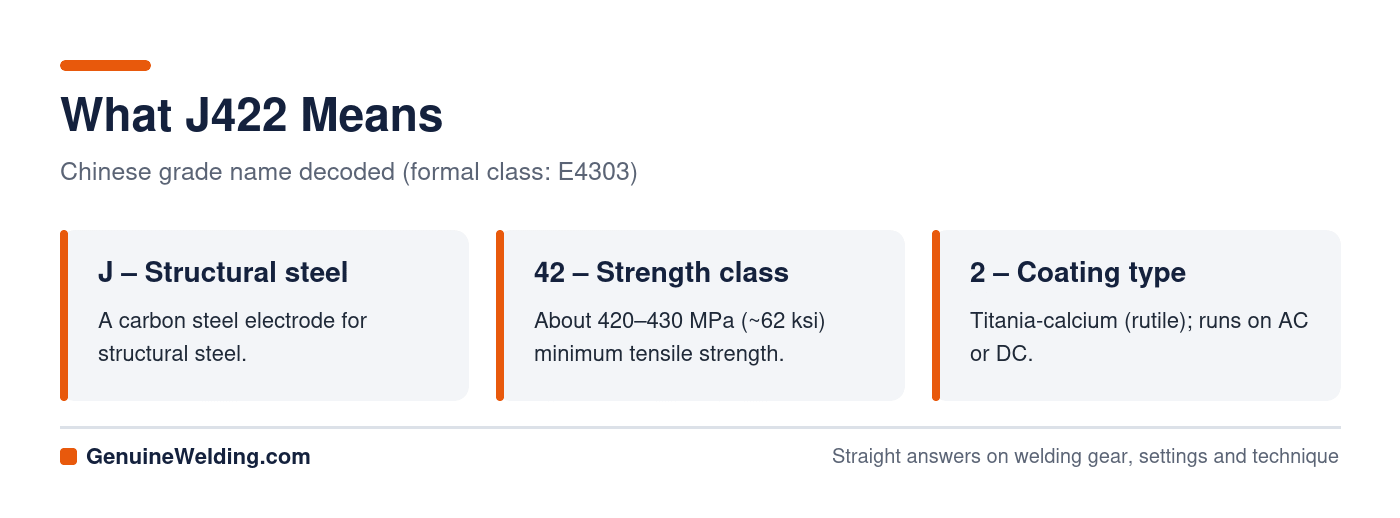
J422 uses the traditional Chinese electrode naming system:
- J: structural steel electrode (结构钢, jiegou gang)
- 42: minimum tensile strength of about 420 MPa (42 kgf/mm²) class
- 2: coating type: titania-calcium (rutile), usable on AC or DC
The modern standard designation is E4303 (GB/T 5117 / ISO 2560-B), where 43 means 430 MPa minimum tensile strength, 0 means all positions, and 3 indicates a rutile-type coating for AC and DC.
J422 AWS Equivalent
There isn’t an exact match because AWS A5.1 doesn’t include an E6003 classification. In practice, J422 is most often compared to AWS E6013, since both are rutile, all-position, AC/DC rods for general mild steel with a smooth arc and easy slag. Some sellers also list it alongside E6019. The metric-to-imperial strength conversion is close: 430 MPa is about 62 ksi, similar to E60XX rods (60 ksi minimum).

If your job requires an AWS-classified rod (for example, code or structural work to AWS D1.1), use rods actually certified to AWS A5.1, not equivalents. See welding rod numbers explained and 6010 vs 6011 vs 6013 vs 7018.
J422 Amperage Settings

Start in the middle of the range and adjust. Use the lower end for vertical and overhead, and the higher end for flat welds on thicker plate. Rutile rods like J422 prefer a short to medium arc length and don’t need whipping.
What Is J422 Used For?
- General fabrication of low-carbon steel (Q235, A36-type steels)
- Light structural work, gates, fences, brackets and frames
- Farm and home repairs
- Sheet and light plate where a soft arc helps avoid burn-through
- Welding on small AC transformer machines and inverters
- Practice rods for beginners
J422 isn’t the best choice for high-strength steel, thick restrained joints, cracking-sensitive steels, low-temperature service or code-critical structural work. For those, use a low-hydrogen rod such as E7018 (similar to the Chinese J507).
How to Weld With J422 Rods
- Clean the metal. J422 tolerates some surface rust, but clean metal gives better welds.
- Set polarity. AC or DC both work. On DC, many welders use DCEP for deeper penetration or DCEN for thin metal.
- Strike the arc with a scratch or tap. Rutile rods start easily.
- Hold a short-to-medium arc and a 10–20° drag angle.
- Travel steadily; small weaves are fine for wider beads.
- Chip slag after each pass. J422 slag usually lifts off easily.
New to stick? See our stick welding guide and stick welding tips.
Storing and Drying J422 Rods
Rutile rods don’t need oven storage like low-hydrogen rods, but moisture still causes porosity, spatter and a rough arc. Keep them in sealed packaging or a dry container. If they get damp, manufacturers commonly recommend redrying at about 150 to 170°C (300 to 340°F) for 30 to 60 minutes. Don’t overbake rutile rods; too much heat can damage the coating.
J422 vs J507
| J422 (E4303) | J507 (E5015) | |
|---|---|---|
| Coating | Rutile (titania-calcium) | Low-hydrogen sodium |
| Polarity | AC or DC | DCEP |
| Strength class | ~430 MPa (62 ksi) | ~490 MPa (70 ksi) |
| Closest AWS rod | E6013 (similar) | E7015 / E7018 (similar) |
| Ease of use | Very easy | Harder; needs dry rods |
| Best for | General mild steel | Structural and crack-sensitive work |
J422 Welding Rod FAQs
Is J422 the same as 6013?
Not exactly, but they’re very similar in coating type, positions and use. J422 is classified as E4303 under Chinese and ISO standards; 6013 is an AWS A5.1 classification.
Is J422 good for beginners?
Yes. It strikes easily, runs smoothly on small machines and leaves easy-to-remove slag.
Can J422 be used on AC welders?
Yes. It runs on both AC and DC.
Is J422 strong enough for structural steel?
For light, non-code structures it’s commonly used. For code-governed structural work, use AWS-certified rods specified by the procedure, usually E7018.
What does J422 mean on the box?
It’s the Chinese grade name. Look for E4303 (GB/T 5117) on the box as the formal classification.
Sources
- Tianqiao Welding: J422 (E4303) electrode data
- American Welding Society: AWS A5.1 Carbon Steel Electrodes for SMAW