

If you are comparing the best budget plasma cutters, focus on clean-cut capacity, input power, arc-start design, air demand and manufacturer support. Two linked models still pass the live buyability and relevance check; one does not.
LOTOS LTP5505D is the best overall because its 55A high-voltage output, non-touch pilot arc, rust-removal mode and auto-sensing dual voltage directly suit rusty or painted repair work. PrimeWeld CUT50D is the stronger choice if warranty coverage and US-based support matter more.
We checked current Amazon listings, manufacturer specifications, warranty information and recall records. We did not add hands-on test claims.
Budget Plasma Cutters Compared
| Product | Best for | Clean cut | Arc start | Input power |
|---|---|---|---|---|
|
Budget
|
Rusty, painted and expanded metal | 5/8 in at 220/240V | Non-touch pilot arc | Auto 110/120V or 220/240V |
|
Mid-range
|
Garage work and manufacturer support | 12 mm clean cut | HF touch-and-lift, non-pilot | 120/240V with adapter pigtail |
| Light DIY reference; not a current pick | Up to 20 mm, listing claim | Non-touch pilot arc | 110/220V |
Best Budget Plasma Cutters: Our Top Picks
1. LOTOS LTP5505D
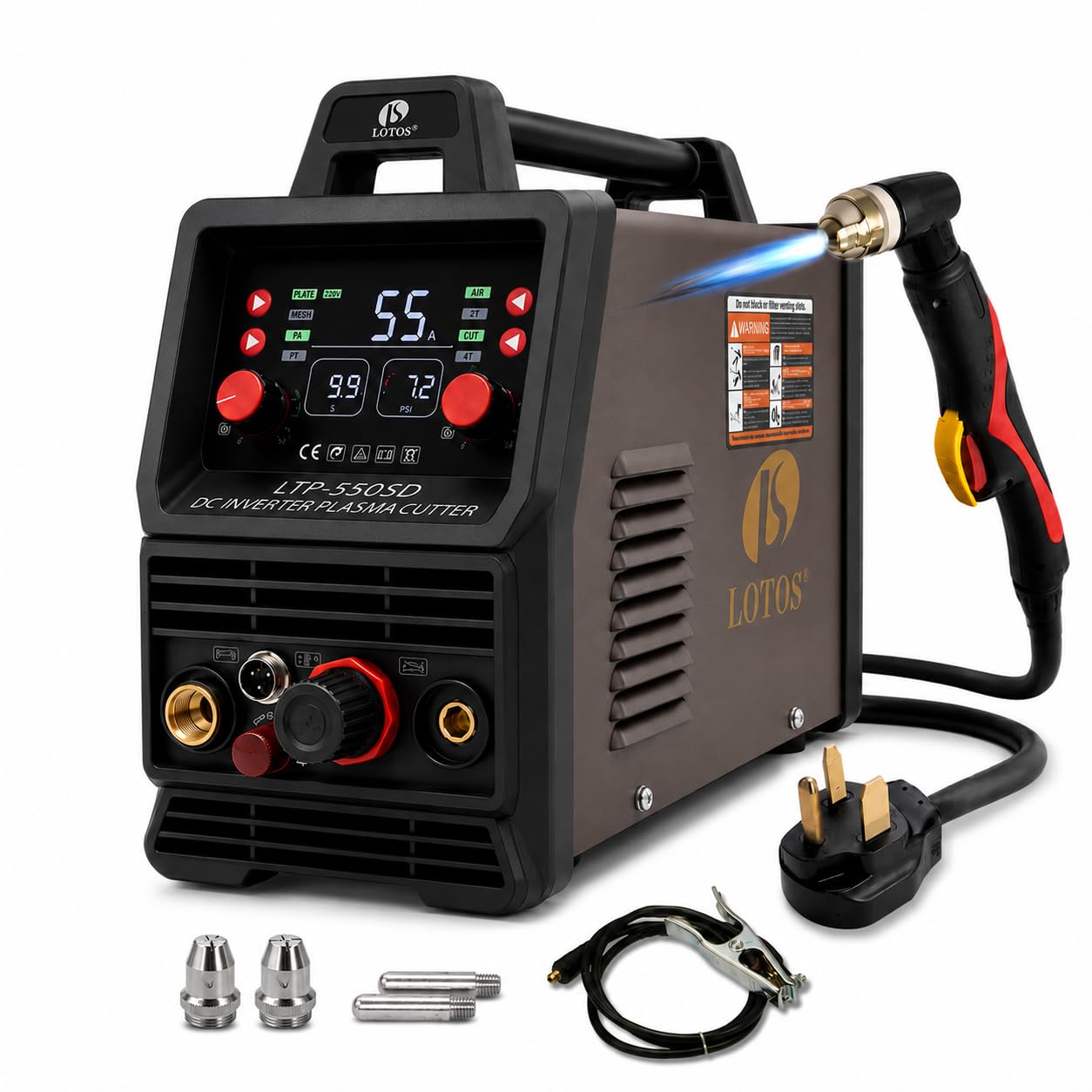
Bottom line: The LOTOS LTP5505D is the most versatile verified pick here for repair, restoration and general shop work. Its pilot arc and dedicated rust-removal mode give it an edge when the metal is painted, oxidized or perforated.
- Input power: Auto 110/120V or 220/240V, useful across garages and shops.
- Clean cut: 5/8 in high voltage; 3/8 in low voltage.
- Arc start: Non-touch pilot arc, useful on dirty or expanded metal.
- Duty cycle: 60% at 55A on 220/240V, solid for intermittent fabrication.
- Air setup: Front regulator plus NPT Type-D plug, simplifies connection.
On 220/240V, LOTOS rates this cutter for 20–55A output and a 5/8-inch ideal clean cut. On 110/120V, output drops to 20–35A with a 3/8-inch ideal clean cut. That makes household power useful for lighter work, while the higher-voltage circuit is the better fit for thicker plate.
The non-touch pilot arc is the practical reason to choose it over a basic contact-start cutter. It can establish the arc without dragging the tip on the workpiece, and the dedicated rust-removal mode is designed for corroded or coated metal. The front-mounted filter/regulator and pre-installed air fitting also reduce setup steps.
LOTOS lists a three-year limited warranty, one-year new-replacement coverage and lifetime US technical support, with registration required for full coverage. That support package strengthens the case for buyers who expect to keep the machine beyond occasional hobby use.

- Non-touch pilot arc works without dragging the tip on metal
- 5/8-inch ideal clean cut on 220/240V
- Automatic dual-voltage sensing
- Dedicated surface rust-removal mode
- Three-year limited warranty with US technical support
- Full 55A output requires 220/240V
- Low-voltage clean-cut rating drops to 3/8 inch
- Warranty registration is required for full coverage
2. PrimeWeld CUT50D

Bottom line: The PrimeWeld CUT50D is a straightforward 50A cutter for clean-metal garage and repair work, backed by a three-year warranty and US-based support. Choose it when support and a conventional drag-start workflow matter more than a non-touch pilot arc.
- Input power: 120/240V via adapter pigtail, flexible for home or shop.
- Clean cut: 12 mm rated, enough for common repair plate.
- Arc start: High-frequency touch-and-lift, non-pilot drag-start design.
- Duty cycle: 60% at maximum rating, useful for repeated short cuts.
- Air setup: 40–75 PSI and 5 CFM at 80 PSI.
The biggest factual correction is the arc-start system. PrimeWeld describes the CUT50D as a high-frequency, non-pilot touch-and-lift machine. You briefly touch the torch to establish the arc, then drag along the workpiece. That is different from a non-touch pilot-arc cutter and matters if you regularly work on rusty, painted or expanded metal.
PrimeWeld lists 20–40A output on 120V and 20–50A on 240V, with a 60% duty cycle at the maximum rating. The published clean-cut specification is 12 mm. The machine also has a front air-pressure gauge, digital power display, overcurrent, overheating and power-spike protection.
The support package is a clear strength. PrimeWeld publishes a three-year warranty for its machines and keeps customer service, parts and technical support in the United States. The AG60 torch also has readily identifiable replacement electrodes, nozzles and shield cups from the manufacturer.

- 50A maximum output on 240V
- 12 mm published clean-cut capacity
- Dual 120/240V input with adapter pigtail
- 60% duty cycle at maximum rating
- Three-year warranty and US-based support
- Touch-and-lift start requires workpiece contact
- Maximum output drops to 40A on 120V
- High-frequency start is a poor fit for some CNC controllers
3. S7 CUT-50

Bottom line: The S7 CUT-50 stays in this article for reference because the linked ASIN failed the live buyability check. It is not one of the current recommendations.
- Input power: 110/220V, dual-voltage format in the linked listing.
- Clean cut: Up to 20 mm, according to the linked listing.
- Arc start: Non-touch pilot arc, intended for coated or uneven metal.
- Air setup: Built-in regulator and gauge, reducing separate fittings.
The linked listing identifies this as a 50A dual-voltage CUT-50 with a non-touch pilot arc, built-in air regulator and IGBT inverter. Those features would normally suit portable DIY cutting and light fabrication.
However, current buyability is required for a recommendation in this roundup, and the linked ASIN did not pass that check. Current manufacturer warranty and support details for this exact linked model also could not be verified from a primary source, so the article does not use it as a value pick or alternative to the two verified models above.
Feedback Snapshot
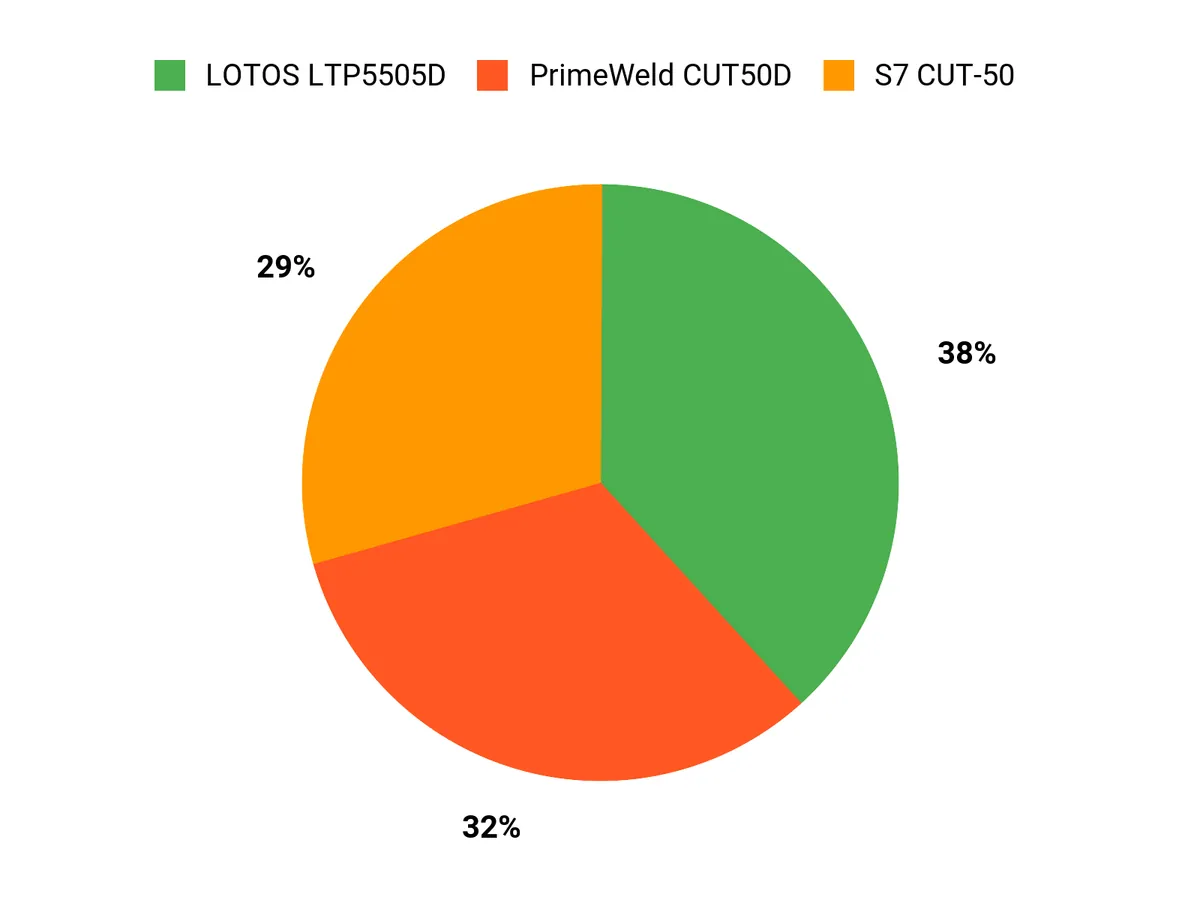
The source article included the sentiment chart below. Because this product failed the live buyability check, the chart is preserved but is not used to support a current recommendation.

- Non-touch pilot arc in the linked product listing
- Dual-voltage 110/220V format
- Built-in air regulator and gauge
- Linked ASIN failed the live buyability check
- Current primary-source warranty details were not verified
- Not included in current picks or structured data
LOTOS LTP5505D vs PrimeWeld CUT50D: Which Trade-Off Matters?
These two verified cutters solve slightly different problems. LOTOS adds a true non-touch pilot arc, rust-removal mode and higher published clean-cut capacity, while PrimeWeld emphasizes a simpler drag-start workflow plus clearly documented support and consumables.
- Dirty metal: LOTOS is built to start on rusty, painted and expanded metal.
- Clean-cut capacity: LOTOS publishes 5/8 inch at high voltage; PrimeWeld lists 12 mm.
- Arc start: LOTOS is non-touch pilot arc; PrimeWeld is HF touch-and-lift.
- Support: Both publish three-year warranty coverage, with different registration and service terms.
Which Plasma Cutter Should You Buy?
- Rusty or painted repair metal: get the LOTOS LTP5505D.
- Expanded metal or grating: get the LOTOS LTP5505D for its non-touch pilot arc.
- Warranty and US support: get the PrimeWeld CUT50D.
- Simple clean-metal garage work: get the PrimeWeld CUT50D.
- Thicker clean-cut target: get the LOTOS LTP5505D based on the published high-voltage rating.
How We Chose
- Current buyability: the linked ASIN had to lead to the same product and pass a live purchase check.
- Cut capacity: we used manufacturer clean-cut ratings, not severance numbers, for the main comparison.
- Power flexibility: we checked low- and high-voltage output separately because dual voltage does not mean equal performance.
- Arc-start design: we separated non-touch pilot arc from touch-and-lift starts because the difference matters on rust, paint and mesh.
- Support and safety: we reviewed manufacturer warranty information, cross-site owner trends and CPSC recall records without adding unverified testing claims.
Customer Preferences
If your work regularly starts with dirty or coated steel, the LOTOS feature set is the more direct fit. If you mainly cut clean material and care most about documented service, parts and warranty access, PrimeWeld is easier to justify. The original preference chart is preserved below, but the current recommendations are based on the live verification above.
Buying Guide for Budget Plasma Cutters
Clean Cut vs Severance Cut
Use the clean-cut rating for normal buying decisions. A severance rating tells you the machine can get through thicker material, but the edge can be rougher and travel speed slower. If your regular work is near a cutter’s maximum clean-cut limit, moving up in amperage gives you more operating margin. For the verified models here, LOTOS publishes the higher clean-cut rating.
120V vs 220/240V Power
Dual-voltage machines are convenient, but their output changes with input power. The LOTOS LTP5505D drops from 55A maximum on 220/240V to 35A on 110/120V. The PrimeWeld CUT50D drops from 50A on 240V to 40A on 120V. Match the cutter to the outlet and breaker you actually have, not only the highest number on the case.
Pilot Arc vs Touch-and-Lift Start
A non-touch pilot arc helps when the surface is rusty, painted, perforated or uneven because the arc can start without first contacting clean bare metal. That is the main functional advantage of the LOTOS LTP5505D. The PrimeWeld CUT50D uses a high-frequency touch-and-lift start, which is better viewed as a clean-metal drag-start design rather than a pilot-arc substitute.
Duty Cycle
Duty cycle tells you how long a cutter can run at a stated output before it needs cooling, usually within a ten-minute reference period. Both verified machines publish a 60% duty cycle at their maximum rated settings under specified conditions. If you make long continuous cuts, keep airflow around the machine clear and do not assume the lower-amperage duty cycle applies at full output.
Compressed Air
Air quality is part of cut quality. Use the pressure and airflow required by the exact machine, and keep the supply clean, dry and oil-free. PrimeWeld specifies 40–75 PSI and 5 CFM at 80 PSI for the CUT50D. A moisture separator and a compressor with enough sustained airflow are more important than a large tank by itself.
Consumables and Support
Before buying, check whether electrodes, nozzles, shield cups and torch parts are easy to identify for your exact torch. Consumables are normal wear items. Manufacturer support matters when a regulator, torch or internal component needs service, which is why the published warranty and parts support for LOTOS and PrimeWeld counted heavily in this update.
Mistakes to Avoid When Buying a Plasma Cutter
- Buying by severance thickness: compare clean-cut ratings first.
- Ignoring input power: confirm the amperage available on your actual outlet.
- Undersizing the compressor: match sustained CFM and pressure, not tank size alone.
- Confusing arc-start types: pilot arc and touch-and-lift are not the same.
- Skipping consumable research: check torch parts and warranty support before purchase.
FAQs
How thick can a budget plasma cutter cut?
Clean-cut capacity depends on input voltage, amperage, air supply and travel speed. The verified LOTOS LTP5505D is rated for a 5/8-inch clean cut on 220/240V and 3/8 inch on 110/120V. PrimeWeld rates the CUT50D for a 12 mm clean cut. Treat severance ratings as a different, rougher limit, not the same as clean-cut capacity.
Do I need 240V power or will 120V work?
120V can work for thinner material and lighter jobs, but these dual-voltage cutters produce less output on household power. LOTOS limits the LTP5505D to 35A on 110/120V, while PrimeWeld lists up to 40A on 120V. If you routinely cut thicker plate, use the manufacturer-approved 220/240V setup and the correct circuit, plug and breaker.
What air compressor do I need for a plasma cutter?
Match the compressor to the cutter’s published pressure and airflow requirements, not tank size alone. PrimeWeld specifies 40–75 PSI and 5 CFM at 80 PSI for the CUT50D. Whatever model you choose, feed it clean, dry air and keep the regulator stable under flow. Moisture and weak airflow can shorten consumable life and hurt cut quality.
Is a non-touch pilot arc worth it?
A non-touch pilot arc is useful when you cut rusty, painted, expanded or uneven metal because the torch can establish an arc without first touching clean bare metal. That is a key advantage of the LOTOS LTP5505D. The PrimeWeld CUT50D instead uses a high-frequency touch-and-lift, non-pilot start, which is simpler for clean shop material but less convenient on dirty surfaces.
Can these plasma cutters cut aluminum and stainless steel?
Yes, plasma cutting works on electrically conductive metals, and both verified manufacturers list materials beyond mild steel. LOTOS lists stainless steel, alloy steel, mild steel, copper and aluminum for the LTP5505D. PrimeWeld positions the CUT50D for general plasma cutting, but cut quality and speed still depend on thickness, amperage, air quality and the correct consumables.
What maintenance and consumables should I expect?
Plan to replace electrodes, nozzles and related torch consumables as they wear. Keep the compressor tank drained, use clean and dry air, inspect the torch lead and ground connection, and replace damaged consumables before cut quality falls sharply. PrimeWeld specifically recommends replacing the electrode and nozzle together when wear enlarges the nozzle opening. Follow the exact manual for your torch.
Final Verdict
For the best budget plasma cutters in this update, the LOTOS LTP5505D is the most complete verified option because it combines a non-touch pilot arc, rust-removal mode, auto dual voltage and the strongest published clean-cut capacity of the current picks.
For a cleaner-metal workflow with strong service backing, consider the PrimeWeld CUT50D. The S7 CUT-50 is not included in the current recommendations because its linked ASIN failed the live buyability check.
| LOTOS LTP5505D 55A Pilot Arc Plasma Cutter | PrimeWeld 50A Air Inverter Plasma Cutter | S7 CUT-50 Plasma Cutter | |
|---|---|---|---|
|
|
|
|
|
| Rating | 4.4/5 (N/A reviews) | 4.7/5 (N/A reviews) | 4.1/5 (N/A reviews) |
| Cutting Thickness | 5/8 inch (16 mm) clean cut | 1/2 inch clean cut | 20 mm clean cut (approx. 3/4 inch) |
| Voltage Options | Dual Voltage: 120V/240V | Dual Voltage: 110V/220V | Dual Voltage: 110V/220V |
| Weight | 16 pounds | N/A | 22.2 pounds |
| Shop Now | Shop Now | Shop Now |


[…] clean fusion and complicates reliable, emancipatory workmanship. Additionally, understanding the performance vs. cost of welding equipment can aid in selecting the right tools for tackling galvanized steel […]
[…] steel. A process such as plasma cutting may be more suitable for those materials; this guide to budget plasma cutters explains that […]
[…] you are comparing other cutting processes, this existing guide to budget plasma cutters covers equipment designed for a different type of arc […]