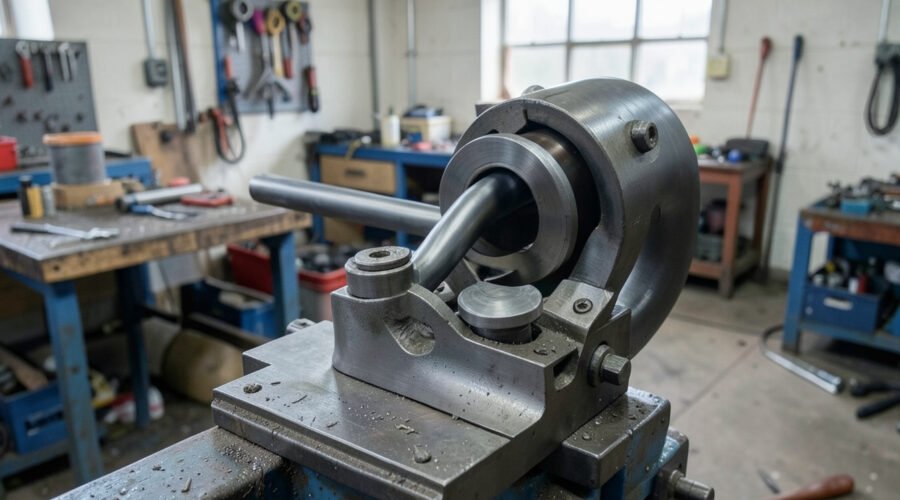
Tube bending shapes round or square tube into curves without kinking or flattening it. The main methods are rotary draw bending (the most precise), ram or compression bending (simple and cheap), press bending and roll bending (for large, gentle curves). The right choice depends on the tube size, wall thickness, bend radius and how many bends you need.
Roll cages, handrails, exhaust systems, furniture frames and bike frames all depend on good bends. This guide explains how each method works, which tools suit a home or professional shop, and how to avoid the common defects of kinks, wrinkles and flat spots.
Key Facts About Tube Bending
- Rotary draw bending pulls the tube around a fixed bend die. It gives the most accurate bends and tight radii.
- Ram (compression) bending pushes a die into the tube. It is simple and cheap but distorts the cross-section more.
- Roll bending passes the tube through rollers for large-radius curves and coils.
- Mandrels and wiper dies support the inside and outside of thin-wall tube to prevent kinks and wrinkles.
- Springback means the tube opens slightly after bending, so you overbend a few degrees.
Tube Bending Methods Compared
| Method | Best for | Limits |
|---|---|---|
| Rotary draw | Roll cages, furniture, handrails, precise parts | Costly tooling; each size and radius needs its own dies |
| Ram or compression | Exhaust, light frames, repair work | More flattening; fixed radius dies |
| Press bending | Large production runs | Heavy equipment |
| Roll bending | Large-radius arcs, coils, hoops | Not for tight radii |
| Hand benders | Conduit, thin-wall tube, small jobs | Limited wall thickness |
How Rotary Draw Bending Works
In rotary draw bending the tube is clamped against a bend die, and the die rotates to pull the tube around its curve. A pressure die supports the straight part, a wiper die prevents wrinkles on the inside of the bend, and a mandrel inside the tube prevents it from collapsing in thin-wall applications. The method is common for roll cages, furniture frames and handrails because the bends are accurate and repeatable. It requires dies matched to the tube diameter and radius.
How Ram and Compression Bending Work
A hydraulic ram pushes a center die into the tube, which sits on two pivoting shoes. The tube takes the shape of the die. This is how most benchtop exhaust and pipe benders work. It costs less than rotary draw, but the cross-section of the tube is distorted more, which is acceptable for exhaust but not for tubing that must stay round. See our pipe bender roundup and exhaust pipe benders.
Roll Bending and Press Bending
Roll benders use three rollers to form large curves, hoops and coils. They are good for gentle arcs and for pipe or tube with thick walls, but cannot make tight bends. Press bending uses a stationary die and a moving ram in production runs. Roll tooling can also be used for angle, flat bar and square tube. See tube rollers.
Bend Radius and Springback
A common rule is to keep the centerline radius at least 2 to 3 times the tube diameter (2D to 3D) for round tube. Tighter bends need a mandrel and a wiper die. Springback depends on material hardness and wall thickness; harder or thinner tube springs back more. Test on a scrap piece and adjust the overbend. Mark each tube before bending and measure from the same reference every time.
Tools for Tube Bending
- A bender sized for your tube: manual, hydraulic or electric.
- Dies for the right outside diameter and radius.
- A tubing cutter, deburring tool and file.
- A tape measure, angle gauge and marker.
- Lubricant or bending oil.
- A tube notcher for fish-mouth joints; see tube notchers.
Common Tube Bending Mistakes
- Kinks from using the wrong die or a radius that is too tight.
- Flattening from using a ram bender on thin-wall tube.
- Wrinkles on the inside of the bend without a wiper die.
- Not accounting for springback.
- Poor lubrication, which scratches or galls the tube.
- Cutting before bending without allowing for the length lost in the bend.
Tube Bending and Welding
After bending, weld seams should be on the neutral axis so they do not split. Notch the end of the tube to fit the mating tube and weld with TIG or MIG. For tube welding basics, see our guide to TIG welding.
FAQs
What is the best way to bend tube?
For precise, repeatable bends, a rotary draw bender with the correct dies is best. For occasional jobs, a hydraulic ram bender is a cheaper option.
What is the minimum bend radius for tube?
A common guideline is 2 to 3 times the tube diameter for the centerline radius. Thin-wall tube needs a mandrel for tighter bends.
Why does tube kink when bent?
A radius that is too tight, thin walls, no mandrel or the wrong die size allows the tube wall to buckle.
Can I bend tube without a bender?
Yes for small tube with a spring or sand fill, but results are poor. See our guide on bending pipe without a bender.
What is a mandrel in tube bending?
A mandrel is a support inserted inside the tube during bending that keeps the tube round and prevents kinking.
How do I stop springback?
You cannot stop it, but you can overbend by a few degrees and test on scrap to find the right amount.
Bottom Line
Choose rotary draw bending for precision work, ram bending for repair and exhaust, and rolling for large arcs. Match the die to the tube, test on scrap and allow for springback. The right bender makes tube work faster and neater.
Sources
- Baileigh: Basic bending concepts
- Rogue Fab: Tube and pipe bending types
- Prolean: Tube and pipe bending methods, tooling and uses
- OSHA 1910.212: General machine guarding