
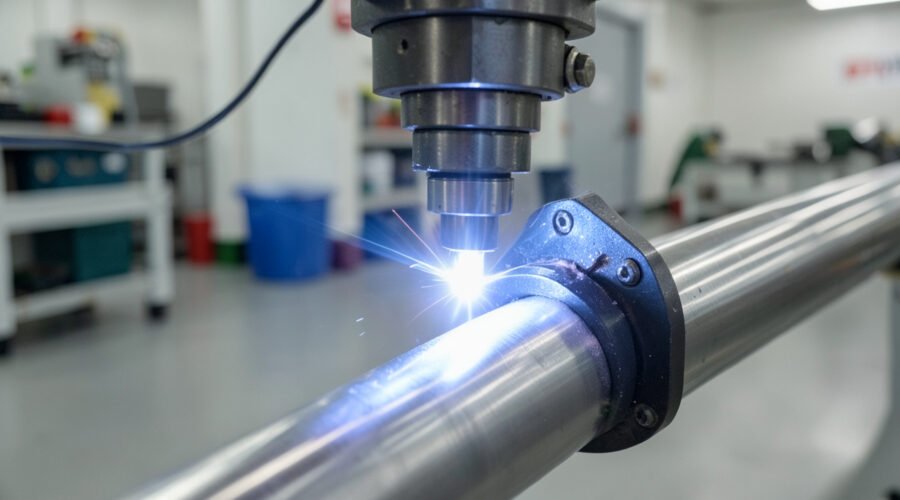
Orbital welding is an automated TIG process in which a welding head rotates 360 degrees around a fixed tube or pipe, following parameters stored in a computer-controlled power source. It produces consistent, high-purity welds that are hard to match by hand, which is why it is used in pharmaceutical, semiconductor, food, aerospace and nuclear work.
If you have searched for an orbital welder or orbital welding machine, you are likely comparing it with manual TIG. This guide explains how the process works, what equipment you need, where it is used and when it makes sense.
Orbital Welding Basics
- Process: most orbital welding uses gas tungsten arc welding (GTAW/TIG), with the torch moving around the joint.
- Origin: developed in the 1960s to fix leak problems on the X-15 rocket plane.
- Purge gas: argon is used inside the tube to protect the weld from oxidation.
- Weld type: tube-to-tube and pipe-to-pipe butt welds are the most common.
- Best for: repeatable, code-quality welds on small to medium tube.
Orbital vs Manual TIG Welding
| Feature | Orbital welding | Manual TIG |
|---|---|---|
| Consistency | Very high; parameters are stored and repeated | Depends on the welder |
| Speed on repeated joints | Fast and uniform | Slower |
| Setup cost | High | Low |
| Operator skill | Trained operator, programming | High manual skill |
| Best joints | Tube and pipe butt welds | Any joint, any position |
| Documentation | Parameters logged for quality records | Manual records |
How an Orbital Welder Works
The weld head clamps around the tube joint and rotates mechanically. A tungsten electrode creates an arc at the joint while the head moves around the tube in a programmed sequence. The power source controls current, rotation speed and, where needed, wire feed. Parameters for each tube size and wall thickness are stored and recalled, so every weld is made in the same way. On very small tube, welds are often autogenous (no filler metal), which needs a precisely prepared, square joint.
Main Parts of an Orbital System
- Power supply: a programmable TIG power source with a controller.
- Weld head: closed-chamber heads for small tube, open heads for larger pipe.
- Shielding and purge gas: usually high-purity argon.
- Tube preparation tools: orbital saws and facing tools to give square, clean ends.
- Cooling: water or air, depending on the system.
Where Orbital Welding Is Used
Orbital welding is common in pharmaceutical and biotech process piping, semiconductor gas lines, food and beverage plants, aerospace hydraulic lines, nuclear power, shipbuilding and oil and gas. These industries need leak-tight, smooth, crevice-free welds that meet standards and inspection requirements. For a broader look at the TIG process, see our TIG welding uses guide.
Orbital TIG vs Orbital MIG
Most orbital welding uses TIG. For thicker pipe, orbital systems with a wire feed or an orbital GMAW (MIG) head fill large grooves faster. Orbital MIG appears in pipeline work where speed and deposition matter more than the finest finish. For more on process differences, see MIG vs TIG.
Costs and Is It Worth It?
Orbital welding equipment costs far more than a standard TIG machine and needs trained operators and tube prep tools. It pays off when you repeat the same type of joint often, when weld quality records are required, or when hand welders cannot be trained fast enough. For one-off work, hand TIG is usually cheaper. Many companies buy or rent orbital machines instead of buying outright.
Orbital Welding Best Practices
- Cut tube ends square and deburr them.
- Clean the joint with solvent to remove oil.
- Purge the inside of the tube with argon until oxygen is low.
- Use the weld parameters recommended for the wall thickness.
- Inspect each weld visually and, if required, by radiography.
FAQs
What is an orbital welder?
An orbital welder is a machine that rotates a welding torch around a pipe or tube to make a consistent weld around the full circumference.
What does orbital welding mean?
Orbital means the torch moves in an orbit around the fixed joint.
How much does an orbital welding machine cost?
Prices range widely with size and features, from tens of thousands of dollars for basic systems to much more for advanced models. Rental is common.
Is orbital welding better than manual TIG?
For repeated tube joints with strict quality requirements, yes. For varied or one-off work, manual TIG is more flexible.
What gas is used for orbital welding?
High-purity argon is the usual shielding and purge gas. Some applications use argon-hydrogen or helium mixes.
Can orbital welding weld stainless steel?
Yes. Orbital TIG is widely used for stainless steel sanitary and high-purity tube.
Bottom Line
Orbital welding gives repeatable, documented, high-purity welds on tube and pipe, and it is the standard in many critical industries. For most small shops, manual TIG remains the practical choice, with orbital welding reserved for repeat work with high quality demands.
Sources
- Westermans: Orbital welding guide
- ESAB University: Orbital welding technology, applications and industries
- Westermans: The art of orbital welding
