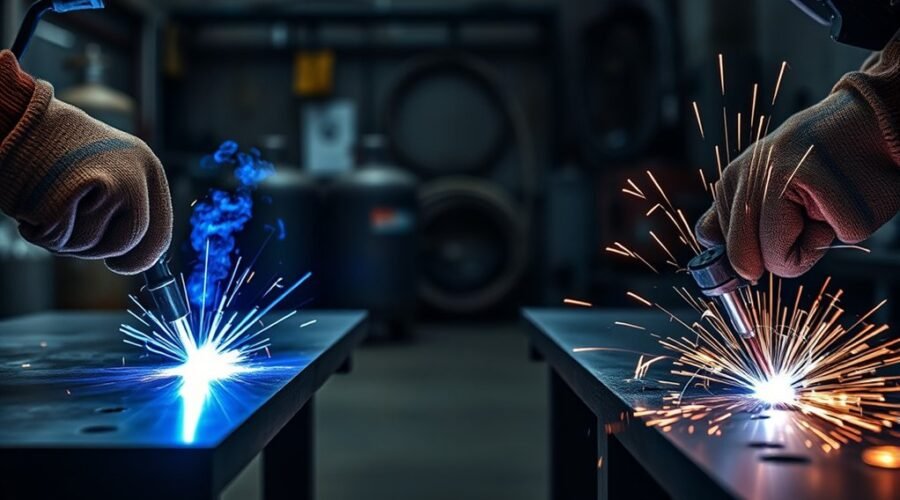
MIG vs MAG welding are two closely related forms of gas metal arc welding (GMAW). In strict MIG/MAG terminology, the deciding difference is the shielding gas: MIG uses an inert gas, while MAG uses an active gas or active-gas mixture. That change affects material suitability, metal transfer, bead shape, spatter, and operating choices.
Quick Answer
Choose MIG in the strict sense when the job needs inert argon or argon-helium shielding, especially for aluminum and other non-ferrous metals. Choose MAG for steels when the shielding contains CO2 or another active component. In the U.S., both are generally grouped under GMAW, and shops often call both processes “MIG.”
Key Takeaways
Key Takeaways
- MIG and MAG use the same basic wire-fed GMAW principle; the shielding gas is what separates the two terms.
- Under ISO terminology, MIG with solid wire is process 131 and MAG with solid wire is process 135.
- A 75% argon/25% CO2 blend is technically MAG because CO2 is an active component, even though many U.S. welders call the process MIG.
- Gas composition influences arc stability, transfer mode, penetration profile, bead shape, spatter, and weld-metal chemistry.
- Many GMAW machines can perform both, but changing materials may also require different wire, feed components, gun setup, and parameters.
What Is MIG Welding?
)
MIG stands for Metal Inert Gas. It is the GMAW variant that shields the arc and molten weld pool with inert gases such as argon, helium, or mixtures of the two.
A continuously fed consumable wire acts as both the electrode and filler metal. The arc forms between that wire and the workpiece, melting the joint while shielding gas flows through the welding gun.
A continuously fed wire creates the arc and supplies filler metal while inert gas protects the molten weld pool.
Because the shielding gas does not intentionally react with the weld pool, MIG is especially useful for aluminum and other non-ferrous metals. TWI’s MIG/MAG process guidance identifies argon, helium, and argon-helium mixtures as typical inert shielding choices.
The process can be manual, mechanized, or automated. Wire feed, voltage, travel speed, joint design, gas coverage, and material preparation still determine the final result. If you are comparing equipment, this MIG welder buying guide covers common machine choices.
What Is MAG Welding?
MAG stands for Metal Active Gas. The equipment and wire-fed arc principle are essentially the same as MIG, but the shielding contains a gas component that interacts with the arc or molten metal.
Common MAG shielding options include carbon dioxide and argon-based mixtures containing CO2 and/or controlled amounts of oxygen. These gases are used extensively for carbon, low-alloy, and other steels.
For solid-wire MAG welding, ISO terminology uses process number 135. MAG is widely suited to mechanized and automated fabrication because GMAW offers continuous wire feeding and high deposition rates. Welders comparing entry-level equipment can also see this beginner welder guide.
MAG Shielding Gases
MAG shielding gas is selected for the metal, transfer mode, welding position, filler wire, and required weld properties. An argon-based mix can contain enough CO2 or oxygen to make the overall shielding system chemically active even though most of the cylinder is argon.
For carbon steel, common choices include argon/CO2 blends and pure CO2. Higher CO2 levels can change penetration, heat transfer, arc behavior, and spatter, so gas choice should follow the qualified procedure or equipment recommendations rather than a single universal formula.
A 75% argon and 25% CO2 blend, commonly called C25, is widely used for short-circuit GMAW on mild steel. However, it should not be treated as the ideal mixture for every transfer mode or every steel.
Active Gas Function
An active shielding component does more than keep air away from the weld. It changes arc characteristics, droplet transfer, weld-pool behavior, penetration profile, oxidation, and potentially the chemistry of the deposited metal.
This is why MAG cannot be reduced to the claim that an active gas simply makes a weld “stronger.” Strength and soundness depend on the complete welding procedure, including filler classification, joint design, heat input, transfer mode, and technique.
- CO2 can produce strong penetration but generally increases spatter compared with suitable argon-rich blends.
- Small active additions to argon can improve arc behavior and wetting on steels.
- The correct mixture depends on the steel grade, wire, transfer mode, and procedure requirements.
Steel Welding Applications
MAG is the usual strict term for solid-wire GMAW on carbon and low-alloy steel because these applications normally use an active shielding mixture. Stainless steel may also use active-gas blends, although the permitted gas composition can be much more restrictive.
Linde’s carbon-steel GMAW guidance notes that pure argon or argon-helium shielding does not provide a stable arc for conventional solid-wire carbon-steel GMAW. Oxidizing argon blends or CO2 are therefore normally used.
Construction, automotive manufacturing, equipment production, and general fabrication all use gas-shielded wire processes. The process can handle thin material or thick sections when the machine, transfer mode, joint design, and procedure are matched correctly.
MIG vs MAG Welding: Key Differences
The strict difference between MIG and MAG is shielding-gas chemistry, not the shape of the welding gun or the basic operating principle. Both are GMAW processes with continuous consumable wire and external gas shielding.
Terminology can cause confusion in North America. The American Welding Society explains that MIG is a nonstandard term for GMAW, and a steel weld made with an argon/CO2 mixture is technically using active shielding rather than purely inert shielding.
| Factor | MIG | MAG |
|---|---|---|
| Shielding gas | Inert argon, helium, or inert mixtures | CO2 or mixtures containing active CO2/O2 components |
| Typical materials | Aluminum and other non-ferrous metals | Carbon, low-alloy, and many high-alloy steels |
| ISO solid-wire process | 131 | 135 |
| Gas effect | Avoids intentional chemical interaction with the weld pool | Active component influences arc, transfer, pool behavior, and weld chemistry |
| Common U.S. wording | “MIG” is often used broadly for GMAW | The term MAG is less commonly used in everyday U.S. shop language |
Neither process has an automatic advantage in strength. The welding procedure, filler, transfer mode, joint preparation, and operator control determine whether the finished joint meets its requirements. Machine capacity and duty cycle are separate equipment considerations.
Shielding Gas Types
Gas type controls much of the difference you see at the arc. Inert argon and helium protect the weld without intentionally reacting with it, while active components such as CO2 or controlled oxygen additions alter transfer and weld-pool behavior.
- Argon: the standard starting point for MIG welding aluminum.
- Argon/helium: an inert combination used where aluminum or other non-ferrous work benefits from different heat characteristics.
- Argon/CO2: a MAG mixture widely used on carbon steel.
- 100% CO2: a MAG option for steel that generally gives deeper penetration and more spatter than C25.
The exact blend should match the wire, metal, transfer mode, and welding procedure rather than being selected by price alone.
Material And Applications
MIG is most clearly distinguished on non-ferrous metals such as aluminum, magnesium, and copper, where inert shielding avoids the problems active gases can cause. The correct wire-feed system is also important because some non-ferrous wires are soft and difficult to push through a long conventional gun liner.
MAG dominates much steel fabrication because active shielding produces the arc behavior required by conventional solid-wire steel GMAW. It can be used on thin sheet, structural fabrication, production components, and thicker multi-pass joints.
The material alone does not determine every setting. Thickness, joint type, welding position, filler wire, transfer mode, and required mechanical properties must all be considered.
Which Gas Should You Use?
Choose shielding gas from the base metal, filler wire, transfer mode, and machine recommendations. There is no single gas that gives the best result on aluminum, carbon steel, and stainless steel.
Warning: Shielding gas does not make welding fumes harmless, and gases can create dangerous atmospheres in confined spaces. Follow applicable ventilation and confined-space controls; OSHA’s welding ventilation requirements include specific controls for enclosed and confined work.
For aluminum, Miller identifies 100% argon as the most common MIG shielding gas. Argon-helium mixtures are another inert option for applications that need different heat-transfer characteristics.
For mild steel, Miller’s mild-steel guidance lists 75% argon/25% CO2 as an all-purpose choice and 100% CO2 as an option that gives deeper penetration with more spatter and a rougher bead.
- Aluminum: 100% argon is the common starting choice.
- Carbon or mild steel: an argon/CO2 blend such as C25 is common; 100% CO2 is another MAG option.
- Stainless steel: use the mixture specified for the grade, wire, machine, and transfer mode because stainless gas combinations vary considerably.
Gas composition affects arc stability, penetration profile, bead shape, spatter, and transfer behavior. Our shielding gas guide and chart provides additional setup context.
MIG for Aluminum, MAG for Steel
“MIG for aluminum, MAG for steel” is a useful starting rule when the terms are used strictly. Aluminum is normally welded with inert argon-based shielding, while carbon steel normally needs a shielding mixture with an active component.
Strictly speaking, aluminum with argon is MIG, while carbon steel with an argon/CO2 blend is MAG.
Aluminum also requires attention to wire feeding. Depending on the machine and wire, a spool gun, push-pull gun, or other aluminum-compatible feeding arrangement may be needed to prevent feeding problems.
Carbon steel behaves differently. Pure argon or an argon-helium inert mixture is generally not used for conventional solid-wire carbon-steel GMAW because it does not provide the desired stable arc and bead characteristics.
That does not mean MAG is only for heavy plate. With short-circuit transfer and suitable settings, it can weld relatively thin steel; with other transfer modes and appropriate equipment, it also handles thicker sections.
If your work regularly switches between metals and processes, multi-process welders may provide more flexibility, but always confirm the machine’s supported wire, gas, gun, and output range.
How Arc Transfer Changes Weld Quality
Metal-transfer mode describes how molten filler moves from the wire into the weld pool. It can affect heat input, spatter, deposition rate, penetration, positional capability, and the thickness range that is practical.
Fronius describes MIG/MAG arc types ranging from low-power short-circuit transfer to higher-power spray and pulsed operation.
- Short-circuit or dip transfer: the wire repeatedly contacts the pool. Its lower-power operating range is useful for thin material, roots, and many out-of-position welds.
- Globular or intermediate transfer: larger droplets and less orderly transfer can produce increased spatter, depending on the gas and parameters.
- Spray transfer: fine droplets cross the arc without repeated short circuits. It supports high deposition and deeper penetration on thicker material but needs suitable gas and operating conditions.
- Pulsed transfer: controlled current pulses detach droplets while reducing average heat compared with continuous high-current spray operation.
Gas composition helps determine which transfer modes are available and stable. A gas that works well for short-circuit steel welding is not automatically the best choice for conventional spray transfer.
Flux-cored arc welding is a different process family rather than another MIG/MAG transfer mode. If you are comparing wire choices, this flux-core welding wire guide covers that separate option.
Can One Machine Do Both?
Yes, many GMAW power sources can perform both MIG and MAG because the core process is the same. However, switching from one material and gas combination to another may involve more than changing the cylinder.
The machine must support the required output and transfer mode. You also need the correct filler wire, shielding gas, drive rolls, liner or feed system, contact tip, gun arrangement, and parameter settings for the metal.
For example, moving from steel MAG welding to aluminum MIG welding can require different wire and an aluminum-compatible feeding system. The same steel filler wire should not simply be retained because both processes use a continuously fed electrode.
Modern synergic machines may store separate programs for material, wire diameter, and shielding gas. Simpler machines rely on the operator to set voltage and wire-feed speed manually.
Check the machine manual before changing gases or materials. A power source being sold as a “MIG welder” does not guarantee that every MIG/MAG material, wire size, gun, or transfer mode is supported.
When to Choose MIG or MAG
Choose between strict MIG and MAG terminology by starting with the metal and the gas that metal requires. Then confirm the wire, transfer mode, machine capacity, joint design, and procedure specifications.
- Choose MIG for aluminum and other non-ferrous work that requires inert argon or argon-helium shielding.
- Choose MAG for carbon and alloy steel when CO2 or an argon blend with an active component is specified.
- Do not choose by penetration alone. Gas mixture, transfer mode, current, voltage, wire, and joint design all influence fusion.
- Protect the shielding gas outdoors. Wind can remove gas coverage and cause porosity in either process.
Gas-shielded GMAW is therefore less convenient in exposed windy conditions unless the work area can be protected. Self-shielded flux-cored or another suitable process may be more practical for some field jobs.
Note: For structural, pressure, code-governed, or safety-critical work, follow the approved welding procedure and qualification requirements for the job. Gas choice by itself does not establish an acceptable welding procedure.
If you are deciding between wire-fed GMAW and tungsten-based TIG rather than MIG versus MAG, this TIG welder guide covers equipment for that separate process.
Frequently Asked Questions
What Is Better, MIG or MAG Welding?
Neither MIG nor MAG is universally better. Strict MIG is the natural choice when inert shielding is required, especially for aluminum and other non-ferrous metals, while MAG is the normal choice for many steels. The better process is the one whose gas, filler, transfer mode, and procedure match the material and joint.
What Pays More, TIG or MIG?
There is no reliable national rule that TIG welding always pays more than MIG welding. The U.S. Bureau of Labor Statistics reports welder earnings as a broader occupation rather than separating wages by TIG and MIG. Pay varies with skill, industry, location, qualifications, experience, and responsibility.
What Is MIG Welding Not Good For?
Gas-shielded MIG/GMAW is poorly suited to unprotected windy conditions because moving air can strip shielding gas from the arc and cause porosity. Strict inert-gas MIG is also not the normal choice for carbon steel. GMAW itself can weld thick material, so thickness alone is not a valid reason to rule it out.
Is MAG the Same as MIG?
No, MIG and MAG are not identical under strict terminology, although both belong to the GMAW family and use the same basic wire-fed arc principle. MIG uses inert shielding, while MAG uses shielding with an active component. In everyday U.S. shop language, both are often casually called MIG welding.
Is 75% Argon and 25% CO2 MIG or MAG?
A 75% argon and 25% CO2 mixture is technically MAG shielding because the CO2 component is active. The mixture is commonly called C25 and is widely used for short-circuit welding of mild steel. In the United States, many welders still refer to welding with this mixture simply as MIG or GMAW.
Can You Use 100% Argon to MIG Weld Steel?
Pure argon is generally not the correct shielding choice for conventional solid-wire carbon-steel GMAW. Carbon steel normally needs an oxidizing active component such as CO2 or oxygen in the shielding system for suitable arc and bead behavior. Use the gas specified for the wire, steel grade, machine, and welding procedure.
Conclusion
MIG and MAG use the same basic GMAW equipment concept, but their shielding gases serve different metallurgical purposes. Start with the metal and required gas, then match the filler, transfer mode, machine, and procedure; that approach is more reliable than choosing between MIG and MAG by name alone.
Sources
- TWI — Gas Metal Arc Welding (MIG/MAG): MIG/MAG definitions, ISO process numbers, shielding gases, and transfer modes.
- American Welding Society — What’s Wrong with MIG and TIG?: AWS terminology and the distinction between inert and active shielding in U.S. usage.
- MillerWelds — MIG Welding for Mild Steel: C25 and 100% CO2 characteristics for mild steel.
- MillerWelds — Shielding Gas Guide: aluminum, stainless, gas coverage, and outdoor shielding guidance.
- Linde — MAG Welding of Carbon Steels: active gas mixtures and limitations of inert argon shielding on carbon steel.
- Fronius — MIG/MAG Welding: gas selection, suitable materials, and arc-transfer types.
- Occupational Safety and Health Administration — Welding Ventilation: ventilation and confined-space controls for welding operations.
- U.S. Bureau of Labor Statistics — Welders, Cutters, Solderers, and Brazers: occupational pay reporting and factors affecting welder earnings.