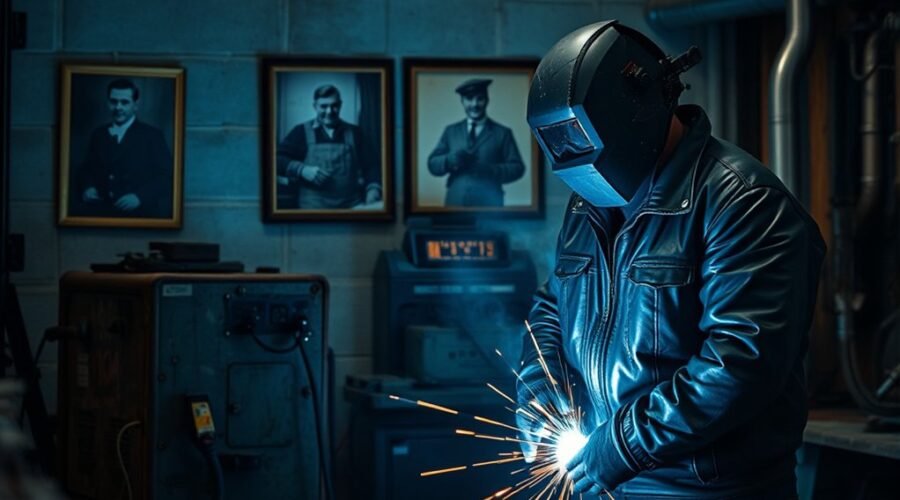
Heliarc welding is the historical name tied to the development of modern TIG welding, or Gas Tungsten Arc Welding (GTAW). The process uses a non-consumable tungsten electrode and inert shielding gas to produce controlled, clean welds. Its early success with magnesium aircraft parts helped establish a welding method that is still widely used today.
Quick Answer
Heliarc welding is the historical name for the process now called TIG welding or GTAW. It uses a non-consumable tungsten electrode and an inert shielding gas to make precise welds; filler metal is added separately when needed. The original process used helium, while modern TIG most often uses argon.
Last checked: September 28, 2026. Dates and figures were verified against official sources.
Key Takeaways
- Russell Meredith filed his tungsten-and-helium welding torch patent in 1941; U.S. Patent 2,274,631 was issued on February 24, 1942.
- GTAW can make a weld with separately added filler metal or, on suitable joints, without filler at all.
- Argon gives easier arc starting and good stability, while helium produces greater heat input and deeper penetration.
- AC TIG is commonly used for aluminum, while DCEN is commonly used for steel and many steel alloys.
- TIG produces little spatter, but its clean-looking arc does not eliminate hazards from radiation, fumes, gases, or hot metal.
What Is Heliarc Welding?
)
Heliarc welding is an early name for the process now generally called TIG or GTAW. According to the American Welding Society description of GTAW, an arc forms between a non-consumable tungsten electrode and the workpiece while inert gas protects the weld pool from atmospheric contamination.
The tungsten carries the arc but normally does not become the filler metal. If the joint needs additional metal, the welder feeds a separate filler rod into the molten pool. Some close-fitting joints can instead be welded autogenously, meaning the base metal is fused without added filler.
This separation of the heat source from the filler metal gives the operator fine control over the weld pool. GTAW is therefore well suited to thin sections, precision joints, reactive metals, and work where bead appearance or contamination control matters.
TIG also demands coordination. The welder may control the torch with one hand, feed filler with the other, and adjust amperage with a foot pedal or torch control. If you are still choosing a process, this beginner welder guide explains where TIG fits alongside MIG and stick welding.
Why Heliarc Is Called GTAW Today
Heliarc, TIG, and GTAW describe the same basic welding principle, but the names come from different periods. Heliarc is the historical name associated with the original helium-shielded process, TIG means Tungsten Inert Gas, and GTAW is the technical term commonly used in American welding standards and documentation.
Russell Meredith developed the production process while working on the problem of welding magnesium aircraft structures. His U.S. Patent 2,274,631 was filed on January 4, 1941 and issued on February 24, 1942. The patent describes striking an electric arc between a tungsten rod and magnesium while helium protects the welding region.
The process built on earlier work with inert-gas-shielded tungsten arcs, but Meredith’s system made the method practical for difficult magnesium fabrication. The Heliarc name reflected its combination of helium shielding and an electric arc.
As the process spread to more materials and shielding gases, the broader GTAW name became more useful. Modern GTAW is not defined by helium alone, so a specification that says TIG or GTAW can call for argon, helium, or a mixture depending on the welding procedure.
Heliarc Welding Equipment and Shielding Gas
A modern Heliarc or TIG setup needs a constant-current power source, TIG torch, tungsten electrode, shielding-gas supply, work lead, and appropriate controls. Filler rod is added separately when the joint design or welding procedure requires it.
A typical setup also includes a regulator or flowmeter and may use a foot pedal or fingertip amperage control. Air-cooled torches are common for lighter work, while water-cooled torches help manage heat during sustained higher-output welding.
The Miller TIG setup guide lists AC for aluminum and DC TIG or DCEN for steel and steel alloys as common starting configurations. Exact polarity, amperage, tungsten type, and preparation still depend on the base material, machine, and qualified welding procedure.
Modern machines may also provide pulse-control features that cycle welding current between higher and lower levels. These controls can help manage heat input on suitable applications, but they do not replace correct joint preparation or shielding.
Argon vs. Helium for Heliarc Welding
Helium gave Heliarc its name, but 100% argon is the common all-around shielding gas for modern TIG welding. The gases behave differently, so the best choice depends on the base metal, thickness, heat input, and welding procedure.
| Gas | Arc characteristics | Typical reason to use it |
|---|---|---|
| Argon | Easy arc starting, stable arc, focused cone, lower gas-flow demand | General TIG work across many materials |
| Helium | Higher arc voltage and heat input, deeper penetration, less stable low-amperage starting | Jobs that benefit from additional heat or faster travel |
| Argon/helium mixture | Characteristics between pure argon and pure helium | Combining added heat with better starting and stability than pure helium |
Miller’s TIG shielding-gas guidance identifies argon as the most common TIG gas because of its availability, cost, starting characteristics, and arc stability. Helium remains useful where greater heat input and penetration are beneficial. This also explains why choosing the correct shielding gas composition matters even though that linked guide focuses on MIG welding.
Warning: A clean-looking TIG arc is not harmless. Protect your eyes and skin from arc radiation, control welding fumes with suitable ventilation or extraction, and use correctly selected respiratory protection where exposure controls require it.
Metals Commonly Welded With Heliarc
Heliarc welding can join many weldable metals because heat input and filler addition can be controlled independently. It is especially useful on aluminum, magnesium, stainless steel, carbon steel, titanium, and other alloys where cleanliness or precise control matters.
- Aluminum: TIG is widely used for clean, controlled joints, particularly on thinner material and visible fabrication.
- Magnesium: this was a central material in the development of the original Heliarc process.
- Stainless steel: GTAW provides precise control and can produce smooth joints with minimal spatter.
- Carbon and low-alloy steel: TIG is useful for precise fabrication and root passes even though faster processes may be preferred for high deposition rates.
- Titanium: TIG can produce sound joints, but cleanliness and complete inert-gas shielding of hot metal are especially important.
For titanium, the challenge is not that the metal is inherently impossible to weld. TWI’s titanium welding guidance explains that oxygen, nitrogen, hydrogen, moisture, and surface contamination can reduce ductility and cause embrittlement if shielding and preparation are inadequate.
The right material, machine capability, filler, current type, and joint design should therefore be matched to the actual welding needs rather than assuming one TIG setup suits every alloy.
Advantages and Limitations of Heliarc Welding
Heliarc welding is valued for control and weld quality rather than maximum deposition speed. Its strengths make it useful for precision work, but the process can be slower and more skill-dependent than MIG or other high-production methods.
Main Advantages
- Precise heat control: the operator can closely manage the weld pool and heat input.
- Little or no spatter: the tungsten electrode is not continuously consumed into the joint.
- Optional filler metal: suitable joints can be fused without added filler.
- Clean weld area: there is no flux slag to remove after normal GTAW.
- Broad material range: the process can be applied to many steels, non-ferrous metals, and reactive alloys with the correct procedure.
Main Limitations
- Slower deposition: adding filler separately is generally less productive than continuously fed wire processes for heavy fill work.
- Higher skill demand: torch angle, arc length, filler timing, travel speed, and amperage must work together.
- Sensitive shielding: drafts, contamination, or poor gas coverage can quickly affect weld quality.
- Surface preparation matters: oil, oxide, moisture, and cross-contamination can create defects or degrade sensitive alloys.
Common TIG Welding Applications Today
Modern TIG welding is used where weld quality, control, cleanliness, or material compatibility outweigh the need for the fastest possible deposition rate. The American Welding Society identifies aerospace, nuclear, marine, petrochemical, and semiconductor manufacturing among important GTAW users.
In aerospace fabrication, TIG can join lightweight and high-performance alloys while giving the operator close control of the weld pool. The process’s aircraft roots explain why Heliarc remains familiar terminology among experienced fabricators.
In pipe and petrochemical work, GTAW is commonly used where controlled root passes and clean internal profiles are required. It can be followed by another welding process when faster fill and cap deposition is more economical.
In food and beverage fabrication, TIG is widely used on stainless-steel piping, tanks, and equipment because it can make smooth, controlled joints without flux slag.
In automotive and motorsport fabrication, the process suits exhausts, aluminum components, stainless parts, and visible joints where appearance and heat control matter.
GTAW also remains relevant to space-related fabrication. NASA maintains welding procedures that include gas tungsten arc welding for several metals and hardware applications, illustrating how the process extends well beyond its original 1940s aircraft role.
The same basic process is available on industrial machines and smaller workshop systems. A machine in the TIG welders under $1,000 category still uses the same tungsten-arc and shielding-gas principle, although available output, duty cycle, AC capability, controls, and accessories can differ.
Frequently Asked Questions
Is Heliarc the Same as TIG?
Yes. In modern use, Heliarc, TIG, and GTAW refer to the same basic gas tungsten arc welding process. Heliarc is the historical trade name tied to helium shielding, TIG is the common shop term, and GTAW is the technical name used by the American Welding Society.
Why Do Welders Drink Milk After Welding?
Some welders drink milk because of an old belief that it protects against welding fumes, but evidence does not support that claim. Cancer Council Australia explains that milk does not prevent metal fume fever. Fume control depends on ventilation, extraction, safe work practices, and appropriate respiratory protection.
What Two Metals Cannot Be Welded Together?
There is no universal pair of metals that can simply be labeled impossible to join by every welding process. Some combinations are extremely difficult with conventional fusion welding. For example, TWI explains why aluminum-to-steel fusion welding is difficult, while specialized interlayers, brazing, friction welding, or other processes can sometimes make a usable joint.
What’s the Hardest Metal to Weld?
There is no single metal that is universally the hardest to weld. Titanium is demanding because hot titanium readily absorbs atmospheric contaminants, but it is weldable with correct preparation and shielding. Cast iron, high-carbon steels, aluminum alloys, and other materials present different problems involving cracking, oxide control, heat input, or filler selection.
Does Heliarc Welding Require Helium?
No. The original Heliarc process used helium, but modern TIG or GTAW does not require helium. Argon is now the common all-around choice because it provides easy arc starting and good stability. Helium or argon-helium mixtures are still used when the welding procedure benefits from greater heat input or penetration.
Conclusion
Heliarc welding is the historical foundation of the modern TIG/GTAW process. Its defining principle is not helium alone but the combination of a non-consumable tungsten electrode, a controlled arc, and inert shielding around the weld area. Today, argon is more common for general TIG work, while helium remains useful when additional heat and penetration are needed.
For safe use, remember that TIG’s low-spatter appearance does not remove exposure risks. NIOSH guidance on welding fumes emphasizes controlling inhalation hazards, while proper eye, skin, electrical, gas-cylinder, and hot-metal precautions remain essential.
Sources
- American Welding Society: GTAW definition, filler use, shielding gas, and industrial applications.
- U.S. Patent 2,274,631: Russell Meredith’s filing and patent dates, magnesium application, tungsten electrode, and helium shielding.
- Miller TIG Welding Basics: typical TIG equipment and AC/DC setup guidance.
- Miller Shielding Gas Guidance: argon, helium, and argon-helium characteristics.
- NIOSH Welding Fumes and Manganese: welding-fume exposure and health protection context.
- Cancer Council Australia: evidence regarding the milk-and-welding-fume myth.
- TWI: Welding Aluminum to Steel: dissimilar-metal fusion-welding limitations and alternative joining methods.
- TWI: Welding Titanium and Its Alloys: contamination, shielding, and titanium weldability.