
Passive welding helmets suit welders who want fixed-shade protection without batteries, sensors or electronic settings. The main trade-offs are viewing area, headgear comfort, shell design and whether the hood accepts future lens or hard-hat upgrades.
Jackson Safety HLX 100 is the top pick because its 6-ounce shell combines a 4.5 × 5.25-inch viewing area with Jackson’s 370 Speed Dial headgear. For a simpler budget-friendly option, ArcOne Hawk H-0300 uses a compact 2 × 4-inch passive layout.
We checked current manufacturer specifications, exact linked models, major-retailer availability and recall records before rebuilding these picks.
Passive Welding Helmets Compared
| Product | Best for | Lens | Viewing area | Headgear | Score |
|---|---|---|---|---|---|
|
Premium
|
Best overall | Shade 10 passive | 4.5 × 5.25 in. | 370 Speed Dial | 95/100 |
| Simple fixed-shade use | Shade 10 passive | 4.5 × 5.25 in. | Ratcheting | 86/100 | |
|
Premium
|
Matching helmets for crews | Shade 10 passive | 4.5 × 5.25 in. | 370 Speed Dial | 80/100 |
|
Mid-range
|
Best backup | Shade 10 passive | 4 × 4 in. | Ratchet | 90/100 |
|
Budget
|
Best value | Shade 10 passive | 2 × 4 in. | Economical ratchet | 78/100 |
Passive Welding Helmets: Our Top Picks
1. Jackson Safety HLX 100

Bottom line: The Jackson Safety HLX 100 is the best fit here for long sessions when you want a large fixed-shade window without a heavy shell. It also gives you a clear upgrade path for compatible Jackson ADFs and hard-hat adapters.
- Lens: Shade 10 passive, simple battery-free protection
- Viewing area: 4.5 × 5.25 in., broad sightline around the weld
- Headgear: 370 Speed Dial, quick ratcheting fit adjustment
- Shell: 6 oz nylon Hydraflex design, reduces shell weight
- Standards: ANSI Z87.1 and CSA Z94.3 compliant
The current Heavy Metal version is manufacturer SKU 20508. Jackson lists the shell at 6 ounces and uses a fixed-front shade 10 polycarbonate filter. The 23.63-square-inch viewing area is the largest format shared by the Jackson helmets in this roundup.
The 370 Speed Dial gives you a ratcheting adjustment instead of a basic strap system. Jackson also lists the HLX 100 as compatible with its 187-S hard-hat adapter and several Jackson auto-darkening filters, so the shell can stay useful if your setup changes.
The catch is that it remains a fixed-shade hood in this configuration. You still need to lift the hood to see normally between welds unless you install a compatible ADF.

- Very light 6-ounce shell
- Large 4.5 × 5.25-inch viewing area
- 370 Speed Dial ratcheting headgear
- Jackson lists both hard-hat and ADF adaptability
- Fixed shade 10 does not cover every welding condition
- Compatible ADFs and hard-hat hardware are separate upgrades
2. Jackson Safety 951P
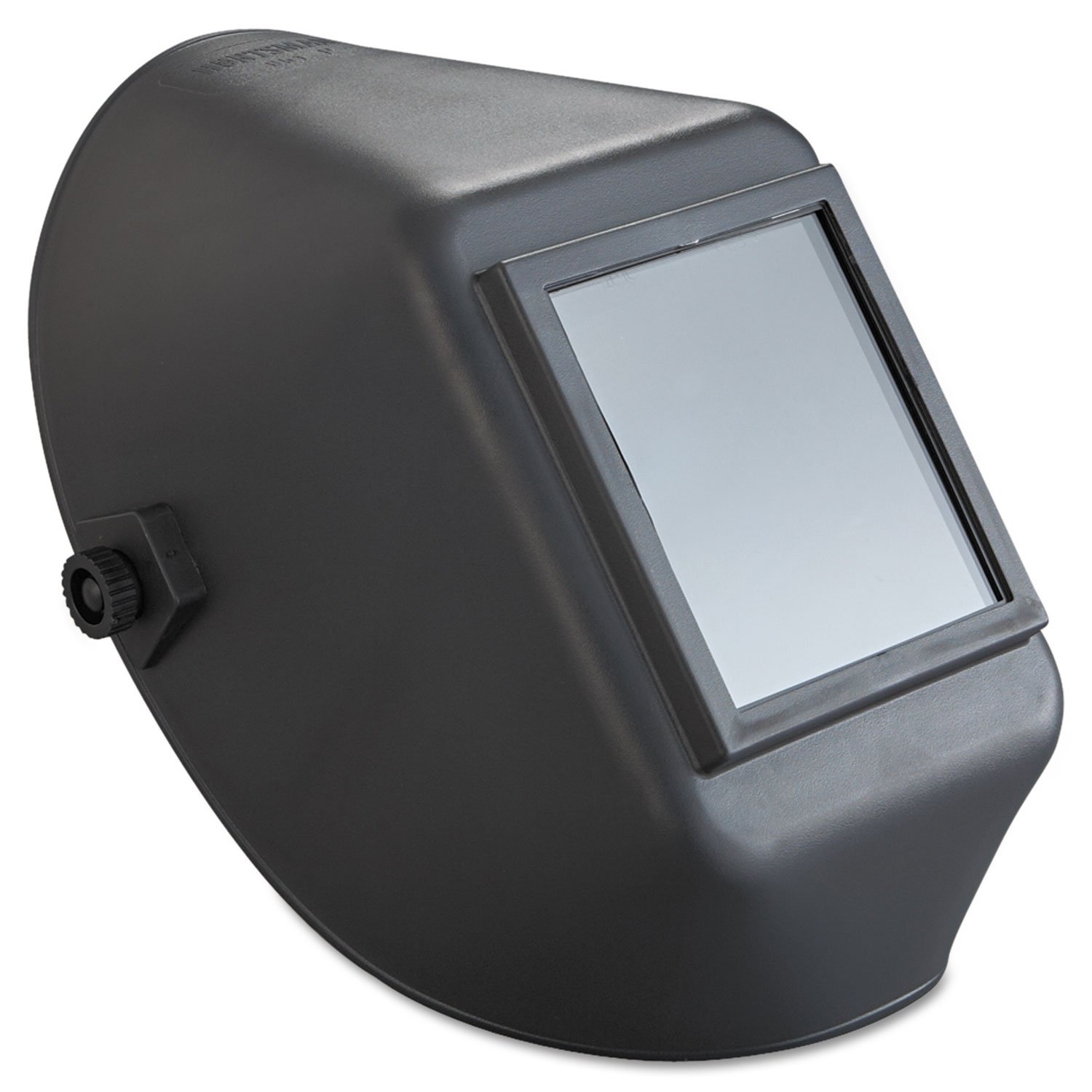
Bottom line: The Jackson Safety 951P is a simple fixed-front shade 10 helmet with a large 4.5 × 5.25-inch window. Its appeal is straightforward passive protection with no batteries, sensors or electronic controls.
- Lens: Shade 10 passive, fixed-front setup
- Viewing area: 4.5 × 5.25 in., wide view for a passive hood
- Headgear: Ratcheting, adjustable fit
- Shell: Thermoplastic, washable fixed-front construction
- Standards: ANSI Z87.1 and CSA Z94.3 compliant
Jackson’s current specification page for SKU 14535 lists a 23.63-square-inch viewing area, a shade 10 IR passive filter and a thermoplastic shell. That makes the 951P easy to understand: there are no sensitivity, delay or battery settings to manage.
The large window is its main practical advantage. The fixed-front design also keeps the lens system mechanically simple, but you give up the convenience of a variable-shade filter unless you use a compatible approved upgrade.
- Large 4.5 × 5.25-inch viewing area
- Simple shade 10 fixed-front design
- Ratcheting headgear
- ANSI Z87.1 and CSA Z94.3 compliant
- Fixed-front setup requires lifting the hood for normal visibility
- Fixed shade limits flexibility across changing processes
- No electronic light state for setup and inspection
3. Jackson Safety HSL-100

Bottom line: The Jackson Safety HSL-100 is the team pick when you need matching fixed-shade helmets in a four-pack. Its narrow shell, extended front and 370 Speed Dial suit training rooms and crews that want the same fit system across multiple hoods.
- Lens: Shade 10 passive, fixed-front protection
- Viewing area: 4.5 × 5.25 in., 23.63 sq. in. total
- Headgear: 370 Speed Dial, ratcheting adjustment
- Shell: Thermoplastic, narrow profile for tight spaces
- Standards: ANSI Z87.1 and CSA Z94.3 compliant
Jackson identifies this model as HSL-100, SKU 14975. The manufacturer highlights the narrow shell for tight work and an extended front intended to increase protection around the neck from sparks and slag.
The helmet uses the same 4.5 × 5.25-inch shade 10 filter size as the larger-window Jackson models above. Jackson also lists a dedicated hard-hat adapter for the HSL-100, which can matter in shops where head protection is part of the required PPE system.
- Narrow shell is designed for tighter work areas
- Large 4.5 × 5.25-inch passive window
- 370 Speed Dial ratcheting headgear
- Hard-hat adapter option listed by Jackson
- Four-pack format is unnecessary if you only need one helmet
- Fixed shade 10 is less flexible than variable-shade optics
- Buying four matching helmets only makes sense for group use
4. Miller MP-10

Bottom line: The Miller MP-10 is the strongest backup pick if you want a battery-free hood with a familiar 4 × 4-inch viewing area. Its nylon shell, ratchet headgear and standard passive lens system keep maintenance straightforward.
- Lens: Shade 10 passive, industry-standard filter format
- Viewing area: 4 × 4 in., centered general-purpose view
- Headgear: Ratchet assembly, replaceable adjustment hardware
- Shell: 16 oz nylon helmet, durable simple construction
- Upgrade: Magnifying lens holder and documented ADF option
Miller currently lists the MP-10, part 238497, as a passive non-auto-darkening helmet with a 16-square-inch viewing field. Its current product specification gives a 16-ounce helmet weight and a nylon shell, correcting the heavier figure shown in the legacy comparison table retained below.
The MP-10 also has a magnifying-lens holder. Miller’s parts literature lists replacement ratchet headgear components, cover lenses and an optional Digital Elite auto-darkening upgrade, which makes the shell more serviceable than a throwaway backup hood.
Its 4 × 4-inch view is smaller than the 4.5 × 5.25-inch Jackson windows, so choose it for simplicity rather than maximum field of view.
- Battery-free shade 10 lens
- 4 × 4-inch viewing field
- 16-ounce nylon helmet
- Replaceable ratchet headgear and lens components
- Magnifying-lens holder
- Smaller view than the 4.5 × 5.25-inch Jackson helmets
- Fixed shade requires lifting the hood for normal visibility
- ADF upgrade is a separate purchase
5. ArcOne Hawk H-0300

Bottom line: The ArcOne Hawk H-0300 is the value pick for welders who prefer a compact 2 × 4-inch passive format. ArcOne describes the Hawk shell as lightweight with strong head, neck and ear coverage for general welding.
- Lens: Shade 10 passive, fixed-front configuration
- Viewing area: 2 × 4 in., compact standard-format window
- Headgear: 04-HG economical ratchet, replaceable assembly
- Coverage: Head, neck and ear coverage, general welding focus
- Upgrade: ArcOne lists compatible 2 × 4 ADF options
ArcOne’s Hawk page identifies the black shell as 0300 and specifies a 2 × 4-inch viewing area with 03-OP inside and outside cover plates. The 04-HG replacement headgear uses an economical ratchet and cloth sweatband.
The smaller view is the trade-off. It gives you a compact hood, but you do not get the wider peripheral view of the Jackson HLX 100. ArcOne does list several compatible 2 × 4 auto-darkening filters for the shell, so you can change the optics later without abandoning the helmet.
- Compact 2 × 4-inch passive format
- ArcOne describes the Hawk as one of its lightest helmet shells
- Replaceable ratchet headgear and cover plates
- Compatible ArcOne 2 × 4 ADF options
- Smaller viewing area than the other verified picks
- Fixed shade 10 in the passive configuration
- Premium headgear features are limited
Jackson Safety HLX 100 vs ArcOne Hawk H-0300: Is the Upgrade Worth It?
The core trade-off is viewing space and headgear versus a simpler, lower-cost 2 × 4 format. The HLX 100 gives you more window area and Jackson’s 370 Speed Dial; the Hawk keeps the design compact.
- Viewing area: HLX 100 uses 4.5 × 5.25 inches; Hawk uses 2 × 4 inches.
- Headgear: HLX 100 uses the 370 Speed Dial; Hawk uses ArcOne’s economical 04-HG ratchet.
- Shell focus: HLX 100 emphasizes a 6-ounce Hydraflex shell; ArcOne emphasizes light weight and broad head, neck and ear coverage.
- Upgrade path: Both manufacturers list compatible auto-darkening filter options for these shells.
Which Passive Welding Helmet Should You Buy?
- Long sessions and a wide view: get the Jackson Safety HLX 100.
- Matching helmets for a crew or class: get the Jackson Safety HSL-100 four-pack.
- Budget-friendly 2 × 4 simplicity: get the ArcOne Hawk H-0300.
- Reliable battery-free backup: get the Miller MP-10.
- Future ADF conversion: compare the approved filter options for the Jackson Safety HLX 100, Miller MP-10 and ArcOne Hawk H-0300 before buying.
How We Chose
- Exact model verification: We matched linked ASINs and model numbers where reliable listings were available.
- Protection and optics: We prioritized fixed-shade filter specifications, viewing area, shell coverage and published safety compliance.
- Comfort and serviceability: We compared shell weight where the manufacturer publishes it, headgear design and replacement-part support.
- Current status: We checked manufacturer pages, major-retailer listings, Amazon-linked model data and public recall sources before keeping products in the recommendations.
- No invented testing: Rankings use published specifications and current product evidence, not claimed hands-on tests.
Passive Welding Helmet Buying Guide
Fixed Shade vs. Auto-Darkening
A passive helmet stays dark all the time, so you usually lift it for setup and inspection. That removes batteries and sensors from the equation, but it also removes the light state and variable shade found on an ADF. If you want passive simplicity now with an upgrade path later, the Jackson Safety HLX 100 has manufacturer-listed ADF compatibility.
Viewing Area
Choose the window size that matches how much peripheral visibility you need. A 4.5 × 5.25-inch window gives more surrounding view than a 2 × 4-inch lens, while a compact window can suit welders who prefer a smaller fixed-front format. The Jackson Safety HLX 100 has the largest verified viewing area among the recommended picks here.
Headgear and Shell Weight
Headgear matters because a good shell can still feel tiring if the suspension slips or creates pressure points. Look for ratcheting adjustment and replaceable parts. Published weight figures should come from the exact model, not a marketplace shipping weight. Jackson lists the Jackson Safety HLX 100 shell at 6 ounces, while Miller lists the Miller MP-10 helmet at 16 ounces.
Lens and Cover-Plate Availability
Passive hoods are inexpensive to maintain only when the correct filter and cover plates remain easy to source. Check the part numbers before committing to an older shell. Miller publishes replaceable lens, gasket and headgear parts for the Miller MP-10, while ArcOne lists 03-OP cover plates for the ArcOne Hawk H-0300.
Hard-Hat and Respirator Compatibility
If your job requires a hard hat or respirator, treat compatibility as a fit-and-safety requirement rather than an afterthought. Jackson lists a specific hard-hat adapter for the Jackson Safety HLX 100. For respirators, confirm clearance with both PPE manufacturers and make sure the helmet can move through its full range without breaking the respirator seal.
Safety Standards and Shade Selection
A certified helmet still needs the correct filter shade for the welding process and current. Fixed shade 10 is common on these passive models, but it is not a universal setting. Follow the welding-equipment maker’s shade guidance and workplace safety requirements, and keep safety glasses on under the helmet when required.
Mistakes to Avoid When Buying Passive Welding Helmets
- Buying by shell looks alone: compare the viewing area, headgear and replacement parts first.
- Assuming shade 10 fits every job: match the shade to process and current before welding.
- Using shipping weight as helmet weight: rely on exact manufacturer specifications where available.
- Forcing an ADF retrofit: use only filter systems the helmet and ADF makers list as compatible.
- Ignoring PPE fit: test hard-hat, respirator, safety-glasses and helmet clearance together.
FAQs
Are passive welding helmets safe?
Yes, passive welding helmets can provide proper eye and face protection when the helmet, filter shade and safety plates match the welding process. The five models here use fixed shade 10 filters, but shade 10 is not correct for every process or amperage. Follow your equipment maker’s shade guidance and wear the required safety glasses underneath the hood.
What shade should a passive welding helmet have?
The correct shade depends on the welding process and current, so there is no single shade for every job. These helmets ship with fixed shade 10 filters, which suits many common welding tasks. If your work spans very different amperages or processes, an approved variable-shade filter may be more practical than one fixed lens.
Passive vs. auto-darkening: which is better?
Passive helmets are simpler because they use a fixed dark filter with no sensors or batteries. Auto-darkening helmets let you see the work before and after the arc without lifting the hood, and many offer adjustable shades. Choose passive for simple, predictable operation; choose auto-darkening when frequent starts, position changes or variable processes make convenience more important.
Are passive helmets good for TIG and low-amperage work?
They can be, but the filter shade still has to match the TIG current and process. A passive lens cannot fail to darken because of sensor placement, which removes one electronic variable. However, a fixed shade 10 lens may be darker than you want for some low-current work, so check the applicable shade guidance before welding.
Can you put an auto-darkening lens in a passive welding helmet?
Sometimes. Compatibility depends on the shell, filter opening and the ADF model. The Jackson Safety HLX 100 is specifically listed by Jackson as ADF adaptable, and Miller documents an optional auto-darkening upgrade for the MP-10. Never force an ADF into a shell that the helmet or filter manufacturer does not list as compatible.
How large should a welding helmet viewing area be?
A larger window can make it easier to see the joint, nearby work and awkward positions, but it is not automatically better for every welder. The Jackson Safety HLX 100 uses a 4.5 × 5.25-inch viewing area, the Miller MP-10 uses 4 × 4 inches, and the ArcOne Hawk uses a compact 2 × 4-inch format.
When should you replace a passive welding helmet lens?
Replace cover plates when scratches, pitting, spatter or haze make the work harder to see, and replace a damaged filter or safety plate immediately. Inspect the shell, headgear and lens-retaining parts before use. If any component is cracked, loose or heat-damaged, use the manufacturer’s approved replacement part rather than improvising a repair.
Customer Preferences
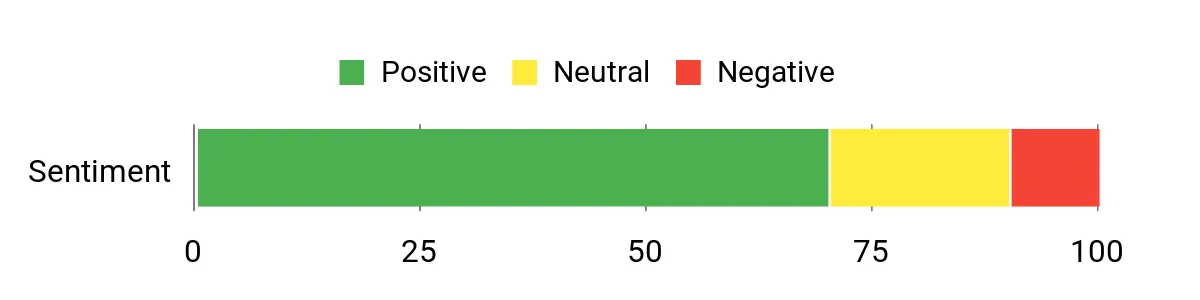
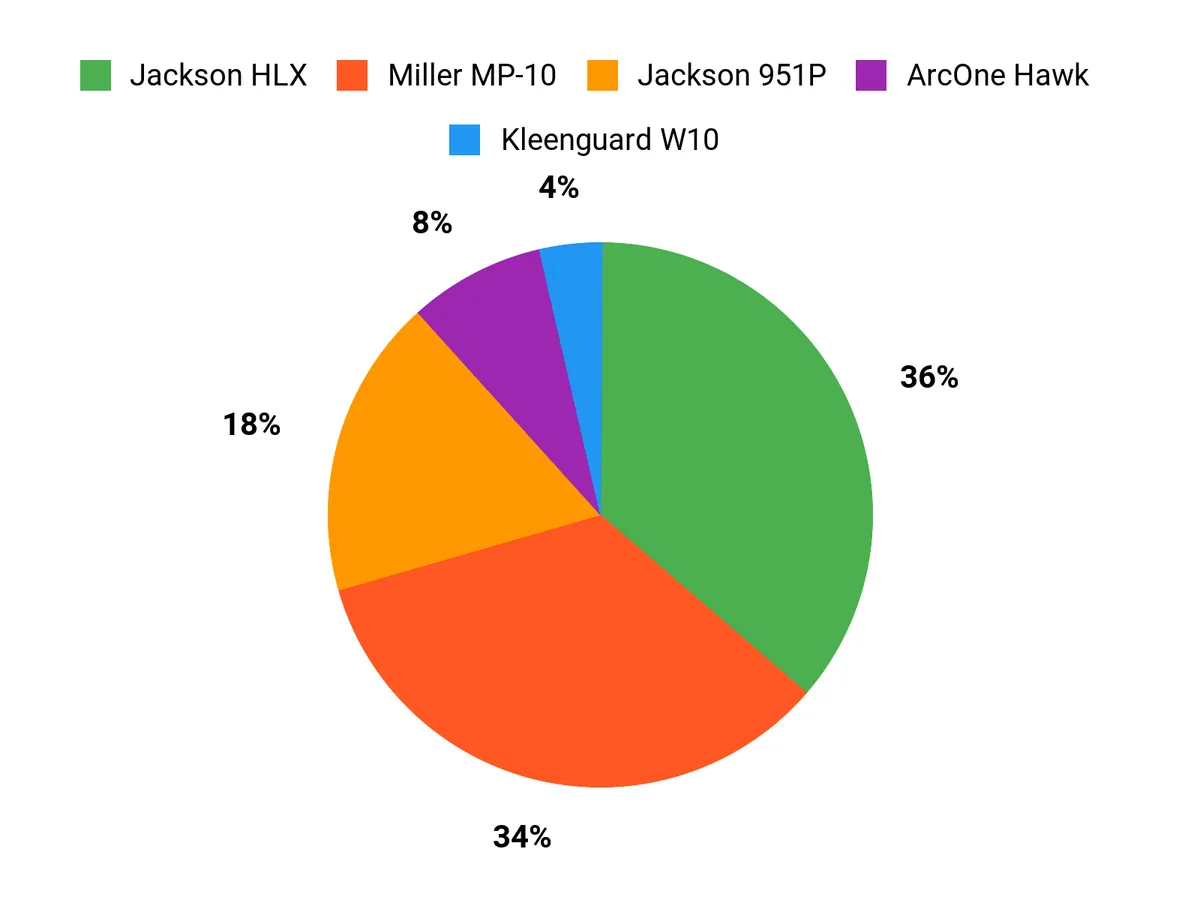
Most buying decisions in this category come down to three practical choices: how much viewing area you want, how the headgear feels over a full session, and whether you want a shell that can accept approved upgrades. A fixed-shade hood is most useful when its fit and lens format match the work you do repeatedly.
Final Verdict
Among the currently verified passive welding helmets in this roundup, the Jackson Safety HLX 100 offers the strongest mix of low shell weight, a large viewing area and adjustable headgear. Its fixed shade keeps operation simple, while Jackson’s listed ADF and hard-hat compatibility gives the shell room to grow.
For a lower-cost compact format, the ArcOne Hawk H-0300 is the value choice; for a simple shop spare, the Miller MP-10 is the backup pick.
See the ArcOne Hawk H-0300 value pick or the Miller MP-10 backup pick if those use cases fit your work better.
| Product Name | Image | Rating | Weight | Material | View Area |
|---|---|---|---|---|---|
| Jackson Safety HLX100 Passive Welding Helmet |
|
4.7/5 (232 reviews) | 6 ounces | Metal | 4.5″ x 5.25″ |
| Jackson Safety 138-14535 Passive Welding Helmet |
|
4.5/5 (33 reviews) | 13.12 ounces | Plastic | 4.5″ x 5.25″ |
| Jackson Safety 14975 W10 HSL 100 Passive Welding Helmet |
|
5.0/5 (2 reviews) | N/A | Plastic | 4.5″ x 5.25″ (pack of 4) |
| Miller 238497 MP-10™ Passive Welding Helmet |
|
4.6/5 (207 reviews) | 1.7 pounds | Other | 4″ x 4″ |
| ArcOne H-0300 Black Hawk Passive Welding Helmet |
|
4.3/5 (8 reviews) | 0.27 pounds | Polycarbonate | N/A |