Thermite welding is a fusion process that uses a powerful exothermic chemical reaction to create molten metal for joining parts. It is best known for welding railroad rails in the field, but related exothermic systems are also used for permanent electrical grounding and bonding connections. Its portability is a major advantage, but the very high heat means preparation, approved consumables, and strict safety controls matter as much as the reaction itself.
Quick Answer
Thermite welding joins metal by using an aluminothermic reaction to create intensely hot molten metal that flows into a prepared mold around the joint. It needs no welding power source at the joint, which makes it useful for field rail work and electrical connections, but trained operators and approved procedures are essential.
Key Takeaways
- Rail thermite welding uses an aluminothermic reaction to produce molten weld metal that fills a refractory mold around prepared rail ends.
- Exothermic electrical connections may use different chemistry, commonly copper oxide and aluminum, rather than the iron-oxide system associated with rail welding.
- Rail alignment, mold fit, dryness, preheating, consumable selection, cooling, grinding, and inspection can all affect weld quality.
- The process is portable and does not require an arc-welding power supply at the joint, making it valuable for track maintenance and remote work.
- Molten metal, radiant heat, ignition flash, fumes, and moisture-contaminated molds create serious hazards that require trained personnel and procedure-specific PPE.
What Thermite Welding Is
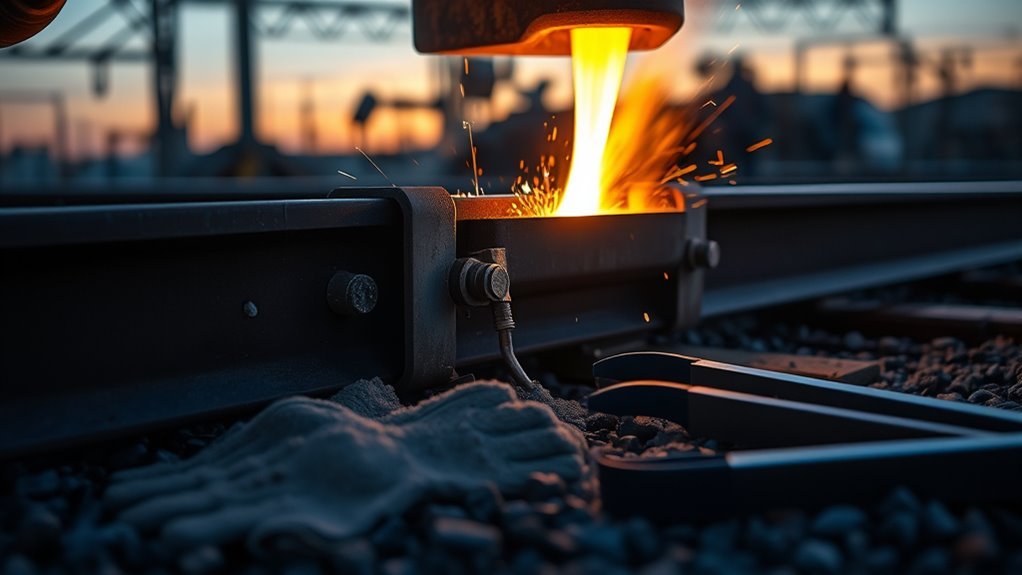
Thermite welding, also called aluminothermic or exothermic welding, produces welding heat through a chemical reaction rather than an electric arc. In classic iron thermite, aluminum reduces iron oxide, producing iron, aluminum oxide, and enough heat to leave the iron molten.
The simplified reaction is Fe2O3 + 2Al → 2Fe + Al2O3 + heat. TWI describes thermite welding as an exothermic process that can operate without an external source of welding current and notes working temperatures around 2,200°C (about 4,000°F). See TWI’s explanation of thermite and exothermic welding.
Commercial rail-welding portions are not simply loose iron oxide and aluminum mixed at the worksite. Approved systems use measured consumables selected for the rail grade, profile, welding process, and required weld-metal properties.
This differs from conventional arc welding, where a power source and electrodes or wire create the weld pool. If you are comparing conventional consumables, this guide to general-purpose welding rods covers a different class of welding process.
For electrical grounding and bonding, exothermic welding can use other metal oxides. nVent ERICO, for example, describes copper-based exothermic systems that form permanent conductor connections without relying on a bolted mechanical joint.
Thermite Welding Step by Step
Industrial thermite welding follows a controlled sequence: prepare and align the parts, fit and dry the mold, preheat where the approved procedure requires it, initiate the packaged welding portion, allow the molten metal to fill and solidify, then remove excess material and inspect the joint. Exact dimensions, temperatures, timings, and consumables depend on the approved welding system.
Warning: Thermite welding produces molten metal and intense radiant heat. Do not improvise charges, ignition methods, mold dimensions, or cooling times. Use the approved manufacturer’s procedure, trained personnel, and the PPE and site controls required for the specific rail or electrical system.
- Prepare the joint. Remove contamination from the surfaces that will be joined and confirm that the parts are suitable for the specified welding process.
- Align and secure the work. Rail ends or conductors must remain in the required position while the mold is fitted and the weld solidifies.
- Install the specified mold. The refractory or graphite mold must match the joint and fit tightly enough to contain molten metal.
- Dry and preheat as required. Rail processes commonly preheat the mold and rail ends; electrical systems have their own preparation instructions.
- Initiate the approved welding portion. The exothermic reaction produces molten metal in the crucible or mold system.
- Allow filling and solidification. Molten metal enters the weld cavity and remains undisturbed for the specified solidification period.
- Finish and inspect. Remove the mold and excess material only when permitted, then grind, clean, and inspect the connection as required.
Material Setup
Good setup establishes the joint geometry before any heat is applied. The surfaces must be clean, the work must be correctly aligned, and the specified refractory mold must fit the rail or conductor configuration.
For rail welding, the weld gap is not a universal number that can be copied from another product. Pandrol notes that aluminothermic welding systems are matched to rail profiles and applications, including standard joints and repairs; its aluminothermic welding overview describes molten steel being cast into a mold around the prepared rail gap.
Preheating serves more than one purpose. Depending on the process, it helps remove moisture from the mold and joint area and brings the rail ends to the thermal condition required for proper fusion.
The mold, crucible, welding portion, rail profile, and procedure should be treated as one approved system. A conventional machine from a list of MIG, TIG, and stick welders is not a substitute for rail-specific thermite equipment.
Ignition To Finishing
Once preparation and preheating are complete, the approved welding portion is initiated according to its procedure. The reaction creates molten weld metal, which enters the mold cavity, surrounds the prepared joint faces, and solidifies into the connection.
The operator should not disturb the assembly during the reaction or initial solidification period. After the specified wait, the mold is removed and excess weld metal is stripped, sheared, chipped, or ground as the particular process requires.
- The reaction occurs in the crucible or integrated mold system.
- Molten weld metal flows into the prepared cavity.
- The hot metal transfers enough heat to fuse with the joint surfaces.
- The weld remains restrained while it solidifies.
- Finishing restores the required surface profile and removes excess material.
- Inspection checks the joint before it returns to service.
The last step is especially important on rails. A structurally sound weld can still create poor wheel contact if the running surface is not ground to the required profile.
How Thermite Welding Joins Rails
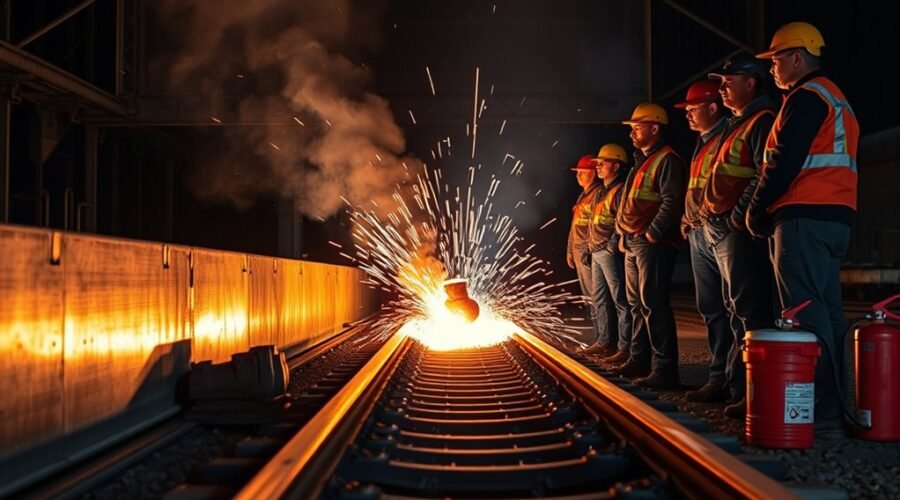
Rail thermite welding turns two prepared rail ends into a continuous joint by casting superheated weld metal into a mold around the gap. The process combines careful alignment, controlled preheating, a rail-specific welding portion, solidification, trimming, grinding, and inspection.
Because rail welds carry repeated wheel loads, small procedural errors can matter. The completed joint must provide both metallurgical continuity and the correct running geometry for the rail head.
Rail End Preparation
Rail-end preparation controls the position and geometry of the finished weld. The rail faces are cleaned, the ends are set to the prescribed process gap, and vertical and horizontal alignment are adjusted before the mold is secured.
The exact gap, mold, weld portion, and preheat cycle must come from the approved process for that rail section. A value that is correct for one standard rail weld may be wrong for a wide-gap repair, a different rail profile, or another supplier’s system.
- Clean the rail faces and nearby mold-contact surfaces.
- Set the specified weld gap for the approved process.
- Align the rail vertically and horizontally.
- Fit and seal the mold so molten metal cannot escape.
- Dry and preheat the assembly according to the welding procedure.
Rail-weld quality depends heavily on following the specified process. This site guide to welding quality provides additional general context, but rail acceptance requirements should come from the railway’s approved procedure.
Molten Metal Flow
During the aluminothermic reaction, molten weld metal forms beneath the lighter oxide slag. The molten metal is released into the refractory mold, where it fills the rail gap and transfers heat into the rail ends.
That heat partially melts the prepared rail faces so the cast weld metal and rail steel form a metallurgical fusion zone. This is why thermite rail welding is more than simply pouring metal into a gap: the joint depends on adequate fusion between the cast metal and the parent rail.
Mold fit, preheating, rail condition, consumable selection, and pouring behavior can all affect the result. Inadequate fusion, porosity, shrinkage cavities, and metal leakage around a mold are recognized rail-weld defects rather than theoretical concerns.
Cooling And Finishing
Cooling and finishing must follow the process specification rather than a universal waiting period. Mold removal, trimming, rough grinding, final grinding, inspection, and the point at which traffic can return may all have separate timing or temperature requirements.
The weld should remain stable while the cast metal solidifies. Removing restraints or disturbing the joint too early can affect geometry or damage a weld that has not developed enough strength.
After the permitted cooling period, the crew removes the mold and excess weld metal. Grinding then restores the rail head and running surface so the wheel sees a smooth transition across the joint.
The Transportation Safety Board of Canada describes porosity, lack of fusion, internal shrinkage cavities, and finning among defects associated with thermite rail welds. Its investigation also shows why mold sealing and removal of unfused fins matter under repeated rail loading.
- Let the weld solidify without disturbance.
- Remove the mold at the procedure’s specified point.
- Trim or shear excess weld metal.
- Grind the rail head to the required profile.
- Inspect the finished weld for geometry and defects.
Thermite Welding Applications
Thermite and related exothermic welding processes are most valuable where a permanent metallurgical connection must be made in the field without conventional arc-welding equipment at the joint. Railway work is the best-known application, while electrical grounding, bonding, signaling, traction-power, and cathodic-protection connections use related exothermic systems.
| Application | Primary Benefit | Typical Outcome |
|---|---|---|
| Railway rail joints | Portable field welding of full rail sections | Continuous rail after grinding and inspection |
| Electrical grounding and bonding | Permanent low-resistance conductor connection | Fused copper-to-copper or copper-to-metal joint |
| Pipeline corrosion-control wiring | Permanent attachment of test or cathodic-protection leads | Electrical wire bonded to an approved metal surface |
Electrical exothermic welding is not chemically identical to every rail thermite process. nVent ERICO states that its Cadweld grounding connections can form permanent conductor bonds with current-carrying capacity equal to or greater than the conductor.
Exothermic systems are also used for cable-to-rail connections in railway signaling, grounding, and traction-power work. These are much smaller connections than a full rail-to-rail thermite weld and use consumables designed for the electrical application.
For workshops that also perform conventional welding, equipment such as welding carts may help organize ordinary shop gear. Thermite rail systems, however, require their own approved molds, portions, preheating equipment, and finishing tools.
Thermite Welding Safety Tips
Thermite welding presents serious burn, fire, eye, fume, and molten-metal hazards. The work area, consumables, mold, PPE, and emergency controls should therefore be prepared before the welding portion is handled or initiated.
Moisture is a particularly important concern around molten metal. nVent’s installation and safety guidance instructs users to prepare molds and conductors correctly, protect nearby personnel, remove fire hazards, provide ventilation, and avoid moisture or contaminants that can cause hot material to be expelled.
- Use trained personnel. Rail authorities and manufacturers specify training and procedure requirements for their systems.
- Keep molds and joint surfaces dry. Moisture can react violently when exposed to molten metal.
- Wear the required PPE. This commonly includes eye, face, hand, body, and footwear protection suitable for hot-metal work.
- Control the work zone. Keep unauthorized personnel and combustible materials away from the reaction and splash area.
- Provide appropriate ventilation. Smoke and metal-containing fumes should not be treated as harmless.
- Inspect equipment before use. Damaged molds, clamps, crucibles, or other components can allow leakage or misalignment.
- Do not improvise consumables. Use the mold, weld portion, and ignition system specified for the connection.
- Leave hot residues alone until safe. Slag, molds, crucibles, and nearby metal can remain hot after the visible reaction ends.
NIOSH lists inhalation as a major exposure route for welding fumes and notes respiratory effects including metal fume fever. Ventilation and process-specific exposure controls matter more than folk remedies.
General welder gear and accessories should never be assumed to satisfy the PPE requirements for aluminothermic rail work.
Note: Rail thermite welding and industrial exothermic electrical connections should be performed under the applicable railway, employer, manufacturer, and site procedures. If you are not trained and authorized for the specific system, use a qualified welding or electrical professional.
Thermite Welding Pros, Cons, and Heat
Thermite welding combines extreme heat with unusual portability. Its main strength is the ability to make large field joints without an arc-welding power source at the joint, while its main limitation is that weld quality depends strongly on preparation, process control, and correct consumable selection.
| Aspect | Effect |
|---|---|
| Heat | Reaction temperatures are high enough to produce superheated molten weld metal |
| Portability | Useful for field locations without conventional welding power at the joint |
| Speed | Reaction is rapid, but preparation, cooling, grinding, and inspection still take time |
| Risk | Molten metal, radiant heat, fumes, fire, and moisture contamination require strict controls |
| Control | Correct mold, portion, alignment, preheat, and procedure are critical to repeatable quality |
Thermite’s temperature is commonly described as roughly 2,200°C or higher in practical welding reactions. That heat is sufficient to produce molten weld metal and establish fusion with prepared steel surfaces.
The process still has less real-time control than arc methods where voltage, amperage, wire feed, torch position, or travel speed can be adjusted continuously. Once an aluminothermic portion has been initiated, the reaction proceeds according to the prepared charge and system design.
This is why thermite welding and multi-process welding machines solve different problems. Thermite excels at certain field joints; MIG, TIG, and stick machines provide much broader control for everyday fabrication and repair.
Dissimilar metals also require care. TWI’s guide to joining dissimilar materials explains that differences in thermal and metallurgical properties can make direct fusion welding difficult, while solid-state, partial-solid-state, brazing, or other joining methods may still be possible.
Frequently Asked Questions
Why Do Welders Drink Milk After Welding?
Drinking milk does not protect you from welding fumes or metal fume fever. Milk goes to the digestive system, while welding fume is inhaled into the lungs; use ventilation, fume control, and required respiratory protection instead.
What Is Thermite Welding Used For?
Thermite welding is mainly used for field rail joints and for permanent electrical grounding and bonding connections. Related exothermic processes also attach conductors to rail and connect cathodic-protection wires to steel structures or pipelines.
What Two Metals Cannot Be Welded Together?
There is no single pair of metals that can never be joined by any welding or solid-state process. Compatibility depends on the materials, joint design, filler or interlayer, and process; some dissimilar combinations are impractical for direct fusion welding but can be joined by another method.
What Two Chemicals Make Thermite?
The classic iron thermite reaction uses aluminum and iron(III) oxide, producing aluminum oxide, molten iron, and heat. Industrial rail and electrical exothermic welding uses engineered, premeasured consumables matched to the joint, so the charge chemistry should come from the approved system rather than a homemade recipe.
The old idea that milk can protect a welder from fumes is not supported by evidence. Cancer Council Australia specifically describes milk as ineffective protection against welding fumes; exposure should be controlled at the source instead.
Conclusion
Thermite welding remains an important field process because it can create full rail joints and permanent electrical connections without conventional arc-welding power at the joint. Reliable results depend on the approved mold and consumables, correct preparation and alignment, controlled preheating and cooling, careful finishing, and strict safety procedures rather than the reaction alone.
Sources
- TWI — Thermite/Exothermic Welding: Process definition, aluminothermic principle, applications, temperature, and lack of external welding current.
- Pandrol — Aluminothermic Welding: Rail-welding process, molds, rail applications, and welding equipment.
- Transportation Safety Board of Canada: Thermite rail-welding process and recognized weld defects.
- nVent ERICO — Exothermic Connections: Electrical grounding, bonding, conductor performance, and copper-based connections.
- nVent ERICO — Installation and Safety: Connection preparation, mold use, ignition systems, moisture precautions, PPE, and ventilation.
- CDC/NIOSH — Welding Fumes: Exposure routes and recognized respiratory health effects.
- Cancer Council Australia: Evidence addressing the milk-and-welding-fume myth.
- TWI — Joining Dissimilar Materials: Limits and alternatives for joining metals with different physical and metallurgical properties.