

The best welders for home use should match your garage power, skill level, and the metal you actually plan to weld. A simple flux-core unit can handle light repairs, while multi-process and AC/DC TIG machines add flexibility for more demanding projects.
For straightforward mild-steel repair, the Lincoln Electric K2278-1 Handy Core is the easiest fit here because it runs flux-core wire from a 115V, 20A supply. The Forney Easy Weld 140 MP is the Best value pick if you want MIG, flux-core, DC TIG, and stick from one 120V machine.
We checked process support, input power, output, duty cycle, warranty coverage, current model information, and public safety records before rebuilding these picks.
Best Welders for Home Use Compared
| Product | Best for | Processes | Input power | Output | Warranty | Score |
|---|---|---|---|---|---|---|
|
Budget
|
Handy flux-core repairs | Flux-core | 115V, 20A | 35–88A | 1 year parts/labor; 90 days gun/cable | 83/100 |
|
Mid-range
|
Multi-process value | MIG, flux-core, DC TIG, stick | 120V | Up to 140A | 1 year internal electrical components | 88/100 |
|
Premium
|
Performance AC/DC TIG | AC/DC TIG, stick | 110/220V | Up to 225A TIG | 3 years | 95/100 |
Best Welders for Home Use: Our Top Picks
|
Category |
Product |
Score |
|---|---|---|
|
🔧 Best Handy Flux-Core |
83/100 |
|
|
💼 Best Multi-Process Value |
88/100 |
|
|
🚀 Best Performance TIG |
95/100 |
1. Lincoln Electric K2278-1 Handy Core

Bottom line: The Lincoln Electric K2278-1 Handy Core is a simple flux-core welder for light home repairs and hobby fabrication. It is easy to understand, but its 35–88A output and 1/8-inch mild-steel limit make it a specialized light-duty choice.
- Processes: Flux-core, simple gasless wire welding
- Input power: 115V, 20A, suited to a dedicated home circuit
- Output: 35–88A, aimed at light-gauge mild steel
- Duty cycle: 20% at 70A, so cooling breaks matter
- Warranty: 1 year parts/labor; 90 days gun and cable
Lincoln rates the Handy Core for 18-gauge through 1/8-inch mild steel. The four output ranges keep setup straightforward, and the package includes the gun, work lead, clamp, flux-core wire, contact tips, hand shield, and chipping hammer or brush.
Because it uses self-shielded flux-core wire, you do not need a gas cylinder. That helps with quick repairs and outdoor work, but it also means more slag and cleanup than gas MIG. Stay inside Lincoln’s published thickness range rather than treating it as a structural or heavy-fabrication machine.

Pros and Cons
|
Pros |
Cons |
|---|---|
|
✅ Very quick to set up and use |
❌ Flux-core only, so finish and penetration differ from gas MIG or TIG |
|
✅ Portable and relatively lightweight |
❌ Not recommended for critical load-bearing welds |
|
✅ Works well on typical home repair thicknesses |
❌ Limited to standard 120V outlet performance |
|
✅ No shielding gas required |
Situational Benefits
|
Situation |
How It Helps |
|---|---|
|
Quick Vehicle Repairs |
You can tackle patching brackets and small frame repairs without hauling the vehicle to a shop, because the unit is portable and ready fast. |
|
Home Fabrication |
For building racks, brackets, and garden projects you get reliable welds on common thicknesses with minimal setup. |
|
Outdoor Work |
Flux-core performs well outside where shielding gas would blow away, so you can work in breezy conditions more effectively. |
|
Hobby Projects |
If you experiment with metal art or small builds, the simplicity and low learning curve help you iterate quickly. |
Ease Of Use
|
Feature |
Ease Level |
|---|---|
|
Setup |
Easy |
|
Controls |
Easy |
|
Portability |
Easy |
|
Maintenance |
Moderate |
2. Forney Easy Weld 140 MP
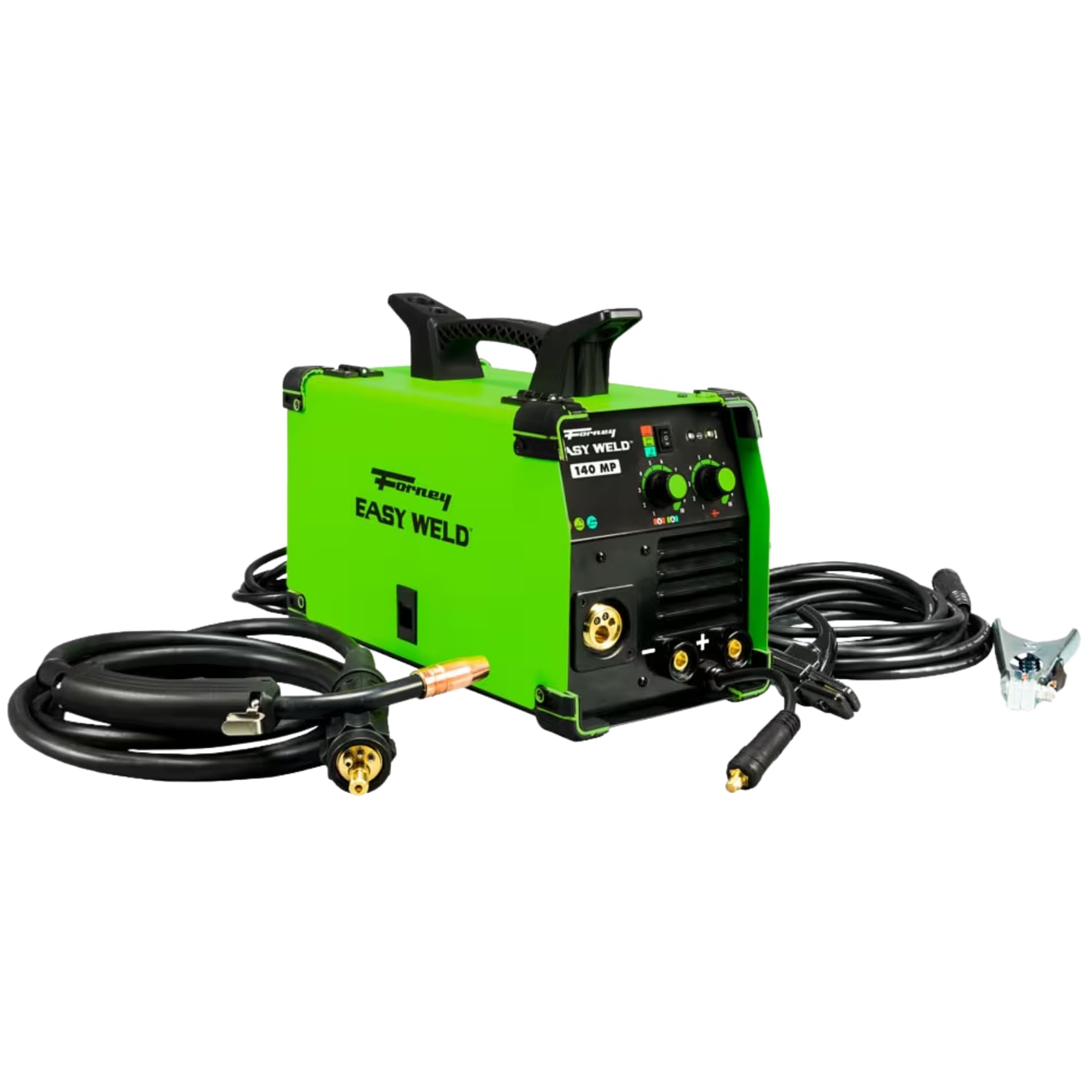
Bottom line: The Forney Easy Weld 140 MP is the most flexible lower-priced machine in this group. It gives you MIG, flux-core, DC TIG, and stick capability from 120V power, but the TIG torch is not included.
- Processes: MIG, flux-core, DC TIG, stick, four useful modes
- Input power: 120V, convenient for many home garages
- Output: Up to 140A, more headroom than the Lincoln
- Duty cycle: 30% at stated MIG, TIG, and stick outputs
- Warranty: 1 year on covered internal electrical components
Forney rates the 140 MP for material up to 1/4 inch and supports solid wire, flux-core wire, stick electrodes, and DC TIG. Infinite voltage and wire-feed controls give you more adjustment than a fixed-range starter machine.
The trade-off is accessory planning. The TIG torch is sold separately, gas MIG needs shielding-gas equipment, and the machine does not support TIG foot-pedal operation. It is also DC TIG, so it is not the aluminum-TIG choice in this roundup.

Pros and Cons
|
Pros |
Cons |
|---|---|
|
✅ Multi-process flexibility in a single compact package |
❌ Limited duty cycle for heavy continuous work |
|
✅ Easy to set up and learn on |
❌ TIG capability is basic compared with dedicated TIG machines |
|
✅ Works well on standard 120V circuits |
❌ Not designed for high-amperage industrial tasks |
|
✅ Portable and relatively lightweight |
Situational Benefits
|
Situation |
How It Helps |
|---|---|
|
Beginner Learning |
You can experiment with different welding styles in one place, helping you find which process suits your projects and skills. |
|
Home Repairs |
Tackle frame brackets, small structural patches, and routine metal fixes without hauling parts to a shop. |
|
Motorcycle Restoration |
Use TIG for cleaner touch-ups and MIG or stick for heavier repairs as you rebuild components and frames. |
|
Mobile Jobs |
The unit’s portability and 120V compatibility let you move between locations and run off common outlets when needed. |
Ease Of Use
|
Feature |
Ease Level |
|---|---|
|
Setup |
Easy |
|
Controls |
Easy |
|
Process Switching |
Moderate |
|
Portability |
Easy |
3. PrimeWeld TIG225X
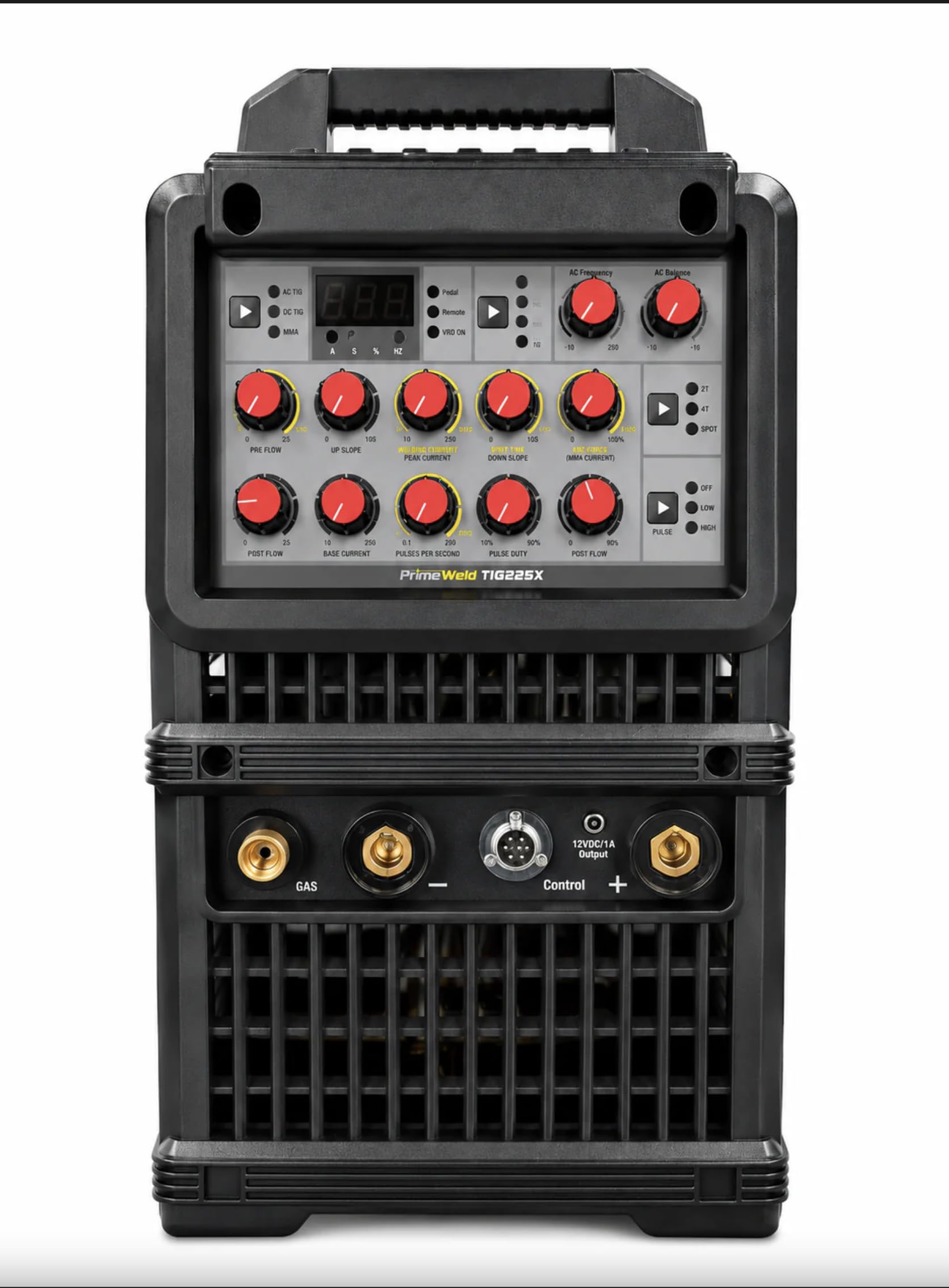
Bottom line: The PrimeWeld TIG225X is the premium choice for home fabricators who want AC/DC TIG, pulse control, high-frequency start, and stick welding. It is the strongest fit here for aluminum TIG and precision-focused work, but it has the steepest setup and learning curve.
- Processes: AC/DC TIG and stick, focused on precision work
- Input power: 110/220V on the linked ASIN configuration
- Output: Up to 225A TIG, the highest output here
- Duty cycle: 40% at maximum output on the linked configuration
- Warranty: 3 years, longer coverage than the other picks
The linked TIG225X configuration pairs AC/DC TIG with pulse and high-frequency start. AC capability is what separates it from the Forney for aluminum TIG, while DC covers steel and stainless applications.
PrimeWeld now markets a revised TIG225X generation with updated power and weight specifications. Because the affiliate link points to the older ASIN configuration with the CK17 torch, the specs here stay scoped to that linked version rather than mixing generations.

Pros and Cons
|
Pros |
Cons |
|---|---|
|
✅ Excellent TIG performance with AC/DC and pulse |
❌ More features mean a steeper learning curve for beginners |
|
✅ Stable arc and precise control for clean welds |
❌ Not a continuous-production industrial machine |
|
✅ High-quality CK17 torch included |
❌ Replacement parts and accessories add incremental cost over time |
|
✅ Good portability for a high-power TIG unit |
Situational Benefits
|
Situation |
How It Helps |
|---|---|
|
Aluminum Repair |
AC mode and pulse control let you weld aluminum with cleaner penetration and less warping, useful for bike frames and trim. |
|
Precision Fabrication |
Fine amperage and HF start provide the control you need for thin-sheet work and aesthetically important welds. |
|
General Workshop Use |
Switch between TIG and stick for versatile shop tasks, from neat welds to heavier tacks and repairs. |
|
Mobile Jobs |
Relatively compact design and accessory availability let you move the unit to different sites and keep working efficiently. |
Ease Of Use
|
Feature |
Ease Level |
|---|---|
|
Setup |
Moderate |
|
Control Panel |
Moderate |
|
Torch Handling |
Easy |
|
Mode Switching |
Moderate |
Lincoln Electric K2278-1 Handy Core vs Forney Easy Weld 140 MP: Is the Upgrade Worth It?
The Lincoln is simpler and more specialized, while the Forney adds three more processes and a higher maximum output. The Forney is the better step-up if you expect your projects to grow beyond flux-core repair.
- Processes: Lincoln is flux-core only; Forney adds MIG, DC TIG, and stick.
- Output: Lincoln tops out at 88A; Forney reaches 140A.
- Duty cycle: Lincoln is rated 20% at 70A; Forney publishes 30% ratings for its main processes.
- Setup: Lincoln avoids gas entirely; Forney needs extra equipment for gas MIG or TIG.
Which Welder Should You Buy?
- Simple flux-core repair: get the Lincoln Electric K2278-1 Handy Core.
- Multi-process learning: get the Forney Easy Weld 140 MP.
- 120V multi-process flexibility: get the Forney Easy Weld 140 MP.
- Aluminum TIG: get the PrimeWeld TIG225X.
- Higher-output precision TIG: get the PrimeWeld TIG225X.
How We Chose
- Process fit: We compared flux-core, MIG, TIG, and stick capability against common home projects.
- Power and output: We checked input requirements, output range, and published duty-cycle data.
- Included equipment: We checked what you still need for gas MIG, TIG, and stick operation.
- Support and warranty: We compared manufacturer warranty terms and current model documentation.
- Verification sources: We used manufacturer specs and manuals first, then current brand pages, major retailers, ASIN-indexed listings, and public recall searches.
Customer Preferences
If most of your work is light mild steel, the Lincoln keeps setup simple. If you want one machine to cover several processes, the Forney gives you more room to learn. If aluminum TIG, pulse control, and higher TIG output matter most, the PrimeWeld is the more specialized choice.
How to Choose the Best Welder for Home Use
Choose the Welding Process First
Flux-core is the simplest path when you want wire welding without a gas cylinder. MIG is fast for general fabrication. TIG gives finer heat and bead control, while stick remains useful for repair work. For the simplest flux-core setup here, start with the Lincoln Electric K2278-1 Handy Core.
Match the Welder to Your Available Power
A 115V or 120V machine can fit many home garages, but the outlet still needs the current the manual specifies. Dual-voltage welders add flexibility when 240V is available. Do not size the circuit from voltage alone; follow the manufacturer’s breaker, wiring, and extension-cord guidance.
Compare Output and Material Limits Together
Maximum amperage does not tell the whole story. Lincoln publishes an 18-gauge to 1/8-inch mild-steel range for the Handy Core, while Forney rates the 140 MP up to 1/4 inch. For aluminum TIG, the AC-capable PrimeWeld TIG225X is the relevant pick in this group.
Understand Duty Cycle
Duty cycle tells you how long the welder can operate at a stated output before it needs cooling time. Short home repairs often involve natural pauses, but longer beads make duty cycle more important. Always compare the percentage together with the amperage and process used to publish it.
Plan for Gas, Torches, and Consumables
Flux-core needs wire and contact tips but no shielding-gas cylinder. Gas MIG adds a cylinder, regulator, hose, and solid wire. TIG adds shielding gas, tungsten, filler rod, and torch consumables. Check what is included before ordering so the machine does not arrive without a part you need to start.
Think About Portability and Storage
Portability is more than a published weight. Consider the machine, cables, gas cylinder, cart, and accessories you will move together. A compact 120V machine is easier to use around a garage, while a more capable TIG setup often makes more sense on a dedicated cart or bench.
Prioritize Ventilation and PPE
Use a suitable welding helmet, gloves, flame-resistant clothing, and closed footwear. Keep combustibles away from sparks and hot metal, and provide adequate ventilation for welding fumes. Inspect leads, clamps, torches, wire paths, and consumables before use, and follow the manual for electrical and maintenance requirements.
Mistakes to Avoid When Buying a Welder
- Buying by amperage alone: compare process, duty cycle, input power, and thickness guidance together.
- Ignoring the circuit: confirm voltage, amperage, breaker, and extension-cord requirements first.
- Forgetting accessories: check whether the torch, gas equipment, pedal, and consumables are included.
- Choosing TIG only for simplicity: TIG offers control but takes more setup and practice than flux-core or MIG.
- Exceeding published limits: stay within the manufacturer’s material and duty-cycle guidance.
FAQs
Which welding process should I choose for home use?
Choose the process that matches your projects and how much setup you want. Flux-core is simple and does not need shielding gas. MIG is fast for general fabrication. TIG gives finer control on thin material and visible welds. Stick is useful for repair work and less-clean steel. Aluminum TIG normally requires an AC-capable TIG machine.
Can I run a home welder on a regular 120V outlet?
Many home welders run from 115V or 120V, but the circuit still has to meet the machine’s input requirements. The Lincoln calls for a 115V, 20A outlet, while the Forney uses 120V input. Follow the manual for breaker size, extension-cord limits, and dedicated-circuit guidance instead of assuming any household receptacle is suitable.
Can these welders handle aluminum?
The PrimeWeld TIG225X is the aluminum-capable TIG option in this group because the linked version supports AC TIG. The Forney Easy Weld 140 MP provides DC TIG, which is better matched to steel and stainless in this setup. The Lincoln Electric K2278-1 Handy Core is a flux-core machine intended for light-gauge mild steel.
Is flux-core welding a good choice for beginners?
Flux-core can be a practical starting point because it avoids a shielding-gas cylinder and keeps setup simple. The trade-off is more slag, smoke, and cleanup than gas MIG. A machine such as the Lincoln Electric K2278-1 Handy Core also has a limited output range, so beginners should stay within its published material thickness and duty-cycle limits.
Do I need shielding gas with these welders?
You do not need shielding gas when using self-shielded flux-core wire. Gas MIG and TIG do require the correct shielding gas, regulator, hose, and related consumables. The Forney can run flux-core without gas but needs gas equipment for solid-wire MIG and TIG. The PrimeWeld TIG225X needs shielding gas for TIG welding.
What duty cycle is enough for a home welder?
A modest duty cycle can work for short repair welds because you naturally stop to reposition parts and clean joints. Longer beads and repeated fabrication make duty cycle more important. Compare the percentage at the amperage and process you plan to use, since a duty-cycle number only makes sense when it is tied to a stated output.
What safety gear and maintenance do I need?
Use a suitable welding helmet, welding gloves, flame-resistant clothing, closed footwear, and adequate ventilation. Keep combustible materials away from sparks and hot metal. Inspect cables, clamps, torches, wire paths, and consumables before use. Follow the machine manual for grounding, power supply, cooling, extension cords, and maintenance intervals, and replace damaged parts before welding.
Best Welder for Home Use: Final Verdict
The Lincoln Electric K2278-1 Handy Core is the Best overall choice in this three-product roundup when you want uncomplicated flux-core welding for light mild-steel repairs. It gives up process flexibility and output, but its purpose and limits are easy to understand.
For more process flexibility, compare the Forney Easy Weld 140 MP; for AC/DC TIG and aluminum work, compare the PrimeWeld TIG225X.
| Lincoln Electric K2278-1 Handy Core | Forney 271 Easy Weld 140 MP Multi-Process Welder | PRIMEWELD TIG225X 225 Amp IGBT AC DC Tig/Stick Welder | |
|---|---|---|---|
|
|
|
|
|
| Rating | 4.6/5 (N reviews) | 4.6/5 (854 reviews) | 4.8/5 (1,424 reviews) |
| Weight | 30 lbs (13.6 kg) | 25.8 lbs (11.7 kg) | 90 lbs (40.8 kg) |
| Power Source | Corded Electric (Flux-Cored) | Corded Electric | 110/220V AC/DC |
| Special Highlights |
|
|
|
| Shop Now | Shop Now | Shop Now |



[…] financial security. Additionally, many women find that having access to versatile equipment, like multi-process welders, enhances their skill development and job […]
[…] and controlled heat input throughout. Incorporating a variety of welding techniques, such as MIG, TIG, and stick, can enhance students’ versatility and […]
[…] and give the welder a clear, liberated path to a sound result. Additionally, understanding welding gauges is crucial for ensuring precise measurements during the inspection […]
[…] speed, good fit-up, and allowing the panel to cool between welds can help avoid excessive warping. Home-shop welders should also confirm that their machine has enough adjustment at the low end for thin […]
[…] amperage, joint preparation, positions, PPE, and common weld discontinuities. Familiarity with home-use MIG, TIG, and stick welding equipment can also help when writing product-focused […]
[…] For general machine-selection background rather than symbol interpretation, see this guide to welders for home use. […]
[…] TIG, Stick, and flux-cored welding each have different applications, and hands-on familiarity with MIG, TIG, and Stick welding can help a new welder discover which type of work best fits their […]
[…] should understand which process suits the material, thickness, location, and desired result. These welder options for home use can help compare equipment types once the required process is […]
[…] permanence, or fabrication efficiency under constrained conditions. Additionally, understanding the best welders for home use can influence the decision-making process for DIY […]
[…] versatility is separate from test selection. The existing guide to multi-process welding capability covers equipment choices rather than hardness […]
[…] a home or small fabrication shop, a machine with multi-process capability can be useful when one project favors wire feed and another needs stick or […]
[…] in vacuum conditions, where metal surfaces can bond unexpectedly. This phenomenon parallels the importance of precise controls in welding techniques, ensuring high-quality connections without compromising material […]