Welding rod numbers are classification codes that tell you important things about a stick electrode before you strike an arc. With common carbon-steel electrodes such as E6011 and E7018, the code identifies the deposited weld metal’s strength class, approved welding positions, and coating/current characteristics. The numbers are useful, but the electrode package, manufacturer data sheet, welding procedure, and job specification still control the actual setup.
Quick Answer
In E6011, “60” means a 60,000 psi minimum tensile-strength class, the next “1” means all-position welding, and the final “1” identifies cellulosic coating/current characteristics. E7018 means 70,000 psi, all-position capability, and a low-hydrogen iron-powder coating. E6011 is penetrating and repair-friendly; E7018 emphasizes low-hydrogen weld deposits.
Key Takeaways
Key Takeaways
- The first two digits of E6011 and E7018 indicate the minimum tensile-strength class of the deposited weld metal: 60,000 psi and 70,000 psi respectively.
- The third digit “1” means both electrodes are classified for all-position welding, although vertical-down use depends on the specific electrode and procedure.
- E6011 is a cellulosic, fast-freeze electrode known for a forceful, penetrating arc and good tolerance for less-than-perfect steel.
- E7018 is a low-hydrogen, iron-powder electrode widely used where hydrogen control and dependable mechanical properties matter.
- Rod diameter affects usable amperage and deposition capacity, but electrode type, polarity, current, joint design, and technique also control penetration.
- Always follow the electrode manufacturer’s data sheet and the applicable WPS or welding code for structural, pressure, or inspected work.
What Welding Rod Numbers Mean
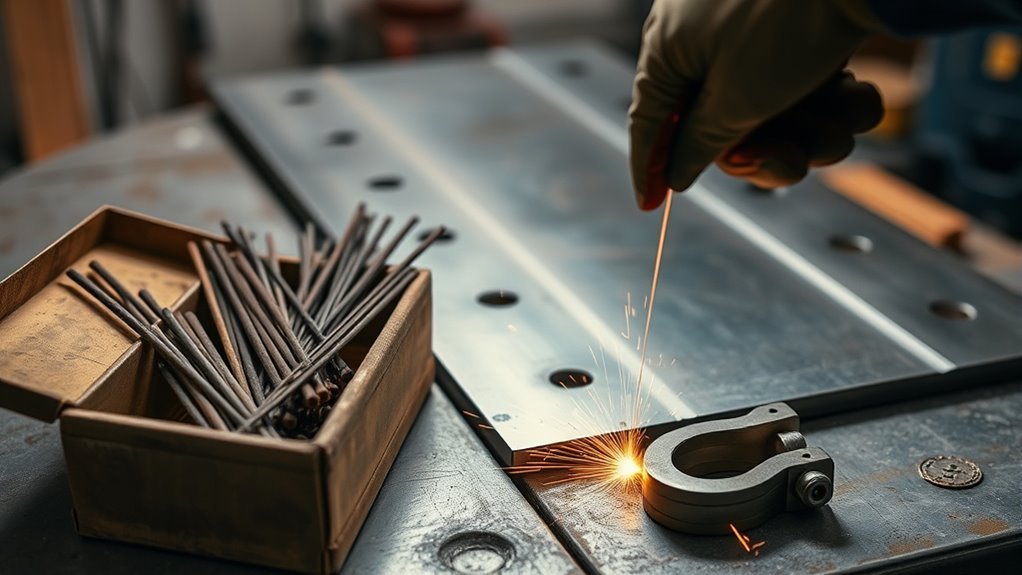
Common carbon-steel stick electrodes use classifications established under the American Welding Society’s AWS A5.1/A5.1M specification. The code gives welders a compact way to identify mechanical-property and usability requirements.
For four-digit classifications such as E6011 and E7018, the basic pattern is:
- E: identifies a covered electrode used as part of the welding circuit.
- First two digits: identify the minimum tensile-strength class of the deposited weld metal in thousands of psi. “60” corresponds to 60,000 psi and “70” to 70,000 psi.
- Third digit: identifies welding-position capability. A “1” means all positions.
- Final digit: relates to electrode covering and usable current/polarity characteristics.
Note: The strength number is a classification of deposited weld metal under specified test conditions. It does not mean every completed joint will safely carry that stress. Joint design, base metal, defects, heat input, procedure qualification, and loading all affect actual weld performance.
How to Decode 6011 and 7018
E6011 and E7018 are both carbon-steel SMAW electrodes, but their coverings and operating characteristics are quite different. Reading the code tells you where to start; manufacturer documentation tells you the exact amperage, polarity, storage limits, and approved technique for the product in your hand.
AWS Number Breakdown
E6011 breaks down into E + 60 + 1 + 1. It is in the 60,000 psi tensile-strength class, is classified for all positions, and belongs to the cellulosic electrode family. E6011 coverings are commonly described as high-cellulose potassium types. They produce a forceful, fast-freezing arc that is useful for maintenance, repair, root work, and out-of-position welding.
E7018 breaks down into E + 70 + 1 + 8. It is in the 70,000 psi tensile-strength class, is classified for all-position welding, and uses a low-hydrogen iron-powder covering. Manufacturer literature commonly lists E7018 for DCEP and AC operation, although the exact approved current must be checked on the electrode package or data sheet.
The code narrows your electrode choice, but the package, manufacturer data sheet, WPS, and applicable welding code determine the final setup.
6011 Vs 7018
E6011 is known for a strong digging arc, relatively deep penetration, thin fast-freezing slag, and tolerance for some rust, mill scale, and imperfect surface preparation. Miller and Hobart both describe E6011 as useful where a penetrating arc and less-than-perfect base material are encountered.
E7018 runs differently. It is a low-hydrogen electrode designed to control diffusible hydrogen in the weld deposit when stored and handled correctly. It generally produces a smoother arc and bead than E6011 and is widely used in construction, pressure-vessel, piping, equipment, and other applications where the required procedure calls for a low-hydrogen electrode.
Pro Tip: Do not select E7018 only because “70” is higher than “60.” Electrode choice should match the base material, joint, position, power source, required mechanical properties, service conditions, and any governing WPS or code.
What the Numbers Say About Strength
The first two digits identify the minimum tensile-strength class of the deposited weld metal. E6011 is in the 60 ksi class, while E7018 is in the 70 ksi class. One ksi equals 1,000 psi.
That makes the code useful when matching filler metal to job requirements, but tensile strength is only one selection factor. Yield strength, ductility, impact toughness, hydrogen level, base-metal chemistry, joint restraint, service temperature, and welding procedure can all matter in critical work.
Tensile Strength Rating
For E6011, the “60” means the classification requires deposited weld metal in the 60,000 psi minimum tensile-strength class. For E7018, “70” means 70,000 psi. These values should not be treated as a simple ranking where E7018 is automatically “better.”
E6011 can be the correct choice when a penetrating, fast-freeze electrode is required. E7018 can be the correct choice when a low-hydrogen electrode and its mechanical-property requirements match the procedure. On code-governed structural work, the approved welding procedure takes priority over a general rod comparison.
Electrode Grade Meaning
The complete electrode classification matters more than the strength digits alone. The position and coating/current portions tell you how the electrode is designed to operate.
For example, the “1” in both E6011 and E7018 means all-position capability. That includes flat, horizontal, vertical, and overhead welding within the product’s approved procedure. However, “all position” does not mean every electrode is approved for every vertical progression. Lincoln Electric’s Excalibur 7018-1 MR and Hobart’s Soft-Arc 7018-1, for example, specify all-position use while excluding or not recommending vertical-down welding.
How Rod Diameter Affects the Weld
Rod diameter affects how much current the electrode can normally carry and how quickly filler metal can be deposited. Smaller electrodes are easier to use on thinner material, tight joints, and many out-of-position welds. Larger electrodes can carry more current and deposit metal faster, making them useful on thicker sections when the joint and procedure allow it.
Diameter alone does not determine penetration. Penetration is also affected by electrode classification, polarity, amperage, arc length, travel speed, electrode angle, joint geometry, fit-up, and the base material.
- Smaller diameter: generally uses lower amperage and offers better control on thin material or restricted joints.
- Larger diameter: generally allows higher amperage and a higher deposition rate.
- Penetration: depends on the complete welding setup rather than rod size alone.
Amperage ranges are also product-specific. As one example, Lincoln Electric lists a 1/8-inch Excalibur 7018-1 MR at approximately 90–160 amps on DCEP and 100–160 amps on AC. Other E7018 products can differ, so the manufacturer’s recommended range should be your starting point rather than a universal amperage chart.
6011 Vs 7018: Main Differences
| Feature | E6011 | E7018 |
|---|---|---|
| Tensile-strength class | 60,000 psi minimum class | 70,000 psi minimum class |
| Position digit | 1 — all positions | 1 — all positions; vertical-down commonly excluded/not recommended |
| Covering | Cellulosic, commonly high-cellulose potassium | Low-hydrogen iron powder |
| Typical current | AC and DCEP are common; check the exact product because some manufacturers approve additional polarity | DCEP or AC for many common products |
| Arc / penetration | Forceful, digging arc; generally deep penetration | Smoother arc; generally lower or medium penetration depending on product and setup |
| Surface condition | More tolerant of rust, mill scale, and imperfect preparation | Best results require clean, properly prepared steel |
| Storage | Do not treat like a low-hydrogen electrode or automatically bake it; follow manufacturer instructions | Moisture control is critical; heated storage/reconditioning rules depend on manufacturer and code |
| Common uses | Repair, maintenance, field work, root work, equipment and less-than-perfect steel | Structural fabrication, construction, pressure applications and other work requiring low-hydrogen electrodes |
E6011’s cellulose-rich covering produces the fast-freezing, penetrating behavior associated with the electrode. It is not a rutile-based electrode. E7018’s low-hydrogen covering behaves very differently and is intended to limit hydrogen introduction when the electrode is stored and handled correctly.
How to Choose the Right Rod
Start with the job requirements rather than choosing a rod based only on bead appearance or the highest strength number.
- Identify the base metal. Confirm that the electrode classification is appropriate for the steel being welded.
- Check the required strength and toughness. Match the filler metal to the drawing, WPS, engineering requirement, or manufacturer’s repair procedure.
- Check welding position. Both E6011 and E7018 have a “1” position digit, but verify vertical progression and other product restrictions.
- Check your power source. Make sure the machine can supply the current and polarity required by the exact electrode.
- Consider surface condition. E6011 handles imperfect steel better, but cleaning rust, grease, moisture, paint, and scale still improves weld quality whenever practical.
- Choose rod diameter. Match diameter and amperage to material thickness, joint design, welding position, and machine capacity.
- Check storage requirements. This is especially important for low-hydrogen E7018.
Warning: An electrode that can weld through rust or surface contamination does not make unknown coatings safe to weld. Welding can produce hazardous fumes and gases. Remove coatings when required, identify the material, use suitable ventilation, wear proper eye/face, hand, skin, and respiratory protection, and keep flammable materials away from the work area.
For structural steel, pressure equipment, load-bearing repairs, or other inspected work, do not substitute E6011 for E7018—or the reverse—without confirming that the governing welding procedure and code allow it.
Storage and Moisture Control
Storage is one of the most important practical differences between these electrodes. Low-hydrogen E7018 coatings can absorb moisture after exposure to the atmosphere. That moisture can compromise the low-hydrogen characteristics the electrode is intended to provide.
Hobart recommends following the filler-metal manufacturer’s storage and reconditioning instructions. Depending on the particular E7018 product, heated holding temperatures can differ. For example, Hobart’s Soft-Arc 7018-1 data sheet specifies controlled oven storage at 250–300°F, while broader manufacturer guidance shows that other low-hydrogen products can use different ranges.
Do not assume the same oven treatment applies to E6011. Cellulosic electrodes depend on their designed covering characteristics, and inappropriate baking can damage their operating behavior. Store and condition E6011 according to its manufacturer instructions.
Note: For code work, electrode exposure limits, heated storage, reconditioning, and discard requirements may be controlled by the applicable welding code and WPS in addition to the manufacturer’s instructions.
Tips for Better Stick Welding
Electrode selection is only part of a good SMAW weld. Arc length, travel speed, angle, current, surface preparation, fit-up, and puddle control all matter.
With E7018, use a short arc and smooth, controlled travel. Manufacturer guidance for Hobart Soft-Arc 7018-1 calls for a very short arc and provides different manipulation recommendations for flat, horizontal, vertical-up, and overhead positions. Do not apply one universal rod angle to every joint.
E6011 behaves differently. Its forceful, fast-freeze arc often responds well to a controlled whip-and-pause or stepping technique when the joint requires it. The exact manipulation depends on welding position, joint type, fit-up, amperage, and the electrode manufacturer’s recommendations.
- Set amperage within the range specified for the exact electrode diameter and product.
- Maintain an arc length appropriate for that electrode.
- Clean the joint as thoroughly as practical before welding.
- Remove slag completely between multipass welds.
- Reduce amperage as needed for vertical or overhead work rather than assuming a flat-position setting will work everywhere.
- Practice on scrap before making a critical weld with an unfamiliar electrode.
Safety Before Stick Welding
Stick welding creates intense ultraviolet and infrared radiation, sparks, molten metal, fumes, electrical hazards, and hot work that can start fires. OSHA identifies burns, eye damage, electrical shock, and metal-fume exposure among the hazards associated with welding.
Wear an appropriate welding helmet and filter shade, safety glasses, flame-resistant clothing, welding gloves, and suitable footwear. Keep your skin covered, inspect leads and the electrode holder, keep the work area dry, and provide adequate ventilation or local exhaust where needed.
Extra precautions are required for confined spaces and for metals or coatings containing hazardous substances. Follow workplace safety requirements and the electrode/base-metal safety data before welding.
Frequently Asked Questions
Should I Use 6011 or 7018?
Use E6011 when the job calls for a penetrating, fast-freeze electrode, especially for repair, maintenance, root work, or steel that cannot be made perfectly clean. Use E7018 when the procedure requires a low-hydrogen electrode and its strength and mechanical properties match the job. For structural or code work, follow the approved WPS rather than choosing by preference.
Is 6013 or 6011 Better?
Neither is universally better. E6011 has a more forceful, penetrating arc and is useful on imperfect steel. E6013 generally has a softer arc, lower penetration, easier slag removal, and is popular for thinner, cleaner material and general fabrication. Match the electrode to the joint, material, machine, and required procedure.
What Is the Hardest Rod to Weld With?
There is no single hardest stick electrode because difficulty depends on the welder, machine, joint, and position. E6011 can challenge beginners because of its forceful arc and puddle manipulation, while E7018 requires tight arc control and proper moisture handling. Practicing both on scrap is more useful than ranking one as universally harder.
Do You Drag or Push a 6011 Rod?
Do not rely on a universal push-or-drag rule for E6011. A slight travel angle combined with controlled whipping or stepping is common, but the correct manipulation changes with joint type and welding position. Follow the electrode manufacturer’s recommendations and maintain control of the leading edge of the puddle.
Can You Run 7018 on AC?
Yes, many E7018 products are approved for AC as well as DCEP. However, AC arc performance can depend on the electrode formulation and the welder’s open-circuit voltage. Check the package or manufacturer data sheet for the exact E7018 product before setting the machine.
Does 7018 Have to Be Kept in a Rod Oven?
Low-hydrogen E7018 must be protected from excessive moisture, but the exact handling rules depend on packaging, exposure time, manufacturer instructions, and the governing welding code. Opened electrodes used for code work commonly require heated storage. Follow the specific product and WPS requirements instead of assuming one universal oven temperature.
Conclusion
Welding rod numbers become much easier to use once you know what each part represents. E6011 is a 60,000 psi-class, all-position cellulosic electrode known for its forceful, penetrating arc. E7018 is a 70,000 psi-class, all-position low-hydrogen iron-powder electrode designed for applications where controlled hydrogen and dependable mechanical properties matter.
The classification is only the starting point. Choose the electrode by base metal, joint design, welding position, power source, surface condition, required mechanical properties, rod diameter, storage requirements, and any applicable WPS or welding code. Then use the exact manufacturer’s amperage, polarity, handling, and technique recommendations for the product you are welding with.
Sources
- American Welding Society — AWS A5.1/A5.1M:2025 — current specification covering classification of carbon-steel covered electrodes for SMAW.
- MillerWelds — Stick Electrode Classification Guide — explains tensile-strength, position, coating, and current portions of common AWS electrode numbers.
- MillerWelds — Factors for Selecting the Right Stick Electrode — supports electrode position, current, E6011 contamination tolerance, and E7018 selection guidance.
- Hobart Brothers — Choosing the Right Stick Electrode for the Job — supports E6011/E7018 characteristics, AC/DCEP use, applications, and low-hydrogen storage requirements.
- Hobart Brothers — Storing and Handling Filler Metals — supports manufacturer-specific low-hydrogen electrode storage guidance.
- OSHA — Welding, Cutting, and Brazing Hazards and Solutions — supports eye, skin, fume, electrical, burn, and other welding safety precautions.