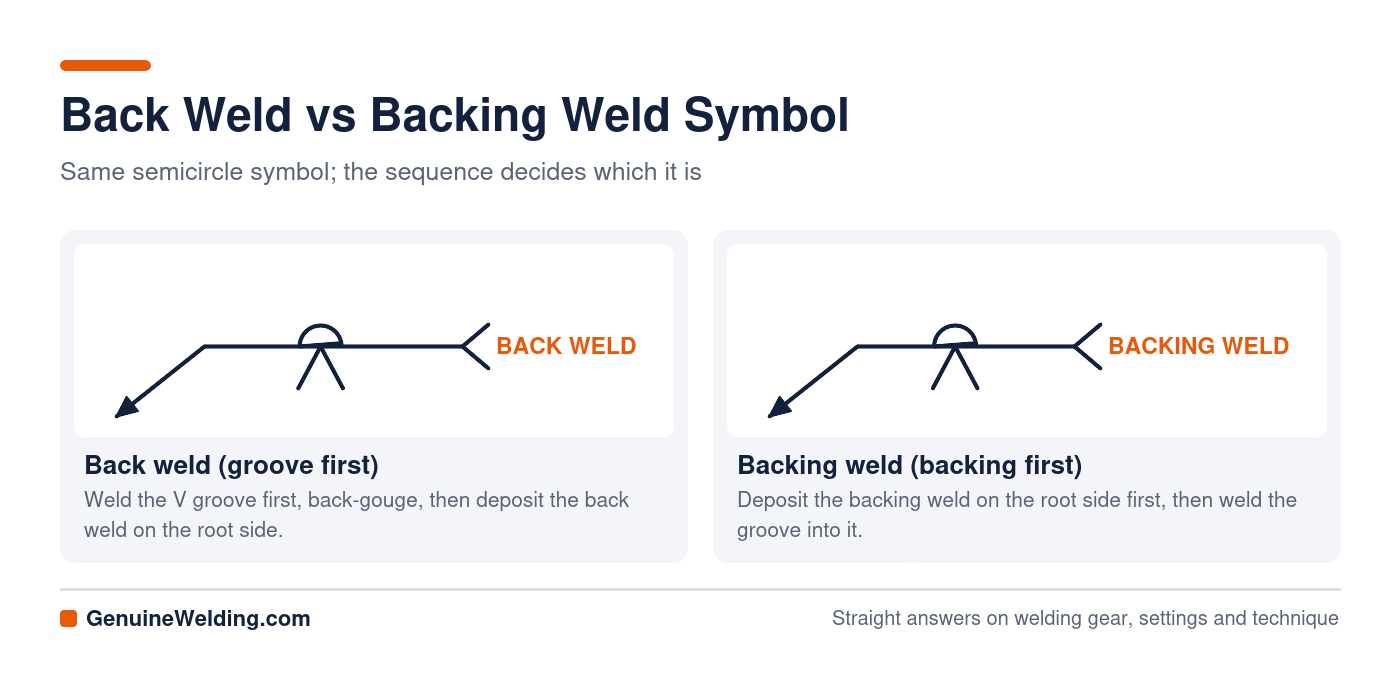
Back welds and backing welds use the same AWS symbol: an open semicircle placed on the opposite side of the reference line from the groove weld symbol. The difference is the welding sequence. A backing weld is made before the groove weld, on the root side, to act as backing. A back weld is made after the groove weld, on the root side, usually after back-gouging, to seal or reinforce the root. Drawings tell them apart with a tail note (“BACKING WELD” or “BACK WELD”) or by using multiple reference lines to show the order of operations. A steel backing bar is a different thing, shown with a rectangle symbol.
This is one of the most confusing parts of reading welding symbols, and it’s a common question on CWI and welding school exams. Here’s a clear breakdown.
What Is a Back Weld?
AWS defines a back weld as a weld made at the back of a single groove weld. In practice:
- The groove weld is made from the prepared (beveled) side first.
- The root side is back-gouged or ground to sound metal.
- The back weld is deposited on the root side to complete fusion and seal the joint.
Back welds are common on complete joint penetration (CJP) groove welds welded from both sides, such as many prequalified joints in AWS D1.1.
What Is a Backing Weld?
A backing weld is backing in the form of a weld. It’s made first, on the root side, so the groove weld has something to weld against:
- The backing weld is deposited on the root side of the joint.
- The groove weld is then made from the opposite (beveled) side, fusing into the backing weld.
Backing welds are used when a steel backing bar isn’t practical or allowed, or when the root opening is too wide to bridge from one side.
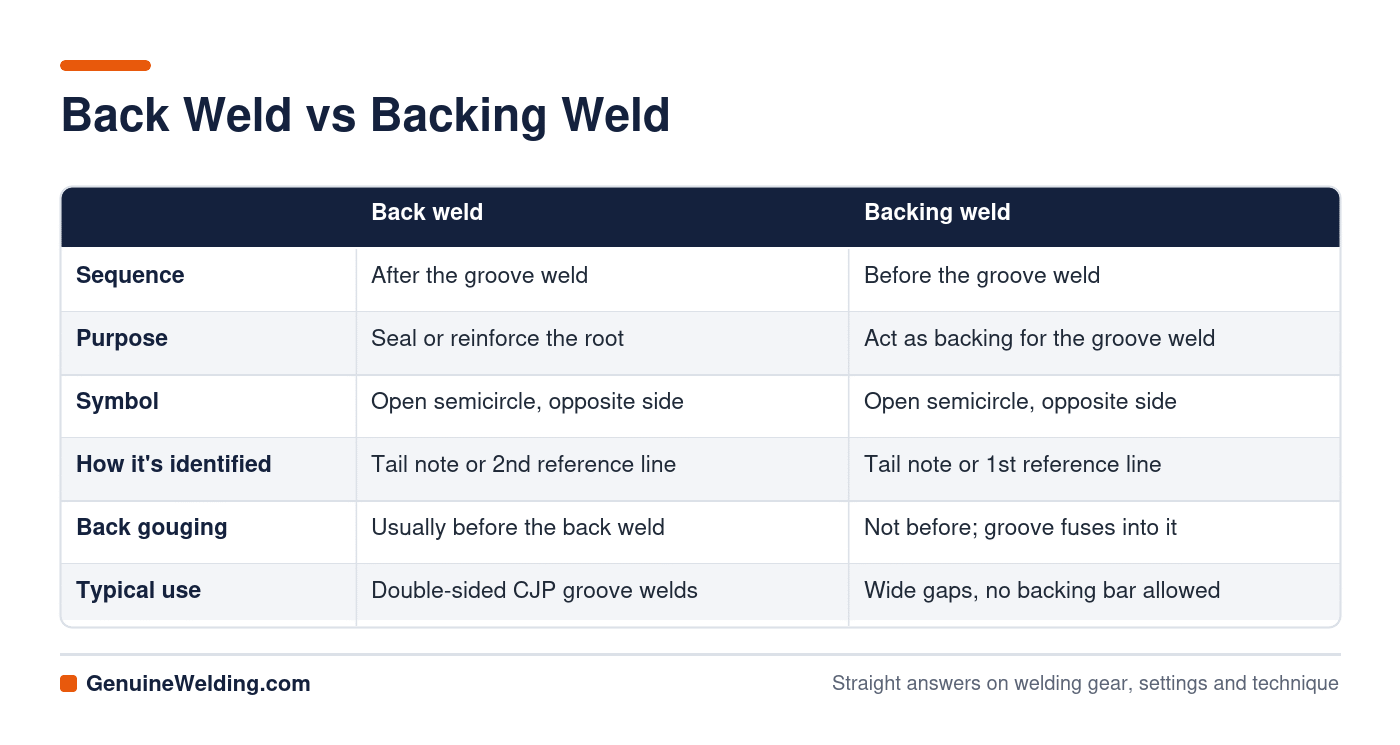
Back Weld vs Backing Weld: Side by Side
How Drawings Show the Difference
Because the symbols are identical, the drawing must specify which one you mean:
- Tail note: the most common method. The tail of the welding symbol says “BACK WELD” or “BACKING WELD.”
- Multiple reference lines: the reference line closest to the arrow shows the first operation; the next line shows the second, and so on. If the semicircle is on the first line and the groove on the second, it’s a backing weld. If the groove is first and the semicircle second, it’s a back weld.
- Notes or details: some drawings use a joint detail or general note instead.
Backing Bars, Spacers and Melt-Through: Don’t Mix Them Up

- Backing (bar or strip): a rectangle on the opposite side of the reference line from the groove symbol. An “M” inside means the backing is material (such as a steel bar); an “MR” means material that’s removed after welding. The type of backing is typically specified in the tail or a note.
- Spacer: a rectangle placed across the reference line, within the groove symbol, showing a spacer between the members.
- Melt-through: a filled (solid) semicircle on the opposite side from the groove symbol, meaning visible root reinforcement from a weld made from one side, not a separate weld.
- Back gouging: usually specified by a note or tail entry such as “BACK GOUGE.”
See groove weld symbols and groove weld types for the groove side of these joints.
When to Use Each
- Back weld: double-sided CJP welds where you can reach both sides, especially when the root needs to be gouged to sound metal before final welding.
- Backing weld: wide root openings, poor fit-up or where steel backing bars aren’t permitted (for example, some fatigue-loaded joints).
- Steel backing bar: single-sided CJP welds where you can’t reach the back, such as many structural beam-to-column joints and welder qualification plates.
- Open root with melt-through: pipe and plate welded from one side without backing, where root reinforcement is visible on the back.
Tips for Making Back and Backing Welds
- Back-gouge or grind the root to sound, bright metal before a back weld; check with dye penetrant if required.
- Keep backing welds small and well fused so the groove weld can penetrate into them without trapping slag.
- Follow the WPS for preheat on both sides.
- Watch for slag inclusions where the groove and back welds meet; see slag inclusions and lack of fusion.
Back Weld vs Backing Weld: FAQs
Is the back weld symbol the same as the backing weld symbol?
Yes. AWS A2.4 uses the same semicircle symbol for both. The sequence, shown by a tail note or multiple reference lines, tells you which one it is.
Which comes first, the back weld or the groove weld?
The groove weld comes first, then the back weld. For a backing weld, the backing weld comes first.
What does a filled semicircle mean?
A filled semicircle is the melt-through symbol: visible root reinforcement from a weld made from one side, not a separate weld.
What does MR mean on a backing symbol?
Material backing that will be removed after welding.
Do I need to back-gouge before a back weld?
Often, yes, for CJP welds. Many procedures require back-gouging to sound metal before the back weld. Follow the WPS.
Sources
- American Welding Society: AWS A2.4 Symbols and AWS A3.0 Terms and Definitions
- AWS Forum: Back weld vs backing weld (A2.4 §4.7.1 discussion)