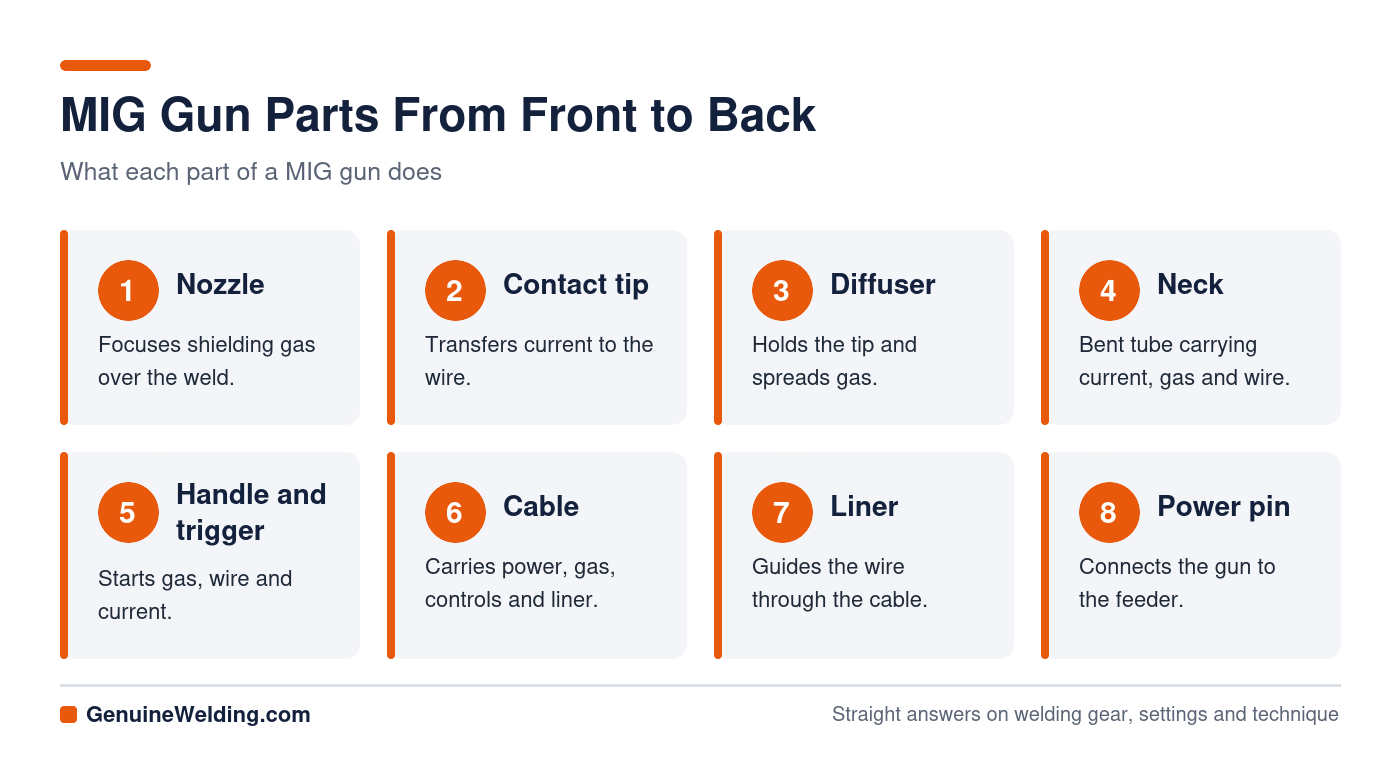
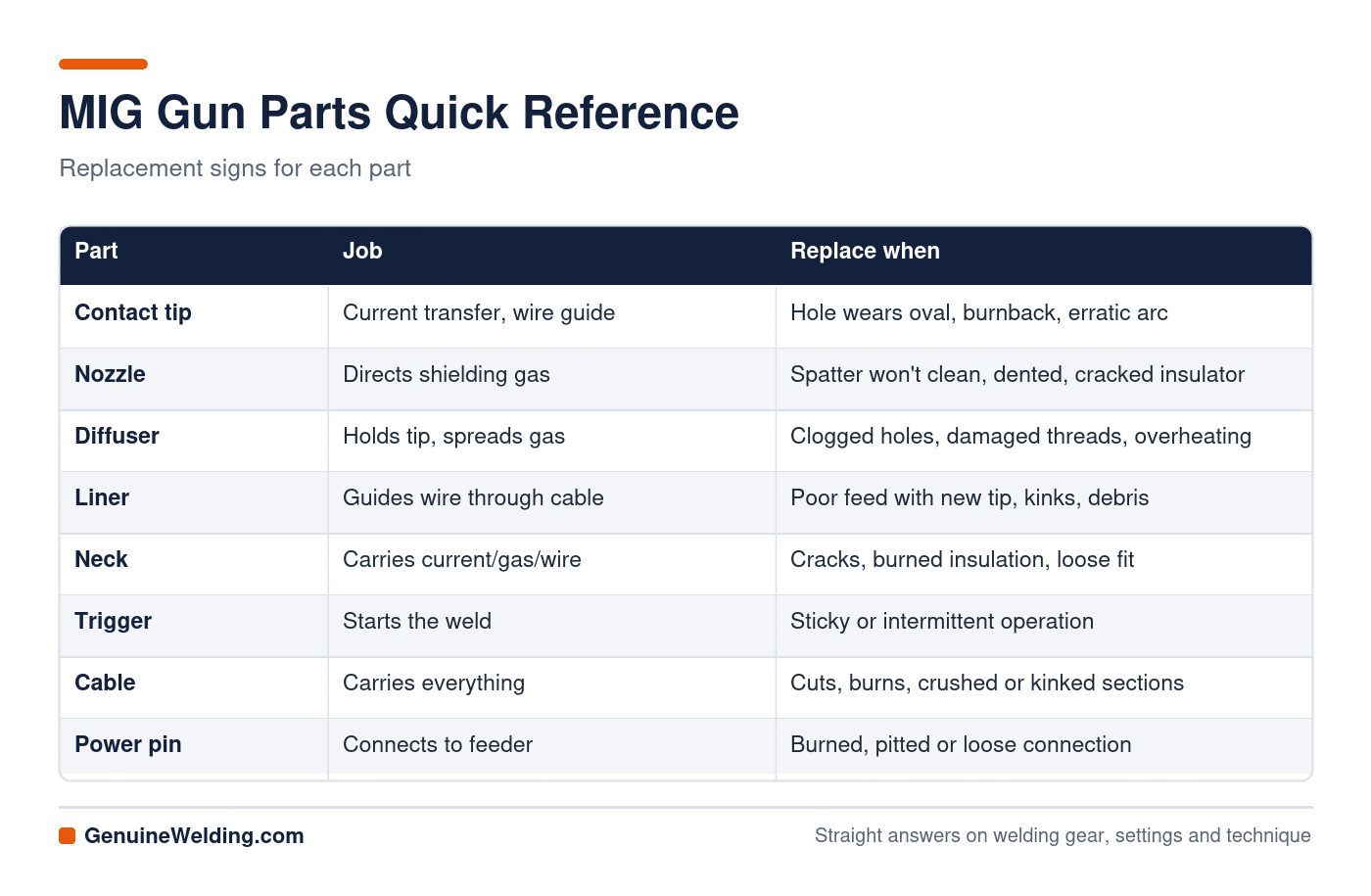
A MIG gun is made of front-end consumables (nozzle, contact tip and gas diffuser), a neck, a handle with trigger, a cable assembly that carries power, gas and wire, a liner inside the cable that guides the wire, and a power pin that connects the gun to the feeder. The contact tip transfers current to the wire, the diffuser holds the tip and spreads shielding gas, the nozzle focuses gas over the weld, and the liner lets wire feed smoothly from the drive rolls to the tip.
When a MIG welder starts misbehaving, the problem is usually in the gun, not the machine. Knowing what each part does makes troubleshooting fast and keeps consumable costs down.
Front-End Consumables
Nozzle
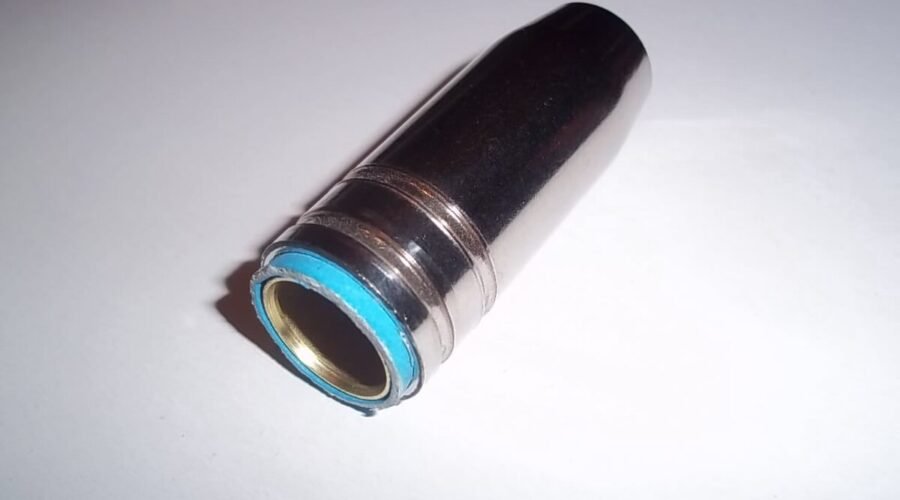
The nozzle (gas cup) slides or threads over the front of the gun and directs shielding gas around the arc. Larger bores give better gas coverage for high-amperage welding; smaller or tapered nozzles reach into tight joints. Spatter buildup inside the nozzle disrupts gas flow and causes porosity, so clean it often and use nozzle gel or anti-spatter spray.
Contact tip
The contact tip transfers welding current to the wire and guides it to the arc. It must match the wire diameter and the gun’s thread style. It’s the most frequently replaced part. See MIG contact tips: sizes and when to replace them.
Gas diffuser (retaining head)
The diffuser screws onto the gun neck, holds the contact tip and has holes that spread shielding gas evenly into the nozzle. Some diffusers also hold the nozzle in place. A blocked or cracked diffuser causes poor gas coverage and overheated tips.
Insulator
Many guns use an insulator between the nozzle and the diffuser or neck so the nozzle isn’t electrically live. A damaged insulator can let the nozzle arc against the work.
Neck (Gooseneck)
The neck connects the front end to the handle and carries current, gas and wire. Necks come in different lengths and bend angles (often 30°, 45° or 60°) to improve access and comfort. Some guns have rotatable or interchangeable necks.
Handle and Trigger
The handle insulates your hand and houses the trigger switch. Pulling the trigger signals the welder to start gas flow, wire feed and current. A sticky or intermittent trigger causes erratic starts. Many guns have lockable triggers for long welds.
Cable Assembly
The cable carries welding current, shielding gas, the trigger control wires and the wire inside the liner. Cables are usually 10 to 25 ft long. Longer cables give more reach but add wire-feed resistance. Keep the cable as straight as possible while welding; tight loops and kinks cause feeding problems.
Liner
The liner runs through the cable from the power pin to the neck and guides the wire. It must match the wire size and type:
- Steel (spring steel coil) liners: for solid steel and flux-cored wire
- Nylon or Teflon (PTFE) liners: for aluminum and sometimes stainless, to reduce friction and prevent shaving
Replace the liner when it’s kinked, worn or clogged with debris, or when wire feeds poorly even with a new tip and correct tension. Cut new liners to the exact length specified for your gun; too long or too short causes feeding issues.
Power Pin and Connector
The power pin (or rear connector) plugs the gun into the wire feeder or welder. Common styles include Tweco, Lincoln, Miller and Euro (Binzel) connectors. It must seat fully and be tight; a loose connection causes overheating and erratic arcs.
MIG Gun Parts Quick Reference
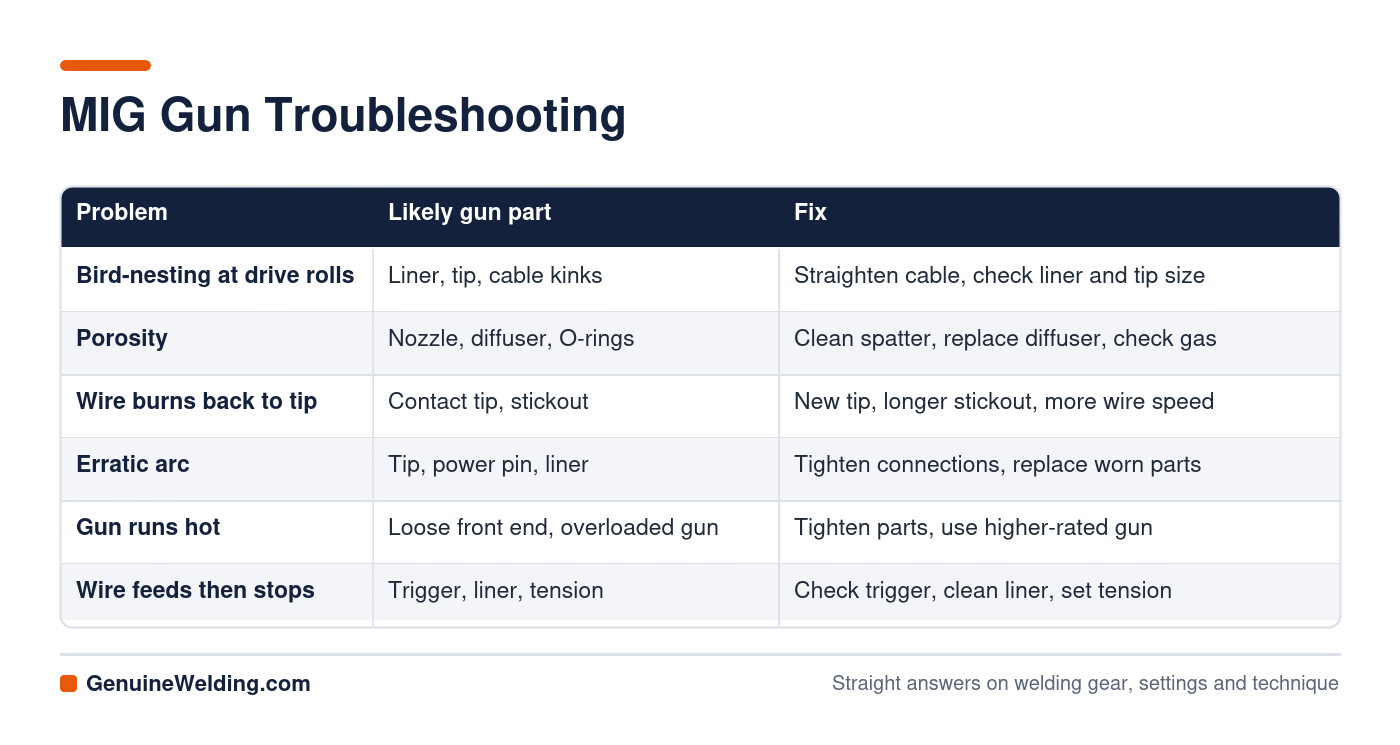
Troubleshooting MIG Gun Problems
More help: how to set up a MIG welder and the weld troubleshooting guide.
How to Maintain a MIG Gun
- Clean spatter from the nozzle and diffuser regularly.
- Replace contact tips when the hole wears or the arc becomes erratic.
- Blow out the liner with compressed air when changing wire spools.
- Check that all front-end parts and the power pin are tight.
- Inspect the cable for cuts, burns and kinks; don’t drag the welder by the gun cable.
- Use consumables from the same system; mixing brands often causes poor fit and overheating.
MIG Gun Parts: FAQs
What is the most commonly replaced MIG gun part?
The contact tip, followed by the nozzle and diffuser. Liners need replacement less often but cause hard-to-diagnose feeding problems when worn.
Are MIG gun parts universal?
No. Consumables are made for specific gun families (for example Tweco, Lincoln, Miller/Hobart, Bernard and Binzel styles). Match parts to your gun.
Do I need a different liner for aluminum?
Yes. Use a nylon or Teflon liner, or better, a spool gun, to feed soft aluminum wire without kinking.
How long should a MIG gun liner be?
As long as your gun’s manual specifies. Most liners are trimmed at the neck end to a measured length after installation.
Why does my MIG gun get hot?
Common causes are exceeding the gun’s amperage or duty cycle, loose front-end parts, a loose power pin or a worn contact tip.