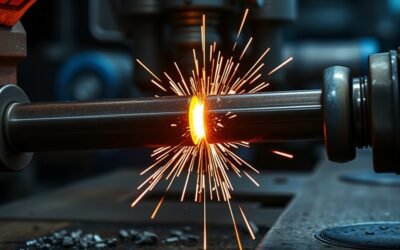
Electroslag welding (ESW) is a high-deposition, single-pass process for joining very thick steel in the vertical position. An arc starts the weld, then it’s extinguished, and electrical current flowing through a bath of molten conductive slag generates the heat that melts the filler wire and the plate edges. Water-cooled copper shoes hold the molten metal in the joint as the weld rises. ESW joins plate roughly 1 in (25 mm) to about 12 in (300 mm) thick, depositing about 15 to 20 kg (33 to 44 lb) of metal per hour per electrode.
Where a submerged arc or flux-core weld on 4 in plate might take dozens of passes and hours of work, an electroslag weld fills it in a single pass. That makes ESW a key process for heavy structural, shipbuilding and pressure vessel work.

How Electroslag Welding Works
- Set up the joint: two thick plates are positioned vertically with a square-edged gap, typically about 3/4 to 1-1/4 in wide.
- Attach copper shoes: water-cooled copper shoes (dams) are clamped on both faces of the joint to contain the molten pool.
- Start the arc: the wire strikes an arc on a starting tab or sump at the bottom, and granular flux is added.
- Form the slag bath: the flux melts into a conductive slag pool. When it covers the wire tip, the arc goes out.
- Resistance heating: current passing through the molten slag heats it well above the melting point of steel, melting the wire and plate edges.
- Weld rises: molten metal sinks below the slag and solidifies. The shoes and wire guide (or the consumable guide) move upward as the joint fills.
- Finish: the weld runs onto a run-off tab at the top, which is later cut off.
Because the arc is extinguished after starting, ESW isn’t technically an arc welding process; it’s a resistance-heated slag process, similar in spirit to submerged arc welding but with a conductive slag doing the work.
Types of Electroslag Welding
- Conventional (nonconsumable guide) ESW: the wire guide and copper shoes travel up the joint on a mechanized carriage.
- Consumable guide ESW: a stationary guide tube extends the full length of the joint and melts into the weld along with the wire. Equipment is simpler and works well on shorter joints.
- Narrow-gap improved ESW (NGI-ESW): a refined version with a narrower gap and controlled heat input to improve weld toughness, developed for bridges.
- Electrogas welding (EGW): a related vertical process that uses an arc and shielding gas instead of a slag bath, typically for somewhat thinner plate.
Key Electroslag Welding Data

Where Electroslag Welding Is Used
- Heavy structural steel: box columns, continuity plates and diaphragm plates in high-rise buildings
- Shipbuilding: thick vertical hull and deck seams
- Pressure vessels and reactors: thick shell longitudinal seams
- Heavy machinery: press frames, mill housings and large castings
- Bridges: using NGI-ESW under specific FHWA conditions
- Cladding: electroslag strip cladding deposits corrosion-resistant overlays on vessel walls
Advantages and Disadvantages

Electroslag Welding in Bridges: The FHWA History
ESW was widely used on U.S. highway bridges in the 1960s and early 1970s. After some welds were found to have poor toughness and defects, the Federal Highway Administration placed a moratorium in February 1977 on electroslag welds in members under tension or stress reversal on federal-aid projects. FHWA then sponsored research that produced narrow-gap improved electroslag welding (NGI-ESW). In March 2000, FHWA rescinded the moratorium and allowed NGI-ESW for non-fracture-critical members in AASHTO temperature zones 1 and 2, on material up to 3 in thick, with 100% radiographic and ultrasonic testing of tension welds. That memo was later superseded by updated FHWA guidance in 2018.
For building structures, the AWS D1.1 Structural Welding Code – Steel includes requirements for qualifying ESW procedures. See welding codes and standards.
Electroslag vs Other Thick-Plate Processes
| Process | Passes on 3 in plate | Position | Notes |
|---|---|---|---|
| Electroslag (ESW) | 1 | Vertical | Fastest for very thick plate; coarse grain |
| Electrogas (EGW) | 1 | Vertical | Better for thinner sections than ESW |
| Submerged arc (SAW) | Many | Flat/horizontal | High quality, needs repositioning |
| Flux-cored (FCAW) | Many | All | Flexible but slow on thick plate |
Electroslag Welding FAQs
What is electroslag welding used for?
Joining very thick steel plates in the vertical position in a single pass, such as box columns, ship hulls, pressure vessels and heavy machinery.
Is electroslag welding an arc welding process?
No. An arc starts the process, but the heat comes from electrical resistance in the molten slag after the arc goes out.
How thick can electroslag welding join?
From about 1 in (25 mm) up to roughly 12 in (300 mm), with multiple electrodes for thicker sections.
Why was electroslag welding banned in bridges?
FHWA restricted conventional ESW in tension members in 1977 because some welds had low toughness and defects. Narrow-gap improved ESW was later developed and permitted under conditions.
What’s the difference between electroslag and electrogas welding?
Electroslag uses resistance heating in molten slag; electrogas uses a continuous arc shielded by gas. Both are vertical, single-pass processes using copper shoes.
Sources
- Wikipedia: Electroslag welding
- TWI: What is electroslag welding?
- FHWA: Electroslag Welding Moratorium Rescinded (2000)