Resistance welding is a pressure-based joining process that uses electrical resistance to generate heat at metal interfaces, producing solid-state joints without filler metal. Spot, seam, projection, butt, and flash welding are the main types. Spot welding serves automotive assembly, seam welding creates leak-tight seams, projection welding suits high-volume dissimilar joints, and butt or flash welding handles strong edge-to-edge parts. Current, time, force, and electrode design control quality, defects, and nugget formation. More detail follows.
Key Takeaways
- Resistance welding joins metals by passing high current through pressed workpieces, using electrical resistance to generate heat without filler metal.
- Main types include spot, seam, projection, butt, and flash welding, each suited to different joint shapes and production needs.
- Spot welding is widely used in automotive assembly, while seam welding creates continuous, leak-tight joints like fuel tanks.
- Projection and butt welding provide strong, high-speed joints, with projection welding effective for dissimilar metals and butt welding for edge-to-edge joints.
- Weld quality depends on current, time, pressure, and electrode condition, which control heat generation, nugget size, and defect prevention.
What Is Resistance Welding?
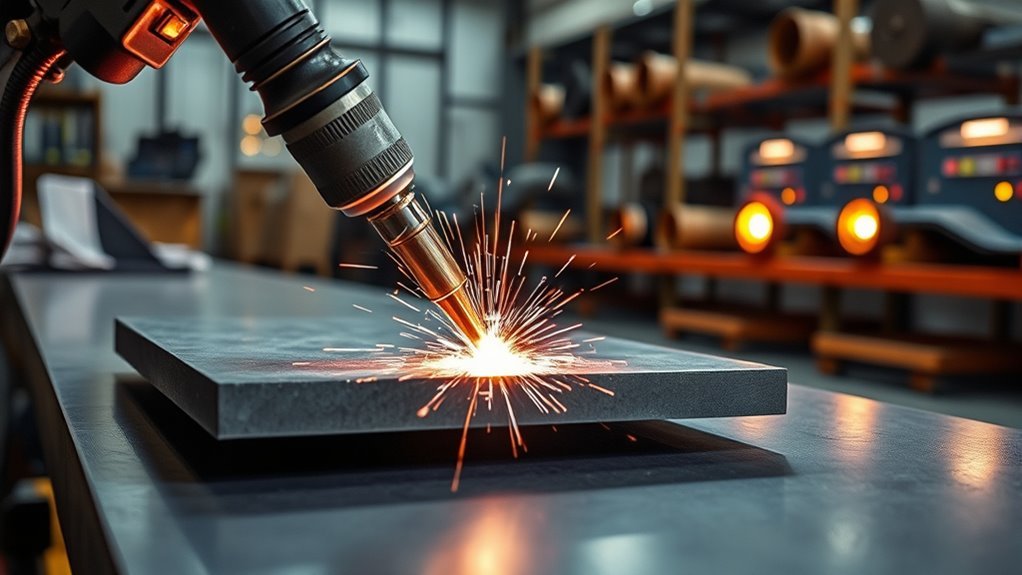
Resistance welding is a metal joining process that produces heat by electrical resistance at the interface of two workpieces while pressure is applied to form a solid-state weld.
In Resistance welding, electrical current passes through contact zones, generating localized heat without added filler metal. This family of processes includes spot, seam, projection, and butt welding, each selected for defined joint geometries, production rates, and materials.
The method is valued for speed, repeatability, and high-strength joints, supporting efficient industrial practice and reducing dependence on external consumables. Commonly joined materials include steels, aluminum alloys, and copper, making the process relevant in automotive and manufacturing applications.
Key welding parameters such as current magnitude, time duration, and electrode design influence joint quality and consistency. As a result, Resistance welding offers a controlled route for joining metal components with precision, economy, and a practical measure of material autonomy.
How Resistance Welding Works
Resistance welding operates by passing electric current through metal workpieces while they are held under pressure between electrodes.
The resulting contact resistance concentrates heat at the interface, causing localized melting and fusion, with heat generation governed by H = I × R × t.
Electrode pressure is essential because it maintains intimate contact, controls resistance, and supports the formation of a sound joint.
Resistance Welding Principle
In resistance welding, electric current is passed through metal workpieces held together under pressure by electrodes, causing localized heating at the contact interface due to electrical resistance.
Welding is a process in which current flow, contact resistance, and heat generation are tightly coupled. The principle depends on welding parameters such as current magnitude, electrode force, and welding time, all of which shape the thermal response.
Heat is commonly represented by H = I * R * t, showing that high temperatures develop where resistance is greatest and current is concentrated. As the interface softens, a weld joint forms under sustained pressure.
Thicker materials generally require longer welding time to achieve adequate bonding. Precise control of these variables promotes consistent strength, efficient energy use, and disciplined industrial production.
Heat Generation Process
Heat is generated at the interface of two metal workpieces when electric current passes through them and encounters contact resistance, producing localized Joule heating.
In resistance welding, this heat generation is governed by H = I²Rt, where welding current, electrical resistance, and time determine the energy delivered to the metal surfaces. Higher current intensifies Joule heating and can enlarge the weld nugget, yet excessive input may cause expulsions.
This welding technique consequently depends on controlled current magnitude and duration to shape each weld with precision.
Pressure from electrodes improves contact, reducing resistance enough to stabilize welding processes while still preserving concentrated heating at the joint.
Accurate parameter selection enables efficient, reliable fusion and supports a disciplined, emancipatory manufacturing practice.
Electrode Pressure Role
Electrode pressure plays a critical role in resistance welding by establishing firm contact between the workpieces and stabilizing the interface where heat is generated. Proper electrode pressure minimizes interfacial gaps, ensuring efficient current flow at the contact point and promoting uniform heat generation.
When pressure is too low, resistance becomes erratic and weld quality declines; when excessive, electrode wear increases and the workpieces may deform. Electrode geometry and material also shape pressure distribution, influencing heat concentration and joint integrity.
In production environments, real-time monitoring and adjusting of electrode pressure are essential to preserve efficiency and maintain consistent weld quality. This control supports reliable fusion, reducing defects and enabling a more autonomous, liberated manufacturing process.
Main Resistance Welding Types
Resistance welding encompasses several distinct process types, each optimized for specific joint geometries and production demands.
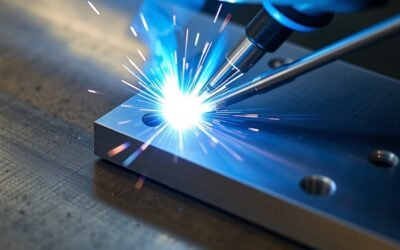
Spot welding is the most common of the resistance welding processes, especially in the automotive industry, where copper electrodes join overlapping metal components into weld nuggets in fractions of a second.
Copper electrodes rapidly fuse overlapping sheets into weld nuggets, making spot welding essential in automotive assembly.
Seam welding replaces point electrodes with rotary wheels, generating continuous joints for leak-proof tanks and pipes.
Projection welding concentrates current on raised projections, enabling multiple high-density welds in one cycle and supporting efficient high-volume production.
Butt welding aligns parts edge to edge, producing full-thickness joints without overlap for pipelines and structural members where strength is decisive.
Flash welding applies a sudden burst of current to melt and cleanse faying surfaces, creating efficient joints in large cross-sectional parts.
Together, these methods define the principal applications of resistance welding, offering controlled, repeatable joining routes that expand industrial autonomy through speed, precision, and material economy.
Resistance Spot Welding Applications
Resistance spot welding is extensively applied in automotive body assembly, where rapid cycle times support high-volume production of car structures.
It is also suited to thin sheet fabrication, joining metals as thin as 0.5 mm with controlled nugget formation and adequate joint strength.
Electrode geometry and automated systems further determine process consistency, making the method effective for both precision manufacturing and repetitive assembly lines.
Automotive Body Assembly
Automotive body assembly relies heavily on spot welding to join steel and aluminum panels into strong, lightweight vehicle structures with high repeatability.
In resistance spot welding, automotive metal parts are clamped between electrode tips, current forms a controlled weld nugget, and manufacturing processes advance with disciplined efficiency. High-volume production depends on rapid cycle times and stable joints when joining dissimilar metals across body-in-white lines.
Typical nugget diameters of 3 to 10 mm support structural integrity while limiting distortion, helping engineers preserve design freedom and material savings. Copper-based electrodes maintain conductivity and durability during continuous operation.
- Door frames align under paired tips.
- Roof rails fuse at precise nodes.
- Floor pans lock into rigid grids.
- Side panels seal into load paths.
Thin Sheet Fabrication
In many thin sheet fabrication lines, resistance spot welding joins steel and aluminum components with low distortion and minimal heat-affected zones, making it well suited to automotive production and other high-speed manufacturing operations.
The spot process passes high current through opposing electrodes, forming a localized nugget in thin sheets without filler metal. Welding is generally selected when rapid joining metal is required at scales where precision and repeatability govern output.
Its compatibility with welding technology and automation lifts production rate while preserving dimensional control. In automotive and construction uses, the method supports strong lap joints and leak-tight joints in fuel tanks, HVAC housings, and other thin-walled assemblies.
Resistance Seam Welding for Leak-Tight Joints
Seam welding uses rotating wheel-shaped electrodes to produce a continuous weld along the joint, making it well suited for leak-tight applications such as fuel tanks and pressure vessels.
In the manufacturing industry, seam welding is used on metal sheets to form leak-tight joints with high structural integrity. The process generates heat along the full seam, producing a continuous weld that binds thin materials without burn-through.
This welding finds applications where precision and freedom from leakage are essential, especially in stainless steel and other ferrous metals. Typical scenes include:
- Two aligned sheets advancing under pressure.
- Heated wheel electrodes tracing the seam.
- A uniform fused line sealing the edge.
- An automated line delivering repeatable output.
Because it is frequently automated, throughput rises and labor demand falls.
Although less suitable for aluminum, it remains highly effective for robust, leak-proof assemblies in constrained, high-performance systems.
Resistance Projection Welding Uses
Resistance projection welding applies concentrated heat and current at small projections or embossments on the parts, allowing localized fusion with limited distortion.
In Resistance Projection, the work pieces are shaped so current density rises at discrete points, promoting efficient joining while preserving surrounding material. This makes the process well suited to high volume production, where multiple welds can be formed in a single cycle with minimal alignment demand.
In the automotive industry, it is used for sensors, valves, wire harnesses, fasteners, and electrical components, where rapid throughput and reliable joints are essential.
The method also joins dissimilar metals effectively because heat is concentrated at the interface, reducing the influence of thermal conductivity differences across the assembly.
Since no filler material is required, the process remains compact, repeatable, and economical. Its controlled nature supports consistent load transfer and helps deliver durable connections across diverse manufacturing sectors, especially where precision and freedom from excess distortion are required.
Resistance Butt and Flash Butt Welding
Butt joining methods create direct edge-to-edge joints by concentrating electrical heat at the interface of aligned metal pieces, producing strong connections without overlap.
In Resistance Butt welding, an electric current passes through the abutting ends, generating resistance heat and a strong joint suited to high-stress applications such as pipelines and structural members. It forms full-thickness joints with direct load transfer, supporting durable, liberated infrastructure.
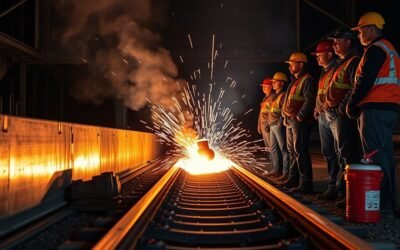
In Flash Butt welding, a surge of electric current creates flashing, expelling contaminants before heat and pressure consolidate the parts. The method is efficient for large sections and joining dissimilar metals.
- Two rail ends glow, clean, and meet.
- Heavy bus bars align under force.
- Pipe edges merge into one line.
- Structural plates lock without overlap.
These processes welding finds applications in mass production because they deliver rapid, reliable, and repeatable results with minimal material waste.
Key Resistance Welding Parameters
At the core of resistance welding lies a tightly controlled set of parameters that determines heat generation, fusion quality, and joint integrity.
Welding current is the dominant variable; because heat rises with the square of current, even modest increases can enlarge the weld nugget and alter strength. Time duration governs total energy input, with thicker sections often requiring longer exposure to secure bond formation.
Welding current dominates heat generation, while duration balances energy input for strong, consistent bond formation.
Resistance at the base metal and interface shapes heating efficiency: lower resistance can concentrate energy where liberation from mechanical restraint is needed.
Electrode design, including shape, size, and material, directs current density across the weld area and stabilizes contact conditions.
Material properties such as conductivity, thickness, and melting point further define process windows in the types of resistance welding.
High welding performance depends on matching these parameters so the joint forms with precision, consistency, and minimal wasted energy.
Common Resistance Welding Defects
Common resistance welding defects often originate from process instability, poor part fit-up, or degraded tooling, and they directly reduce joint strength and consistency.
In Resistance Spot joining, metal pieces must be clamped and heated with controlled force; otherwise welding defects emerge as weak nuggets, expulsion, or cracking.
- Electrode degradation narrows current paths and alters pressure.
- Gaps between sheets prevent full contact and raise resistance.
- Misalignment of electrodes creates uneven heat and incomplete fusion.
- Thermal expansion/contraction and liquid metal embrittlement can distort or fracture the joint.
Each mode undermines fatigue life and dimensional accuracy.
Effective quality control consequently requires inspection of electrode shape, fit-up, alignment, and material compatibility before production.
Stable schedules, precise tooling, and timely replacement of worn tips restore process freedom by limiting defect formation at the source.
Frequently Asked Questions
What Are the Different Types of Resistance Welding?
The different types of resistance welding include spot welding, seam welding, projection welding, flash welding, and upset welding.
Each process relies on resistance welding equipment and carefully controlled welding parameters to localize heat and form joints.
Spot welding suits sheet metals, seam welding creates continuous seams, projection welding concentrates current at raised points, while flash welding and upset welding join sections end to end.
Laser welding and thermocompression bonding are separate processes.
What Are the Applications of Resistance Welding?
Resistance welding is applied in automotive manufacturing, electronics assembly, metal fabrication, aerospace applications, HVAC systems, railway construction, medical devices, jewelry production, and the construction industry.
It enables fast, repeatable joining of metals with high structural integrity, low distortion, and precise control of heat input. Its utility spans body panels, electrical contacts, leak-tight seams, critical aircraft components, pipework, connectors, and fine assemblies where efficient, liberated production demands reliability.
What Are the 7 Basic Types of Welding?
Like a forge of endless possibility, the seven basic types are Arc Welding, MIG Welding, TIG Welding, Spot Welding, Seam Welding, Projection Welding, and Laser Welding.
Electron Beam welding and Submerged Arc are also commonly recognized in practice, depending on classification.
Arc Welding melts metal with an electric arc; MIG and TIG offer controlled fusion; resistance methods such as spot, seam, and projection enable rapid, precise joining for liberated industrial production.
What Are the Four Types of Welding Processes?
The four types of welding processes are arc welding, resistance welding, gas welding, and laser welding.
Arc welding includes MIG welding, TIG welding, plasma welding, and electron beam methods for diverse joints.
Resistance welding covers spot welding and seam welding for high-speed production.
Gas welding uses a flame to fuse metals, while laser welding delivers precision.
Friction welding is often categorized separately, yet it supports advanced manufacturing autonomy.
Conclusion
In conclusion, resistance welding unites metals through controlled heat and pressure, offering efficient, repeatable joining across spot, seam, projection, butt, and flash butt processes. Its strength lies in speed, automation, and suitability for mass production, while joint quality depends on current, force, time, and electrode condition. When properly controlled, the process performs like a precisely calibrated instrument, delivering consistent welds. However, defects remain possible if parameters drift outside specified limits.