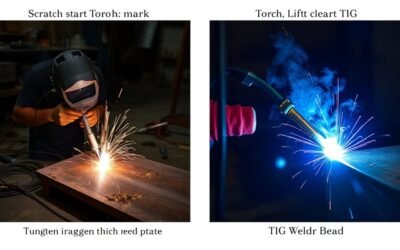
Metal transfer modes in MIG welding describe how molten electrode metal moves across the arc and into the weld pool. The main modes are short-circuit, globular, spray, and pulsed-spray transfer. Each behaves differently in terms of heat, penetration, spatter, deposition rate, welding position, shielding gas, and equipment requirements, so choosing the right mode is an important part of producing a sound weld.
Quick Answer
Short-circuit MIG uses repeated wire contact and relatively low heat, making it useful for thin material and all-position welding. Globular transfer forms large, spatter-prone droplets. Conventional spray uses a hot, stable arc with fine droplets for thicker material, mainly flat or horizontal. Pulsed spray reduces average heat and expands positional control.
Key Takeaways
- Short-circuit transfer uses repeated wire-to-puddle contact, relatively low current and heat, and works well on thin material and in all welding positions.
- Globular transfer produces droplets larger than the wire diameter, generally creates substantial spatter, and is usually limited to flat or horizontal work.
- Spray transfer produces fine droplets, high deposition rates, good fusion, and very little spatter, but its hot, fluid puddle normally limits conventional spray to flat and horizontal positions.
- Pulsed-spray transfer alternates peak and background current, lowering average heat compared with conventional spray and making spray-like transfer practical in more positions.
- Transfer mode depends on the complete setup: wire type and diameter, wire-feed speed/current, voltage, shielding gas, contact-tip-to-work distance, material, joint, and power source.
What Are Metal Transfer Modes?
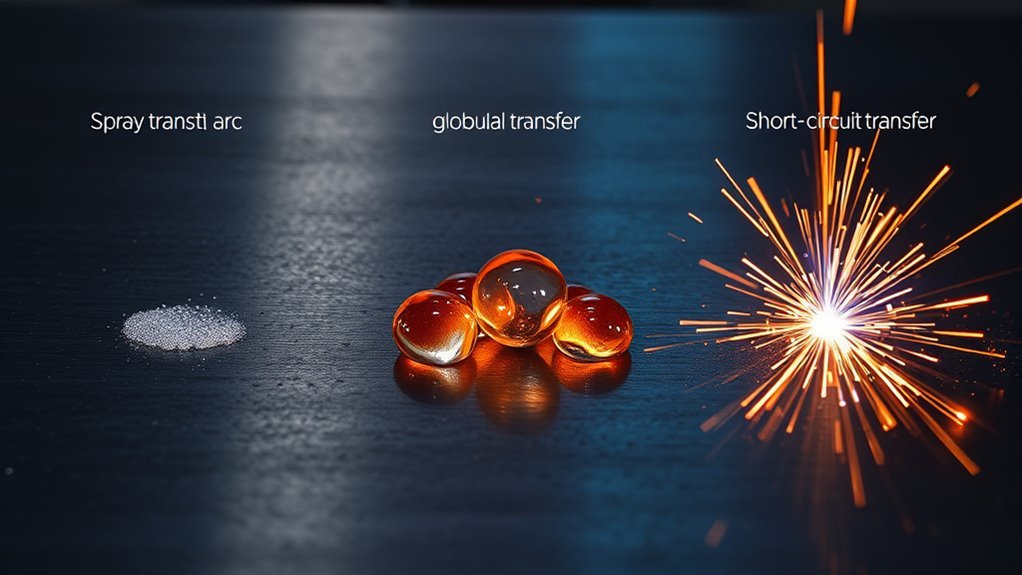
Metal transfer modes in MIG welding, also called gas metal arc welding or GMAW, describe the way molten filler metal leaves the continuously fed electrode wire and crosses the arc into the weld pool.
The three conventional transfer behaviors are short-circuit, globular, and spray transfer. Pulsed-spray transfer is an electronically controlled variation of spray transfer in which the machine cycles between a high peak current and a lower background current.
Transfer mode affects arc stability, puddle fluidity, penetration, deposition rate, spatter, welding position, and the risk of defects such as lack of fusion or burn-through. According to Miller’s guidance on MIG transfer modes, shielding gas, voltage, amperage, and power-source capability all influence which mode occurs.
There is therefore no single voltage, wire-feed speed, or gas blend that universally creates a specific transfer mode. The correct range depends on the electrode material and diameter, shielding gas, base material, joint design, and welding procedure.
Note: For production or code work, use the filler-metal manufacturer’s recommended parameter chart and the applicable qualified welding procedure specification (WPS). Generic settings are starting concepts, not substitutes for a qualified procedure.
MIG Welding Transfer Modes Compared
| Mode | Typical Heat | Spatter | Positions | Common Use |
|---|---|---|---|---|
| Short circuit | Low to moderate | Moderate; depends strongly on setup | All positions | Thin material, root work, position-sensitive joints |
| Globular | Moderate to high | High | Primarily flat/horizontal | Certain carbon-steel applications, often with CO₂-rich shielding |
| Spray | High | Very low when correctly set | Flat and horizontal | Thicker material, high deposition, production welding |
| Pulsed spray | Lower average heat than conventional spray | Low | Can be used in all positions with the proper procedure | Thin-to-thick material, out-of-position work, aluminum, stainless, production welding |
How Short-Circuit Transfer Works
Short-circuit transfer begins when the continuously fed electrode wire reaches the weld pool and physically contacts it. That contact creates an electrical short circuit. Current rises, the end of the wire pinches off into the puddle, the arc reestablishes, and the cycle begins again.
This repeated contact-and-reignition cycle occurs many times each second. Hobart Brothers describes short-circuit transfer as typically occurring about 90 to 200 times per second.
Because short-circuit transfer operates at relatively low current and voltage, it produces a smaller, cooler puddle than conventional spray transfer. This makes it especially useful where heat control and positional control matter.
Short Circuit Contact
During short-circuit contact, the wire repeatedly touches the molten weld pool. Metal transfer occurs during these brief short-circuit events rather than as a continuous stream of droplets across an open arc.
Smaller solid-wire diameters are commonly used for light-gauge work, but wire diameter should be selected for the joint, material thickness, amperage range, and machine capability rather than by one universal rule.
A consistent contact-tip-to-work distance, or CTWD, is important. Excessive changes in CTWD affect electrical stickout, current, arc length, penetration, and transfer stability.
- Lower operating parameters help control thin material.
- A stable CTWD improves arc consistency.
- Incorrect settings can increase spatter or produce an erratic arc.
- On thick joints, inadequate heat can contribute to lack of fusion.
Controlled Wire Reignition
After each droplet transfers, the short circuit clears and the arc reignites. This rapid sequence gives short-circuit MIG its characteristic sound and relatively cool operating behavior.
A 75% argon/25% CO₂ blend is a common choice for short-circuit welding of carbon steel, although other gases can be appropriate depending on the wire and procedure. Hobart identifies approximately 75/25 argon/CO₂ as a common short-circuit blend for solid wire.
Short-circuit transfer is often used on material around 1/8 inch or thinner, but that figure is a practical guideline rather than an absolute limit. The mode can be used on thicker material when the joint design and procedure support adequate fusion.
When to Use Short-Circuit Transfer
Short-circuit transfer is useful when heat control, thin-material capability, and welding-position flexibility matter more than maximum deposition rate.
According to Miller’s welding-position guidance, short-circuit MIG can be used in all positions.
- Thin sheet and tubing: lower heat helps reduce burn-through and distortion.
- Vertical or overhead joints: the smaller puddle is easier to control than conventional spray.
- Root passes and gap-sensitive work: the operator can manage the puddle at relatively low heat.
- Confined joint geometry: a smaller, less fluid puddle may be easier to place accurately.
The main limitation is fusion. On thicker or highly restrained joints, a poorly designed short-circuit procedure may deposit metal without adequately melting the sidewalls or root. Correct joint preparation, travel speed, wire feed, voltage, work angle, and procedure qualification are therefore important.
Pro Tip: Do not judge short-circuit settings only by the familiar “frying bacon” sound. Confirm bead shape, tie-in, penetration, and the manufacturer’s recommended parameter range. A pleasant arc sound does not prove that the weld has adequate fusion.
How Globular Transfer Works
Globular transfer occurs when relatively large droplets of molten electrode metal form at the wire tip and cross the arc into the weld pool. The droplets are generally larger than the electrode diameter and transfer less uniformly than spray droplets.
Globular transfer commonly appears between short-circuit and spray conditions, depending on current, voltage, gas composition, electrode type, and wire diameter. With carbon steel, high-CO₂ or 100% CO₂ shielding can promote globular behavior at currents above the short-circuit range.
The arc and droplet movement are less stable than optimized spray transfer, so globular welding commonly produces substantial spatter and a rougher bead appearance.
It is generally most manageable in flat and horizontal positions, where gravity helps control the relatively large, fluid droplets.
Where Globular Transfer Makes Sense
Globular transfer can be used on thicker carbon-steel work where low shielding-gas cost or an established procedure makes the mode practical. However, it is usually selected less often than well-optimized short-circuit, spray, pulsed MIG, or flux-cored procedures because of its spatter and comparatively irregular transfer.
Thick Material Welding
On heavier material, globular transfer can operate at higher current and heat than short-circuit transfer. That does not mean it automatically provides better penetration or weld quality than spray transfer.
For many flat and horizontal production applications where the equipment and gas are available, conventional spray transfer provides a smoother arc, lower spatter, and high deposition rates.
- Globular transfer can handle higher deposition than light short-circuit settings.
- Large droplets make puddle behavior less smooth than spray transfer.
- Spatter and cleanup can reduce the productivity gained from higher deposition.
- Joint design and procedure still determine whether adequate fusion is achieved.
Flat And Horizontal Joints
Globular transfer is usually easiest to control in flat and horizontal joints because gravity helps carry the large droplets toward the puddle. Vertical and overhead use becomes difficult as the molten droplets and weld pool become harder to control.
Conventional spray transfer is also primarily a flat-and-horizontal process, but for a different reason: its high-current arc creates a very fluid weld pool. Pulsed spray reduces average current and puddle fluidity enough to expand spray-like transfer into additional positions when the machine and procedure support it.
Managing Spatter Cleanup
Substantial spatter is one of globular transfer’s main disadvantages. Spatter can adhere to the workpiece, gun nozzle, fixtures, and surrounding surfaces, adding cleanup time and potentially interfering with gas coverage if buildup is allowed to accumulate inside the nozzle.
- Use the recommended voltage and wire-feed range for the selected wire and gas.
- Maintain consistent CTWD and gun angle.
- Keep the nozzle and contact tip in serviceable condition.
- Remove rust, oil, moisture, paint, and other contamination when the welding procedure requires clean base metal.
- If globular transfer is unintentional, verify the shielding gas and determine whether the process should be moved into a stable short-circuit or spray range.
How Spray Transfer Creates Cleaner Welds
Spray transfer sends a rapid stream of small molten droplets axially across the arc. The droplets are generally smaller than the electrode diameter, and the wire does not repeatedly short into the puddle after the arc is established.
This stable transfer can produce very little spatter, a smooth bead appearance, high deposition rates, and good fusion. It is one reason spray transfer is widely used for higher-productivity welding of thicker material.
Unlike short-circuit transfer, conventional spray operates at relatively high current and voltage. The puddle is therefore hot and fluid rather than low-heat.
Conventional spray transfer combines fine droplets, a stable continuously burning arc, high deposition, and very low spatter—but it also produces a hot, fluid weld pool that normally restricts welding to flat and horizontal positions.
Spray transfer also requires an appropriate shielding gas. Carbon-steel spray normally uses an argon-rich gas rather than straight CO₂. The exact minimum argon percentage depends on the electrode and procedure. Miller notes that carbon-steel spray and pulsed welding generally require at least about 80% argon, while Hobart guidance for some solid-wire applications specifies at least 85% argon.
Why Spray Transfer Works for Thicker Metal
Spray transfer is well suited to heavier sections because it combines relatively high current with a stable arc, strong energy delivery, high filler-metal deposition, and a fluid puddle that wets into the joint.
These same characteristics make conventional spray less suitable for very thin sheet or uncontrolled out-of-position work, where excessive heat and puddle fluidity can cause burn-through, sagging, or loss of control.
Penetration and Fusion
With the correct joint design and parameters, spray transfer can provide strong penetration and sidewall fusion. The high-current arc continuously delivers heat to the joint rather than repeatedly extinguishing as in short-circuit transfer.
- Higher current supports strong fusion on heavier sections.
- Fine droplets transfer smoothly into the puddle.
- Very low spatter can reduce post-weld cleanup.
- The hot puddle requires appropriate material thickness and travel control.
Penetration is never determined by transfer mode alone. Joint geometry, arc length, current, travel speed, torch angle, electrode size, material, and shielding gas all affect the final penetration profile.
High Deposition Rates
One of spray transfer’s main advantages is its high deposition rate. A larger amount of electrode can be melted and transferred smoothly into the joint than with typical low-current short-circuit settings.
This can improve productivity on thick plate and long welds, especially where the joint can remain in a flat or horizontal position.
Low spatter further improves effective productivity because less deposited wire is lost around the joint and less time is required for cleanup.
Stable Arc Control
A correctly established spray arc is smooth and stable. Once the process is above the transition into spray transfer, fine droplets move axially through the arc instead of forming large irregular globules.
The operator still has to control travel speed, CTWD, work angle, shielding-gas coverage, and joint placement. Excessive arc length, poor gas coverage, incorrect current, or improper CTWD can degrade the bead even when the process is nominally in spray transfer.
How Pulsed-Spray Transfer Improves Control
Pulsed-spray transfer, often called pulsed MIG or GMAW-P, uses an advanced power source that rapidly alternates between a high peak current and a lower background current.
During the peak portion of the waveform, current rises high enough to detach a controlled droplet. During the background portion, the arc remains established but average current and heat are reduced.
This gives pulsed spray several practical advantages over conventional spray:
- Lower average heat input than conventional spray.
- Better control on thinner sections.
- Lower risk of burn-through when the procedure is properly set.
- Low spatter.
- Good deposition efficiency.
- Improved control of the molten puddle.
- Capability for out-of-position welding with appropriate equipment and settings.
Miller notes that pulsed MIG can be used in all positions, while conventional spray transfer is generally limited to flat and horizontal welding.
Pulsed welding also requires a power source capable of generating the required waveform. Modern synergic machines may coordinate wire feed, peak current, background current, pulse frequency, and arc length automatically after the operator selects the wire, diameter, gas, and material.
What Is the Spray Transition Current?
The change from globular behavior to true spray transfer does not occur at one universal voltage. Instead, spray transfer develops when the welding current exceeds a transition-current range for the particular electrode and shielding gas.
That transition changes with:
- Electrode material.
- Wire diameter.
- Shielding-gas composition.
- Electrode extension or CTWD.
- Power-source characteristics.
For that reason, a statement such as “spray begins at 27 volts” is not reliable by itself. Two setups operating at the same voltage can be in different transfer modes because their wire size, current, gas, or electrical stickout differs.
Note: Wire-feed speed on a constant-voltage MIG system strongly affects welding current. Increasing wire feed generally increases amperage, but the exact relationship depends on electrode diameter, extension, material, and machine characteristics.
How to Choose the Right Transfer Mode
The best transfer mode is the one that matches the base material, thickness, welding position, joint design, required deposition rate, shielding gas, power source, and qualified procedure.
- Choose short circuit when thin material, gap control, or all-position capability is the priority.
- Use globular when an established carbon-steel procedure specifically calls for it and its spatter and positional limits are acceptable.
- Choose conventional spray for high-deposition welding of suitable thicker material in flat or horizontal positions.
- Choose pulsed spray when spray-like transfer is desired with lower average heat, better puddle control, or out-of-position capability.
Material also changes the decision. Carbon steel, stainless steel, and aluminum do not use identical gases or parameter ranges.
How Wire, Gas, and Settings Affect Transfer
Wire diameter, shielding gas, wire-feed speed, current, voltage, polarity, CTWD, and power-source characteristics all influence metal transfer.
Wire Diameter and Wire-Feed Speed
Smaller wires reach a given current density at different feed rates than larger wires. Wire-feed speed strongly influences welding current on typical constant-voltage MIG equipment.
A wire size that works well for thin short-circuit welding may not be the best choice for a high-deposition spray application. Follow the consumable manufacturer’s recommended operating range.
Shielding Gas
Shielding gas has a major influence on transfer behavior.
- Carbon steel, short circuit: 75% argon/25% CO₂ is a common mixture, although straight CO₂ and other blends may also be used depending on the procedure.
- Carbon steel, spray/pulsed spray: an argon-rich blend is normally required. Miller identifies 90% argon/10% CO₂ as a common choice and notes a typical minimum argon content around 80% for spray/pulsed operation.
- Solid-wire spray: some Hobart guidance specifies at least 85% argon, illustrating why the wire manufacturer’s data should control the final choice.
- Aluminum: CO₂-containing steel blends are not used. MIG welding commonly uses 100% argon or suitable argon/helium mixtures.
- Stainless steel: specialized argon-rich mixtures are commonly used; gas selection should match the wire manufacturer’s recommendation and required weld properties.
Voltage and Current
Short-circuit transfer normally operates at lower current and voltage than spray transfer. Raising wire feed/current and voltage can move the process through different transfer behavior, but the boundaries depend on the complete welding setup.
Too little voltage for the selected wire-feed speed can produce an unstable, harsh arc and excessive spatter. Excessive voltage can lengthen the arc, flatten the bead, increase undercut risk, and reduce control.
Polarity and Power Source
Solid-wire MIG welding is normally performed with direct-current electrode positive (DCEP) unless the electrode or equipment manufacturer specifies otherwise.
Short-circuit, globular, and conventional spray modes can be produced with conventional constant-voltage MIG equipment when the wire, gas, and parameters support them. Pulsed spray requires a power source designed to create the pulsed waveform.
Contact-Tip-to-Work Distance
CTWD changes electrical stickout and therefore affects current, penetration, arc behavior, and deposition. A large change in CTWD can move the process away from the manufacturer’s intended operating window even if the machine settings have not changed.
Use the CTWD recommended for the selected electrode and procedure rather than assuming one distance fits every transfer mode.
How to Identify the Transfer Mode While Welding
Transfer modes have recognizable characteristics, although visual observation should be combined with the manufacturer’s parameter data rather than used as the only test.
- Short circuit: repeated wire-to-puddle contact, noticeable rapid crackling, smaller puddle, and periodic arc interruption.
- Globular: visibly larger droplets, irregular transfer, more arc disturbance, and substantial spatter.
- Spray: smooth continuously burning arc, fine droplets moving axially toward the puddle, and very little spatter.
- Pulsed spray: controlled rhythmic arc produced by programmed peak/background current cycling, typically with low spatter and a more controllable puddle than conventional spray.
When welding for code, structural, or critical applications, the transfer mode should be established by the welding procedure and verified through the specified electrical parameters—not simply identified by sound.
Common Transfer-Mode Problems and Fixes
Excessive Spatter
Excessive spatter may indicate an unsuitable relationship between voltage and wire-feed speed, excessive or inconsistent CTWD, contaminated material, poor work-lead connection, incorrect gas, worn gun components, or operation in globular transfer when another mode was intended.
Do not simply keep increasing voltage. Return to the manufacturer’s recommended parameter range and verify gas, wire, polarity, CTWD, and electrical connections.
Lack of Fusion
Lack of fusion can occur when heat input is too low, travel is too fast, the gun angle is incorrect, the joint is poorly prepared, or short-circuit parameters are used on a joint that requires a hotter procedure.
For critical work, visual appearance alone cannot establish adequate fusion. Follow the applicable WPS and inspection requirements.
Burn-Through
Burn-through is most likely when heat input is too high for the material thickness or joint gap. Conventional spray is particularly challenging on light sheet because of its high current and fluid puddle.
Possible solutions include using an appropriate short-circuit or pulsed procedure, reducing the parameter range as allowed by the WPS, increasing travel speed appropriately, improving fit-up, or using backing where permitted.
Unstable or Accidental Globular Transfer
If a process intended to run in spray transfer instead produces large irregular droplets, verify the shielding gas first. An argon content that is too low for the selected wire can prevent stable axial spray transfer.
Also check whether welding current is above the transition range recommended for that electrode diameter and gas.
Safety When Changing MIG Transfer Modes
Warning: Higher-current spray and pulsed processes can increase arc radiation, heat, molten-metal exposure, and fume generation. Use appropriate welding PPE, protect nearby workers from arc radiation, provide adequate ventilation or local exhaust, remove combustible hazards, and follow applicable equipment and workplace safety requirements.
Transfer-mode selection is not only a weld-quality decision. Welding creates intense ultraviolet and infrared radiation, hot metal, sparks, electrical hazards, fumes, and fire risk.
OSHA’s welding, cutting, and brazing requirements address PPE, ventilation, fire prevention, confined spaces, and other workplace controls. Local exhaust or other ventilation may be necessary to keep welding fumes and gases out of the breathing zone.
Never assume outdoor welding automatically guarantees adequate fume control, and do not weld inside tanks, vessels, or other confined spaces without following the applicable confined-space and ventilation procedures.
Frequently Asked Questions
What is the difference between globular and spray transfer?
Globular transfer moves relatively large, irregular droplets across the arc and normally produces more spatter. Spray transfer moves much smaller droplets axially across a stable arc, producing high deposition rates and very little spatter. Both usually favor flat or horizontal welding, but conventional spray requires an appropriate argon-rich shielding gas and sufficient current to exceed the spray-transition range.
What do short circuit, globular, spray, and pulsed spray mean in GMAW?
They describe different ways electrode metal transfers into the weld pool. Short circuit transfers metal during repeated wire contact. Globular transfer uses large droplets. Spray transfer uses a continuous stream of fine droplets. Pulsed spray electronically cycles between peak and background current to transfer controlled droplets with lower average heat than conventional spray.
What are the three basic modes of metal transfer?
The three conventional GMAW transfer behaviors are short-circuit, globular, and spray transfer. Pulsed-spray transfer is commonly discussed as a fourth mode because modern power sources deliberately control the current waveform to produce spray-like droplet transfer at a lower average current.
What is the difference between short-circuit transfer and spray-arc transfer?
Short-circuit transfer repeatedly touches the wire to the puddle and normally operates at lower current and heat, which makes it useful on thin metal and in all positions. Conventional spray maintains an open arc and transfers fine droplets at higher current, giving high deposition and low spatter but a hotter, more fluid puddle that is normally limited to flat and horizontal work.
Can you use 75% argon and 25% CO₂ for spray transfer?
A 75/25 argon/CO₂ blend is widely used for short-circuit welding of carbon steel, but it is generally not the preferred mixture for stable conventional spray transfer with solid wire. Spray normally needs a more argon-rich gas. Follow the electrode manufacturer’s data because the required argon percentage varies with the wire and application.
Can conventional spray transfer be used vertically or overhead?
Conventional spray transfer is normally limited to flat and horizontal welding because its high-current arc produces a very fluid puddle. Pulsed-spray MIG can provide spray-like transfer with lower average heat and better puddle control, allowing properly developed procedures to be used in additional positions.
At what voltage does MIG welding change to spray transfer?
There is no universal spray-transfer voltage. The transition depends on electrode material and diameter, shielding gas, current, wire-feed speed, CTWD, and power-source characteristics. Use the wire manufacturer’s spray-transfer parameter range rather than relying on one voltage number.
Conclusion
Metal transfer mode has a major effect on MIG welding performance. Short-circuit transfer provides lower heat and excellent positional flexibility for thin material and controlled joints. Globular transfer uses large droplets and generally creates more spatter, so its applications are more limited. Conventional spray transfer provides a smooth, high-current arc, fine droplets, high deposition, good fusion, and very little spatter on suitable thicker material, primarily in flat and horizontal positions. Pulsed spray retains many spray-transfer advantages while reducing average heat and improving puddle control.
The correct mode cannot be selected from thickness alone. Wire type and diameter, shielding gas, welding position, joint design, CTWD, current, voltage, power-source capability, and the applicable welding procedure all matter. Use the equipment and filler-metal manufacturer’s parameter data as the starting point and verify weld quality through the inspection requirements appropriate to the job.
Sources
- Miller — Guide to Pulsed MIG Welding in Manufacturing — transfer-mode characteristics, pulsed-spray operation, and shielding-gas guidance.
- Miller — Basic Welding Positions — positional limits for short-circuit, conventional spray, and pulsed MIG.
- Hobart Brothers — Welding Transfer Modes — short-circuit frequency, globular behavior, spray characteristics, CTWD, and applications.
- Hobart Brothers — Choosing Solid Wire — wire diameters, voltage ranges, shielding gases, and spray-transfer gas requirements.
- OSHA 29 CFR 1910.252 — Welding, Cutting, and Brazing — PPE, ventilation, confined-space, and welding-safety requirements.