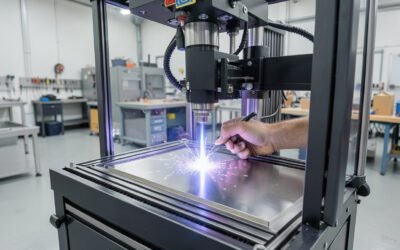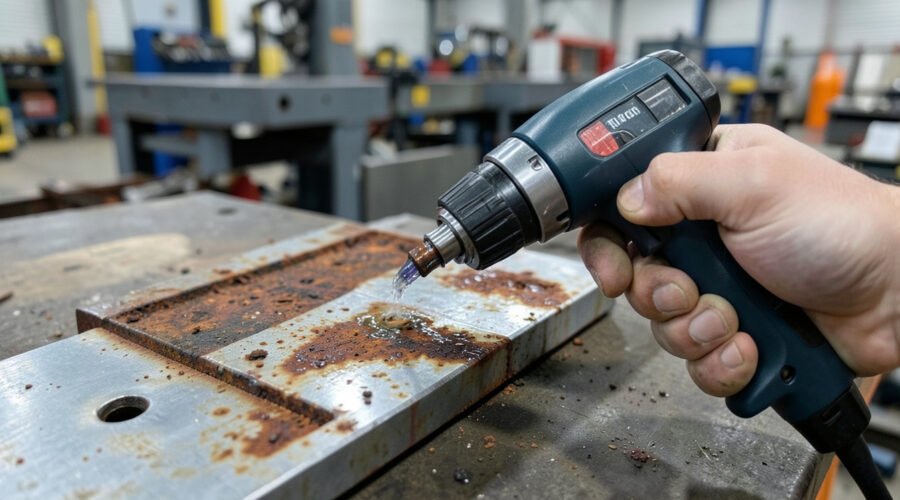
Laser rust removal uses short pulses of focused laser light, usually from a fiber laser, to vaporize rust, paint and oxide from metal without touching the surface. It is fast, clean and leaves no media or chemicals, but the machines are expensive, use Class 4 lasers that need strict safety controls, and are only worth buying for frequent or high-value work.
Laser cleaners have moved from factory lines to handheld units sold online. This guide explains how the process works, what it costs, how it compares with blasting, wire wheels and chemicals, and who should and should not buy one.
Laser Rust Removal at a Glance
- Process: laser ablation. The rust absorbs the energy and flashes off, while the bare metal reflects most of it.
- Laser type: pulsed fiber lasers are favored for rust; continuous-wave lasers can overheat the metal.
- Safety class: Class 4, which can damage eyes and skin and start fires. Training and proper eyewear are essential.
- Cost: from a few thousand dollars for entry handhelds up to tens of thousands for industrial systems.
- Best for: precision parts, molds, weld prep and repeat work.
Laser vs Other Rust Removal Methods
| Method | Pros | Cons |
|---|---|---|
| Laser cleaning | No media, no chemicals, precise, low waste | High cost, Class 4 laser safety, slower on large areas |
| Sandblasting or media blasting | Fast on large areas, cheap equipment | Messy, dust, media cleanup |
| Wire wheel or flap disc | Cheap, simple | Removes metal, dusty, slow on pitting |
| Chemical rust remover | Reaches into crevices | Slow, hazardous waste |
| Electrolysis | Gentle on small parts | Slow, setup needed |
How Laser Rust Removal Works
A laser rust remover aims a pulsed beam at the surface. Rust and paint absorb the energy, heat quickly and vaporize or are blown off by micro-explosions. Clean metal reflects most of the beam, so the process largely stops when the metal is bare. This is called laser ablation. The operator moves a handheld head across the surface, or a robot arm does it on an automated line. A fume extractor removes the particles.
Pulsed vs Continuous-Wave Lasers
Pulsed lasers deliver short, high-energy bursts, which remove rust with little heat in the base metal. Continuous-wave (CW) lasers are cheaper but put more heat into the part and are better for loose paint than for tough rust. If you are buying, check the laser type and power, usually in the range of 100 W to 3,000 W for handheld cleaners.
How Much Does a Laser Rust Remover Cost?
Prices vary widely with power, laser source, cooling and safety features. Entry-level handheld cleaners cost several thousand dollars, mid-range pulsed machines cost much more, and industrial systems with automation cost far more still. Running costs are low because there are no consumables, but you need electricity, an extractor and sometimes cooling. Compare against the cost of media, chemicals and labor if you clean parts often. See our roundup of laser rust removal machines for options.
Is Laser Rust Removal Worth It?
Yes, if you clean many parts, work with precision surfaces such as tools and molds, prepare welds regularly, or restore classic vehicles for a living. No, if you have one rusty project, large panels to clean or a small budget. For a single job, a wire wheel, flap disc or a local blasting service costs far less. See how to remove rust with a wire wheel.
Laser Cleaning Before Welding
Welding over rust causes porosity and weak welds. Laser cleaning leaves a clean surface without embedded grit and without removing base metal, which makes it useful for weld prep on stainless, aluminum and structural steel. Always clean the weld zone just before welding, because bare steel starts rusting quickly again. See our guide on welding porosity.
Laser Safety
- Class 4 lasers can cause permanent eye injury, even from reflected light. Use laser safety eyewear rated for the wavelength.
- Use an enclosed work area or barriers and warning signs.
- Extract fumes; ablated paint and coatings can contain lead, chromium or other hazards.
- Keep flammable material away.
- Follow OSHA guidance on laser hazards and, for business use, appoint a laser safety officer.
FAQs
Does laser rust removal damage the metal?
When set up correctly, it removes the rust and leaves the base metal largely unchanged. Wrong settings can discolor or heat the surface, so follow the manufacturer’s guidance.
How fast is laser rust removal?
Speed depends on laser power and the thickness of rust. High-power machines clean quickly on light rust, while heavy scale takes multiple passes.
Can I use a laser rust remover at home?
You can, but the equipment is Class 4 and needs safety training, eyewear and fume control. Many home users are better served by a wire wheel or blasting.
Is laser cleaning better than sandblasting?
It is cleaner and more precise, with no media to dispose of. Sandblasting is faster and cheaper on large areas.
What power do I need?
Light surface rust can be cleaned with lower power. Heavy rust, paint and scale need higher power and pulse energy. Check the machine’s ratings.
Is laser rust removal safe for the environment?
It uses no chemicals or media, which reduces waste, but fumes still need to be captured.
Bottom Line
Laser rust removal is a precise, clean method that suits repeat work and precision parts. For occasional use, the high price and laser safety requirements make a wire wheel, flap disc or a blasting service the better choice. If you decide to buy, choose a pulsed fiber machine from a supplier that gives training, safety guidance and service.
Sources
- Thunder Laser: Laser rust removal, how it works, costs and what to buy
- JPT: Laser rust removal and choosing a machine
- OSHA: Laser hazards