The best bead roller for most fabricators is the Eastwood 19 in. gear-driven bead roller, with offset dies and a wide throat. For long beads, add the Eastwood power drive. For a lower price, the VEVOR 19 in. 16-gauge roller is a solid budget choice.
A bead roller stiffens panels and forms flanges and channels in sheet metal. This guide compares the main bead rollers on Amazon by throat depth, capacity and drive, using listing details.
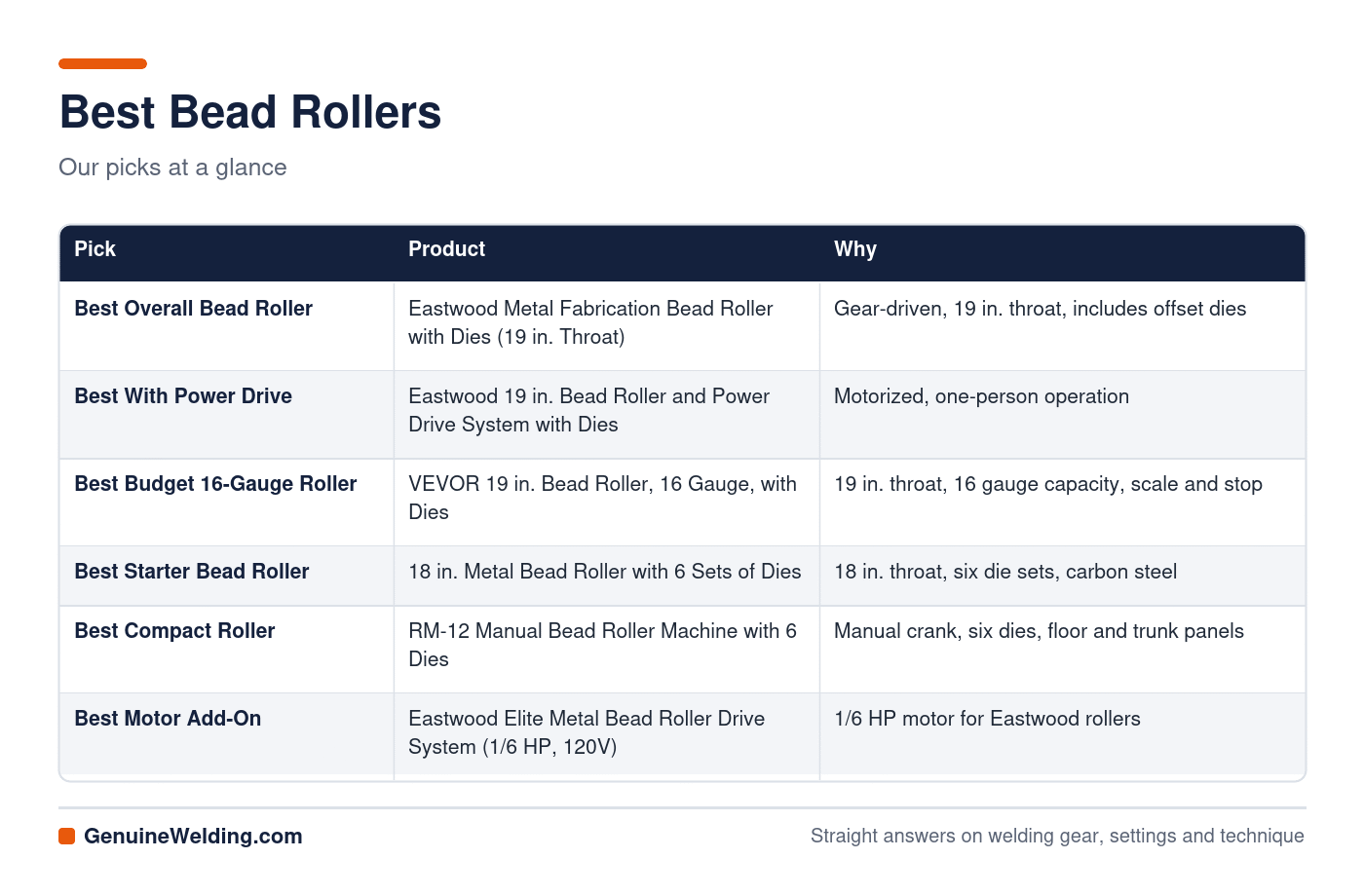
Our Top Picks
- Best Overall Bead Roller: Eastwood Metal Fabrication Bead Roller with Dies (19 in. Throat) – Gear-driven, 19 in. throat, includes offset dies
- Best With Power Drive: Eastwood 19 in. Bead Roller and Power Drive System with Dies – Motorized, one-person operation
- Best Budget 16-Gauge Roller: VEVOR 19 in. Bead Roller, 16 Gauge, with Dies – 19 in. throat, 16 gauge capacity, scale and stop
- Best Starter Bead Roller: 18 in. Metal Bead Roller with 6 Sets of Dies – 18 in. throat, six die sets, carbon steel
- Best Compact Roller: RM-12 Manual Bead Roller Machine with 6 Dies – Manual crank, six dies, floor and trunk panels
- Best Motor Add-On: Eastwood Elite Metal Bead Roller Drive System (1/6 HP, 120V) – 1/6 HP motor for Eastwood rollers
We research every pick using manufacturer specifications, published manuals and long-term owner feedback. As an Amazon Associate, GenuineWelding earns from qualifying purchases at no extra cost to you. Prices change often, so check the current price before you buy.
Comparison Table
| Product | Best for | Key feature |
|---|---|---|
| Eastwood Metal Fabrication Bead Roller with Dies (19 in. Throat) | Best Overall Bead Roller | Gear-driven, 19 in. throat, includes offset dies |
| Eastwood 19 in. Bead Roller and Power Drive System with Dies | Best With Power Drive | Motorized, one-person operation |
| VEVOR 19 in. Bead Roller, 16 Gauge, with Dies | Best Budget 16-Gauge Roller | 19 in. throat, 16 gauge capacity, scale and stop |
| 18 in. Metal Bead Roller with 6 Sets of Dies | Best Starter Bead Roller | 18 in. throat, six die sets, carbon steel |
| RM-12 Manual Bead Roller Machine with 6 Dies | Best Compact Roller | Manual crank, six dies, floor and trunk panels |
| Eastwood Elite Metal Bead Roller Drive System (1/6 HP, 120V) | Best Motor Add-On | 1/6 HP motor for Eastwood rollers |
Reviews of Our Top Picks
1. Eastwood Metal Fabrication Bead Roller with Dies (19 in. Throat) – Best Overall Bead Roller
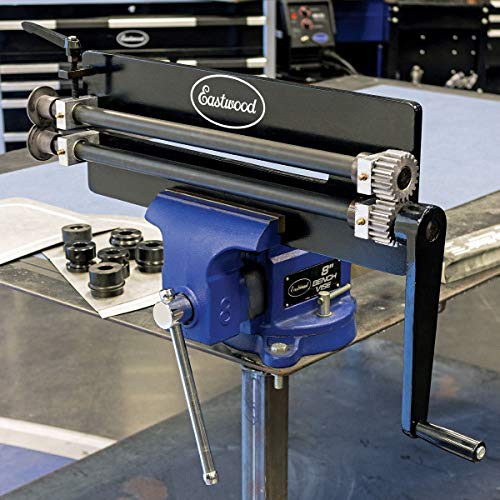
Eastwood Metal Fabrication Bead Roller with Dies (19 in. Throat)
Gear-driven, 19 in. throat, includes offset dies
Bottom line: Eastwood is a well-known name for auto-body fabrication, and this gear-driven bead roller is the standard hand-crank option. The listing says it has a 19 in. throat, includes offset dies for channels and flanges and gives high forming power with low handle force. It is built to roll strengthening ribs into floor pans, firewalls, trunk floors and inner fenders.
Key specs
- Throat: 19 in.
- Drive: Gear-driven hand crank
- Dies: Includes offset dies
- Use: Ribs, channels, flanges
Pros
- Wide 19 in. throat
- Gear drive reduces effort
- Known automotive brand
Cons
- Needs a bench or stand
- Motor is sold separately
Best for: auto restorers and sheet-metal fabricators.
2. Eastwood 19 in. Bead Roller and Power Drive System with Dies – Best With Power Drive

Eastwood 19 in. Bead Roller and Power Drive System with Dies
Motorized, one-person operation
Bottom line: This kit pairs the Eastwood bead roller with a power drive so one person can operate it, per the listing, at a fraction of the cost of a standard motorized bead roller. A powered drive makes long beads on large panels much easier and more even.
Key specs
- Throat: 19 in.
- Drive: Powered
- Dies: Included
Pros
- One-person operation
- Even bead speed
- Cheaper than industrial motorized units
Cons
- Higher cost than hand crank
- Needs mounting
Best for: frequent beading on large panels.
3. VEVOR 19 in. Bead Roller, 16 Gauge, with Dies – Best Budget 16-Gauge Roller

VEVOR 19 in. Bead Roller, 16 Gauge, with Dies
19 in. throat, 16 gauge capacity, scale and stop
Bottom line: VEVOR’s roller handles up to 16 gauge (1.2 mm) and a 19 in. throat, with a precision scale and an adjustable stop to keep the material aligned, per the listing. It is made from 45# steel. A good low-cost way to start beading.
Key specs
- Throat: 19 in.
- Capacity: 16 gauge (1.2 mm)
- Material: 45# steel
Pros
- Low price
- Scale and stop help repeat beads
- Wide throat
Cons
- Less proven
- Dies may need fitting
Best for: hobbyists and small shops.
4. 18 in. Metal Bead Roller with 6 Sets of Dies – Best Starter Bead Roller

18 in. Metal Bead Roller with 6 Sets of Dies
18 in. throat, six die sets, carbon steel
Bottom line: An 18 in. manual bead roller with six die sets, built from carbon steel with a sprayed coating. The die variety lets you form beads, flares and flanges. It is a starter option.
Key specs
- Throat: 18 in.
- Dies: 6 sets
- Material: Coated carbon steel
Pros
- Six die sets
- Cheap
- Portable
Cons
- Light-duty
- Check capacity
Best for: DIY projects and trial use.
5. RM-12 Manual Bead Roller Machine with 6 Dies – Best Compact Roller
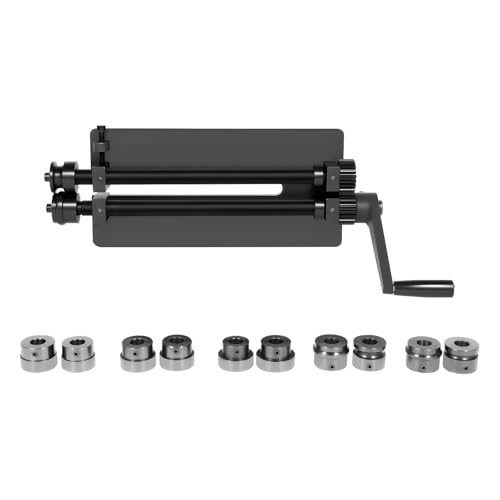
RM-12 Manual Bead Roller Machine with 6 Dies
Manual crank, six dies, floor and trunk panels
Bottom line: The RM-12 is a manual bead roller with a crank handle and six dies, sold for forming car floors and trunk floors. It gives control over force and speed.
Key specs
- Type: Manual crank
- Dies: 6
- Use: Floors, trunk, panels
Pros
- Simple
- Low price
- Control of speed
Cons
- Narrower throat
- Light duty
Best for: small panels and repairs.
6. Eastwood Elite Metal Bead Roller Drive System (1/6 HP, 120V) – Best Motor Add-On

Eastwood Elite Metal Bead Roller Drive System (1/6 HP, 120V)
1/6 HP motor for Eastwood rollers
Bottom line: This motor drives Eastwood bead rollers and others with a compatible shaft. It turns a hand-crank unit into a powered one.
Key specs
- Motor: 1/6 HP, 120V
- Fits: Eastwood and compatible rollers
Pros
- Less effort
- Consistent speed
- Fits many rollers
Cons
- Needs a compatible roller
- Extra cost
Best for: Eastwood bead roller owners.
What Is a Bead Roller?
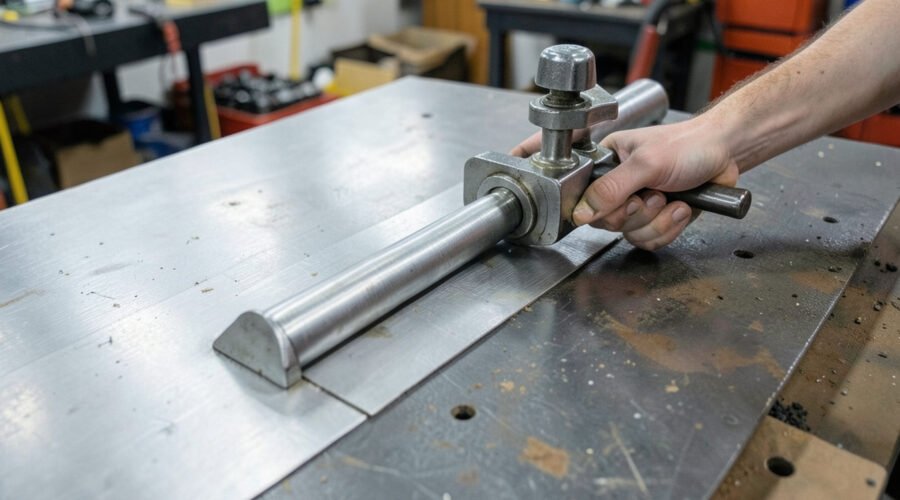
A bead roller squeezes sheet metal between two shaped dies to form a raised or recessed line called a bead. Beads stiffen panels, form flanges and add decoration. They are used in auto body restoration, aircraft and custom fabrication. A bead roller is often paired with a sheet metal brake and a slip roller.
Hand-Crank or Motorized?
Hand-crank rollers are cheaper and give good control for short beads. Motorized or powered rollers keep a steady speed, reduce fatigue and are better for long beads or production. A foot pedal or variable speed helps control the feed.
How to Choose a Bead Roller
- Throat depth: 18 to 19 in. covers most panel work.
- Gauge capacity: 16 to 18 gauge steel is typical for hobby machines.
- Dies: check which die sets come in the box and whether more are available.
- Frame: a rigid cast or steel frame keeps beads consistent.
- Drive: choose gear drive for force and an optional motor for speed.
Using a Bead Roller
Mark your bead line and run a scrap piece first. Feed slowly and keep the sheet flat, and tighten the dies in small steps, because deep beads in one pass can tear or wrinkle the metal. Use a guide or table to keep long beads straight. Wear gloves when handling sheet edges.
FAQs
What is a bead roller used for?
To form beads, ribs, flanges and decorative lines in sheet metal, mainly for stiffening panels and car floor pans.
What gauge can a bead roller handle?
Most hobby rollers handle 16 to 20 gauge steel. Check the listing for the rating.
Do I need a motor on a bead roller?
No, a hand crank works for short beads. A motor makes long beads easier and more even.
Can I roll aluminum with a bead roller?
Yes, and it is easier than steel. Aluminum can crack with sharp beads, so use gentle dies.
What dies do I need?
A standard set includes beads, flares and flanges. Add dies to suit specific tasks.
Is a bead roller better than a brake?
They do different jobs. A brake makes bends, while a bead roller makes ribs and flanges.
Final Verdict
Buy the Eastwood for quality, add a power drive if you roll long beads often, and choose a VEVOR or a starter roller on a budget. Practice on scrap and add dies as projects need them.