
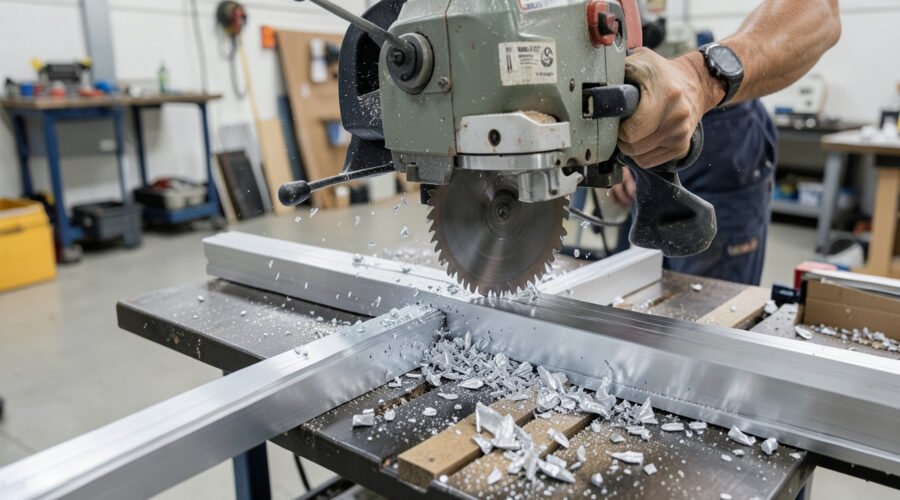
The best way to cut aluminum is with a carbide-tipped blade made for non-ferrous metal, on a miter saw, table saw or circular saw, with a little cutting lubricant and a steady feed. For thin sheet use shears or snips, for curves use a jigsaw or band saw, and for thick plate use a band saw or plasma cutter.
Aluminum is soft and cuts easily, but it also melts onto teeth, clogs blades and throws sharp chips. The right blade, lubrication and feed rate make the difference between a clean cut and a ruined blade. This guide covers each tool, the settings and the safety steps.
Quick Answers
- Blade: carbide-tipped, non-ferrous or triple-chip tooth, with a negative or low hook angle.
- Lubricant: wax stick, cutting fluid or a light oil to stop chips welding to the teeth.
- Speed: full blade speed with a slow, steady feed.
- Clamp the work. Aluminum grabs and vibrates easily.
- Avoid: abrasive wheels, which clog; and dull blades, which heat the metal and gum up.
Best Tool for Each Type of Aluminum Cut
| Cut | Best tool | Blade or setup |
|---|---|---|
| Thin sheet, straight | Aviation snips or shears | Straight-cut snips |
| Thin sheet, curves | Aviation snips or nibbler | Left, right and straight patterns |
| Extrusion, angle, channel | Miter saw or chop saw | Non-ferrous carbide blade |
| Plate and bar | Table saw, band saw or circular saw | Carbide blade; lubricate |
| Curves and cutouts | Jigsaw or band saw | Fine bi-metal blade |
| Thick plate | Band saw or plasma cutter | See our plasma guides |
Why Aluminum Is Different to Cut
Aluminum is softer than steel and has a lower melting point. It conducts heat well, but the friction of a high-speed blade can still make chips weld onto the teeth. That buildup, called galling or loading, causes rough cuts, binding and kickback. Using a lubricant, a blade with enough tooth spacing and the correct feed rate prevents it. Many sources recommend a carbide blade made for non-ferrous metal.
Cutting Aluminum With a Circular Saw or Miter Saw
- Fit a carbide-tipped non-ferrous blade. Triple-chip grind (TCG) teeth with a negative hook angle give a smooth, controlled cut.
- Clamp the aluminum firmly. Extrusions are best supported on both sides of the cut.
- Lubricate the blade with a wax stick (with the saw off) or a few drops of light cutting fluid. A university shop guide recommends re-lubricating every four or five cuts.
- Let the saw reach full speed before it touches the metal.
- Feed slowly and steadily without forcing. Retract the blade only after it has stopped or you are clear of the cut.
- Deburr the cut edge with a file or deburring tool.
For a circular saw on sheet, set the blade depth about 1/8 in. below the metal.
Cutting Aluminum With a Jigsaw, Band Saw or Hacksaw
- Jigsaw: use a fine bi-metal blade and a slow to medium speed, with the orbital action off. Add a drop of lubricant.
- Band saw: a metal-cutting blade with 10 to 14 TPI works for most aluminum. Use a slow blade speed on thicker stock.
- Hacksaw: good for small jobs. Use 18 to 24 TPI with long, even strokes.
Cutting Thin Sheet: Snips, Shears and Nibblers
Thin aluminum up to about 0.063 in. cuts well with aviation snips. A nibbler makes clean cuts in curves and leaves little distortion. A shear gives straight cuts in sheet. Wear gloves, because the cut edges are razor sharp.
Cutting Aluminum With Plasma, Laser or Waterjet
Plasma cutters cut aluminum well when set for the right gas and amps; see our guide on plasma cutter gases. Laser machines need fiber or higher power for aluminum. Waterjet cuts aluminum without heat distortion but requires specialist equipment. For thick plate, a shop with a band saw or CNC plasma table is the practical option.
What About Angle Grinders?
Angle grinders are a poor choice for aluminum because abrasive wheels clog with soft metal and the wheel can bind. If you must use one, use a wheel made for aluminum or a diamond blade. Otherwise use a saw. See how to cut steel with an angle grinder for the safety setup.
Aluminum Cutting Safety
- Wear safety glasses or a face shield, hearing protection and gloves.
- Tie back loose hair and clothing.
- Clamp the work; do not hold small pieces by hand.
- Sweep up chips; they are sharp and hot.
- Keep fine aluminum dust away from sparks and open flame.
FAQs
What is the best blade for cutting aluminum?
A carbide-tipped blade made for non-ferrous metals, with triple-chip teeth and a negative hook angle, gives the cleanest cut in a saw.
Can I cut aluminum with a wood blade?
Sometimes, for a few cuts in thin material, but it is not ideal. A non-ferrous carbide blade lasts longer and cuts cleaner.
Do I need lubricant to cut aluminum?
It is strongly recommended. Wax or cutting fluid keeps chips from sticking to the teeth and keeps the blade cooler.
What is the best saw for cutting aluminum?
A miter saw or table saw with a non-ferrous blade for straight cuts; a band saw for thick stock; and a jigsaw for curves.
How do I cut aluminum sheet by hand?
Use aviation snips for thin sheet, or score and bend very thin sheets. Wear gloves, as the edges are sharp.
Can I cut aluminum with a Dremel?
Yes, for small cuts using a reinforced cutoff wheel or carbide cutter. Go slowly to avoid melting the metal.
Can I weld what I cut?
Yes, but clean the edge and remove oxide first. See our guide to TIG welding aluminum.
Bottom Line
For most people, the best aluminum cutting setup is a miter saw or circular saw with a carbide non-ferrous blade, a wax stick for lubrication and a clamp. Use snips for thin sheet and a band saw for thick stock. Slow, steady feeds and sharp blades give clean cuts with little burr.
Sources
- McGill University: Circular saw (cutting non-ferrous metals)
- Popular Woodworking: Q&A on sawing aluminum
- OSHA 1910.213: Woodworking machinery requirements
